
The Archbishop of Canterbury spoke in a debate on the Safety of Rwanda (Asylum & Immigration) Bill on 29th January 2024, expressing concern that the legislation would be damaging to the UK in outsourcing asylum to another country, calling on the government to establish a wider strategy for refugee policy and to lead internationally on this:
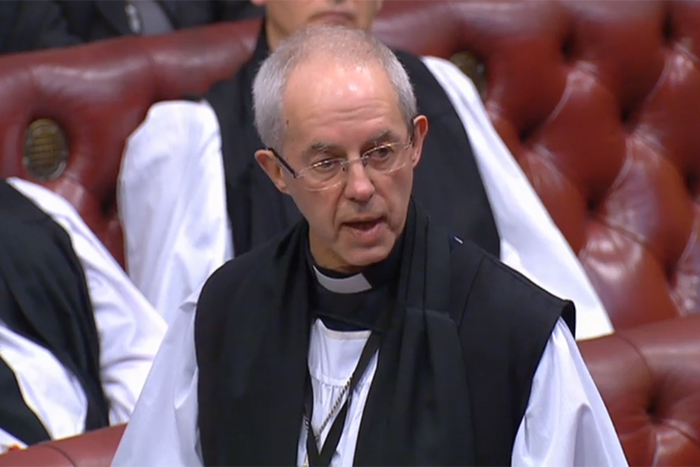
The Lord Archbishop of Canterbury: My Lords, in almost every tradition of global faith and humanism around the world, the dignity of the individual is at the heart of what is believed. In the Christian tradition, we are told to welcome the stranger. Jesus said:
“I was a stranger and you invited me in”.
In numerous places in the Old Testament and the New, the commands of God are to care for the alien and stranger. It has already been said, and I agree, that the way that this Bill and its cousin, which we debated in the summer, work is by obscuring the truth that all people, asylum seekers included, are of great value. We can, as a nation, do better than this Bill.
With the Bill, the Government are continuing to seek good objectives in the wrong way, leading the nation down a damaging path. It is damaging for asylum seekers in need of protection and safe and legal routes to be heard. It is damaging for this country’s reputation, which the Government contradicted even as late as last week, when the Prime Minister himself spoke eloquently on the value and importance of international law for this country. It is damaging in respect of constitutional principles and the rule of law.
Most of all, it is damaging for our nation’s unity in a time when the greatest issues of war, peace, defence and security need us to be united. We are united on, I think, almost all Benches, in agreeing that the boats must be stopped. The Government are to be congratulated that the number has come down. We also agree that the people smugglers who trade in human misery must be brought to justice, and it is good news that so many of those groups have been broken up. We need to be united on effective controls on agreed limits to immigration. The right way forward, though, is to enable the unity on ends to be translated into a unity on means. That is not happening in the way that these Bills are successively brought to the House and before the country.
The challenge of migration is, as has been said, long-term and global. So must our response be. We need a wider strategy for refugee policy—I spoke on this at boring length in the summer and will not repeat it—that involves international co-operation and equips us for the far greater migration flows, perhaps 10 times greater, in the coming decades, as a result of conflict, climate change and poverty. Instead, the Bill offers only ad hoc, one-off approaches.
Rwanda is a country that I know well. It is a wonderful country, and my complaint is not with it, nor its people. It has overcome challenges that this House cannot begin to imagine. But, wherever it does it to, the Bill continues to outsource our legal and moral responsibilities to refugees and asylum seekers—when other, far poorer, countries are already supporting multitudes more than we are now—and to cut back on our aid. At the end of 2022, 76% of refugees globally were being hosted in low- and middle-income countries—countries far poorer than our own. The UK should lead internationally, as it has in the past, not stand apart.
Others on these Benches will say more about international and domestic law, human rights and the constitutional impact. I say simply that a pick-and-choose approach to international law undermines our global standing and offends against the principle of universality that is their increasingly threatened foundation.
Finally, my colleagues and I on these Benches take our revising role seriously. When we vote, we seek to improve something. I will—sadly—not be voting with those who want to vote the Bill down today, although I found the speech by the noble Lord, Lord German, convincing and powerful. We must wait until Third Reading and we have done our revising work. We on these Benches have been criticised many times over many decades by those thinking that defence of the Government of the day should be our highest virtue and aspiration. We were accused last week of voting against the Government’s Whip. I am sorry to say we do not take the Government’s Whip. It may be worse news for this House to recognise that on the Labour Benches it is not 95% of times that there has been a vote against the Government’s Whip—that is a false statistic—but 100%. Maybe they should be criticised for that obnoxious behaviour.
We serve on these Benches as independent Members. As recently as last Thursday, we were discussing what had happened in a particular vote and saw that we had cancelled each other out—bishops often cancel each other out in every possible way. We vote because we value deeply the traditions of this country and this House, and the truth we derive from the Bible and our service to Jesus Christ—our first priority. To misquote Luther, slightly: on that we stand. We can do no other.
Extracts from the speeches that followed:
Baroness Goldie (Con):
What I have gleaned is that, across the gamut of opinions about these perilous channel crossings, one inescapable conclusion is drawn: something must be done. The most reverend Primate referred to that. Paradoxically, with the exception of the Government’s proposals, I have seen no other credible, deliverable solution advanced—and I am afraid to say that, so far in this debate, that lacuna remains. So I have been prompted to speak in this debate in support of the Government not because I consider this measure excellent but because I think it is the only thing to do. I therefore do not support the amendment from the noble Lord, Lord German.
Why are the criminal gangs able to extort money from these vulnerable victims? Regrettably and tragically, it is because their victims, desperate to reach the UK, feel that any risk—even the risk of drowning in the channel—is worth taking, and the gangs ruthlessly exploit that desperation. The gangs could not care less about the safety of the migrants; all they care about is money. So we have to cut off that money supply, which will happen only if migrants seeking to come here illegally realise that they will not be able to stay here. I say to the noble Lord opposite that the examples of Australia and Albania indicate that that approach works.
Lord Paddick (Non-Afl): My Lords, the movement of large numbers of people seeking asylum is in danger of overwhelming the international asylum system, as the Government’s policy statement on this Bill suggests, and this requires a different response. There appear to me to be two alternatives: work collaboratively with all countries affected, with a global response to a global problem; or take this Government’s approach, working in the United Kingdom’s sole interests, or, arguably, in the interests of party politics. As the most reverend Primate the Archbishop of Canterbury said in this House on 12 July last year,
“this is a massive, international issue on a generational basis and that tackling it needs profound thinking on a long-term basis … It is essential that the solutions, as we go forward, bring together the whole of politics, all sides of both Houses, and unite our country instead of using this as a wedge issue to divide things”.—[Official Report, 12/7/23; col. 1872.]
The most reverend Primate reiterated that this afternoon.
Baroness Northover (LD): As the right reverend Prelate the Bishop of Durham and the most reverend Primate the Archbishop of Canterbury have rightly said, Rwanda has made great strides since the terrible years of its genocide. Nevertheless, the UK Supreme Court has deemed it still an unsafe country—and we have heard a number of reasons why that is the case, not least from the noble Lord, Lord McDonald. We have recently granted asylum to Rwandan refugees, as my noble friend Lady Brinton pointed out. Of course, it appears to be part of the Government’s narrative for the right-wing press that Rwanda is a desperate place in which to end up—acting as an apparent disincentive to those who may seek asylum in the UK. It is ironic that they then deem the country safe.
Conflict and climate change will doubtless increase migration. Working on global strategies to tackle this, as the most reverend Primate Archbishop of Canterbury pointed out, is clearly vital. Right now in central America, they are facing a massive traffic in migration. Costa Rica, with a population of 5 million, is housing a further 1 million from Nicaragua. One of the first things must be to invest in conflict prevention and development. The assistance that has been channelled to Rwanda since its terrible conflict has clearly improved the lives of many of its citizens, so there is less migration from Rwanda itself, despite the clear limits to freedom there. Yet we cut our aid budget—how short-sighted.
Others have argued with overwhelming force that the Bill offends against both morality and legality. From what I have seen of the UK’s plan on the ground in Rwanda, compared with more effective ways of supporting refugees in that very country, it seems to me that we are pouring huge amounts of money into what is almost an amateur scheme. That hardly reflects well on the United Kingdom.
Lord Frost (Con): The most reverend Primate, who is in his place, reminds us that all human beings are of great value. Of course I agree with him, and for the same reasons; of course we should welcome the stranger. But, in my very humble view, in this area you cannot get from that undoubted existential truth to a political proposition—a proposition that large numbers of people from many countries around the world, if they can persuade a criminal trafficker to take them, have the de facto right to settle in this country. Those are propositions of a completely different nature and kind.
It follows logically from all this that of course I support the Bill and its deterrent purpose. I admit some doubts as to whether, in its current form, it will be robust enough to achieve the desired end. I think it would certainly have been better if it had been amended to strengthen the exclusion of international law, as proposed in the Commons; in my view, we will one day have to go there. But it is done now; the Commons debated it fully and has spoken. I support the Government in bringing it into force swiftly and I hope noble Lords will do likewise.
Baroness Fox of Buckley (Non-Afl): The most reverend Primate the Archbishop of Canterbury stressed the important issue of individual dignity and the value of each and every individual, and of course, he is right. However, that was very much with a focus on those seeking asylum. I ask noble Lords to broaden their focus. It insults the dignity of the British public when their concerns about the potential security threat posed by those entering the country illegally in the absence of proper checks are given second-class status versus international treaties. I can also imagine how vulnerable people feel when they discover that, for example, universities are offering visas to overseas students for lower grades than their kids need to get on to a degree course in this country.
Lord Coaker (Lab): As noble Lord and noble Baroness after noble Lord and noble Baroness have said in this debate, we have no way of knowing whether these obligations are actually going to be fulfilled. The Bill says that they will be but we do not know. It will be an act of faith; it will be a belief that it is going to happen. We hope it will happen, but there is no mechanism in the Bill by which we can ensure that we hold the Rwandan Government to account and know that the things that we want to happen will happen. I suspect that the amendments will seek to address that particular point and ask whether there is some way to make a reality of the various things that have been put in the Bill.
As I said, there is no difference between any of us in wanting to deal with this problem. The Labour Party is continually goaded on the basis that, if His Majesty’s Government continually say that we have no plan, then sooner or later people will think there is no plan. It may be that noble Lords do not agree with what we are saying, but time after time my noble friend Lady Smith and I, and many others, have said that there should be tough measures to tackle the criminal gangs and that we should establish new agreements with other countries. We believe in the establishment of safe and legal routes. We believe that the asylum system and process should be speeded up, so that applications are dealt with speedily and effectively. We also believe that it is necessary, as the most reverend Primate continually points out, for problems to be dealt with at source, through a new way of looking at this together, so that there is a sharing of the problem.
That is the plan. If people do not agree with it, they should argue about it and say it will not work, in the same way that we say the Government’s plan will not work. But I am quite happy to go and put before people that five-point plan as a better way of dealing with those problems than what the Government have laid before us.
Lord Sharpe of Epsom (Con, Home Office): My Lords, I am grateful to all noble Lords who have spoken today and shared their thoughts on this legislation. We have heard many thoughtful speeches from many noble Lords, but I welcome particularly the valued insights of my noble friends Lady Goldie, Lady Verma, Lord Wolfson, Lord Dobbs, Lord Horam and Lord Murray. It is clear from across the Benches that there is common ground in needing to find a solution to the challenges we face. Just for the record, of course I agree with the most reverend Primate the Archbishop of Canterbury on the worth of individuals.
Stopping illegal migration is an important issue for both the public and the Government. Parliament and the British people want an end to illegal migration, as my noble friend Lady Stowell powerfully argued; therefore, we need a deterrent. As noble Lords will have heard me say last week, we made progress towards stopping the boats but we must do more to break the business model of the criminal gangs and deter illegal migrants. I say to the noble Lord, Lord Kerr, that there is evidence of deterrence—and that it works. I am also grateful to my noble friends Lord Udny-Lister and Lord Horam for reminding us of Albania and the Australian example.
The dangerous channel crossings are often made by young, fit men in search of better life opportunities. Many of those have travelled through safe countries to reach the UK, as my noble friend Lord Hannan set out, and they have paid substantial amounts of money to the criminal gangs to facilitate their journey. As my noble friend Lady Goldie highlighted, these criminal gangs could not care less about the safety of migrants; they care only about the money. I think noble Lords are in agreement that we cannot let this continue.
The most reverend Primate the Archbishop of Canterbury and other noble Lords were right to place the Bill in its moral context, but proceeding with it is the moral course, as my noble friend Lord Blackwell powerfully noted. We must put a stop to the dangerous channel crossings that are putting lives at risk and to this mass trafficking of people in order to save lives. That is the humane thing to do, and it is the fair thing to do, as my noble friend Lady Verma argued.
 The Church of England in Parliament
You must be logged in to post a comment.