
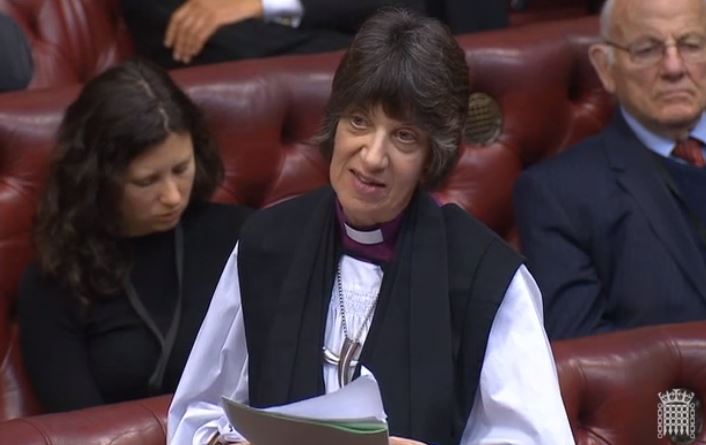
On 12th November 2025, the Bishop of Gloucester spoke at the second reading of the Sentencing Bill, expressing concern at the lack of comprehensive long term planning in the legislation:
The Lord Bishop of Gloucester: My Lords, I declare an interest as Anglican bishop to His Majesty’s prisons in England and Wales. I, too, pay tribute to the late Baroness Newlove, not least in her role as Victims’ Commissioner. I want to echo so much of what the noble Lord, Lord Beith, and the noble and learned Lord, Lord Burnett, have just said, which has lifted my spirits.
There is much to welcome in this Bill. For example, as has been said, we know in general that short custodial sentences do more harm than good, so I am delighted that we are now seeing some evidence-based policy-making rather than policy shaped by media headlines. We also need to clarify our long-term vision and aims. As a Christian, I believe that every human being is made in the image of God and is created to live in interdependent relationship, and broken relationship sits at the heart of all brokenness. Strong relationship sits at the heart of all that is good and transformative. I thank the Minister for his introduction, but I am dismayed that we are setting the context of this Bill as overcrowded prisons and a current crisis. Surely our long-term vision and big picture is not simply about more prisons or even decent prisons, but ultimately about strengthening communities so that people flourish in a network of healthy and safe relationships.
I am therefore hugely concerned by the piecemeal selection of David Gauke’s recommendations from his independent sentencing review and our failure to look at that big, long-term picture. For example, including victims in the statutory purpose of sentencing is welcome, but, if we want to respond well to victims and reduce the number of victims in the future, we need to pay attention to where relationship has been broken in people’s lives as well as in their offending. When sentencing, the place of trauma needs to be addressed for offender as well as victim. It is interesting that many people are both, and I wonder where that leaves us when we talk about putting victims first.
There needs to be scope to be attentive to the underlying reasons for people’s behaviour, not least in an endeavour to break the cycle of reoffending and fractured communities which is costly: physically, emotionally and financially. In wider society, there has increasingly been a push, as we have heard, for longer sentences and more punishment. The review found that
“punishment … has been given disproportionate weight and … there has been insufficient focus on reducing crime”,
and it stated that custody should be a “last resort”. The Bill does not address these criticisms. We are failing to ask what will enable a reduction in reoffending in the individual and bring transformation not only for them but for those who are impacted by their choices. We must include reduction of crime in the purpose statement, as recommended by David Gauke.
Creativity with community sentencing could be life-changing, but, sadly, even the proposed changes are set within such a punitive framework and tone. This is pandering to public opinion, not changing it. On that note, measures to name and shame people completing unpaid work as part of their community sentence need greater scrutiny. I am sure that the last thing the Government would intend is harmful consequences for thousands of children and young people whose parents are completing their sentence.
I applaud the skills and professionalism of our probation officers, and I am glad to see the rehabilitation activity requirement replaced by a probation requirement. But, to be effective, resource must continue to be increased, such that money currently wasted on inappropriate prison sentences is redirected to the recruitment, training and retention of dedicated probation staff and, indeed, prison staff. If prison sentences are going to be restorative, the recruitment, training, valuing and retention of prison and probation staff are vital.
All this is set against a backdrop of severe financial challenge. We need to spend financial resources differently, and that brings me back to the need for clarity about vision and aims, and what long-term good looks like. Although HMPPS has mission and purpose statements, I urge us to define in legislation the purpose of imprisonment. That would bring much-needed clarity to all parts of the criminal justice system and wider stakeholders, and would reduce confusion, if we are truly committed to reimagining and building an effective, well-functioning prison system.
I will seek amendments to the Bill to define in legislation the purpose of imprisonment. In recent days, we have seen yet again intense media and political attention on prisons, but we need to reduce the political heat and seek cross-party solutions. I am dismayed by much of what I heard from the noble Lord, Lord Sandhurst. We must shape public opinion rather than follow it. Is the Minister prepared to face down the media on matters of principle and evidence? Sadly, we saw the exact opposite of that earlier this year when we had before us the Sentencing Guidelines (Pre-sentence Reports) Bill. There was bluster and knee-jerk reaction, and we saw the independence of the Sentencing Council put at risk, as we have heard more about today.
The Government refer to the position of the Sentencing Council as a “democratic deficit”, yet the independent sentencing review makes plain that politics has been a driver of the current misuse of prison. I am deeply disappointed that the Government have not addressed that charge and, notably, have ignored the recommendation to introduce an external advisory body to help Ministers to make sentencing policy, plan prison capacity and invest the money needed wisely. There is nothing in the Bill to give assurance that our planning and management of the overall prison population is going to be significantly better than it is now, or that we have grasped the significant changes needed, because we have failed to articulate the big aim and clarify what good would look like for victims, offenders, families and wider society in the long term.
If we had a well-functioning prison system with good headroom and capacity, low rates of violence and self-harm, and people coming out of prison less likely to offend than when they went in, this Bill might have been sufficient. Instead, it is a long way from the radical and bold thinking that is necessary to reset the appropriate use of prison.
Beyond the doors to the Chamber is a statue of Queen Victoria, positioned between the figures of Justice and Mercy—two key attributes, I believe, of God, who is in the business of reconciliation and transformation. If we allowed mercy and justice to truly dialogue, the Bill could be transformed. We need a joined-up public health approach to the criminal justice system that puts relationship front and centre. The Bill contains some good elements, but I urge the Government to listen more carefully to the Gauke sentencing review in the round, as well as to the many who call for the Minister to go further.
Extracts from the speeches that followed:
Lord Moylan (Con): I find myself speaking in the company of very distinguished and knowledgeable noble Lords, with great judicial experience and knowledge of the sentencing system in its widest sense. I am not in that company. I would venture to say, though, that I have considerable sympathy with what the Government are trying to achieve here. I have doubts about the efficacy of ever longer prison sentences, and indeed about their purpose. Listening to the right reverend Prelate the Bishop of Gloucester, I allowed myself a measure of doubt about whether we have a clear notion of the purpose of prison. After all, prison as we understand it is a relatively modern idea; it goes back only to Jeremy Bentham. It is a sort of 200-year experiment. If the right reverend Prelate is going to give us an opportunity, in the course of the Bill, to give some consideration to what we are actually trying to achieve and whether we are succeeding, that might be of some general benefit.
Lord Hastings of Scarisbrick (CB): If charities and organisations recognise that dignity changes people’s outcomes, and that when people are reformed they do not come back, we must ask: why are we building more prison places to keep people in, rather than investing in better second chances processes, as well as relationships, that will lead to an effective culture of reform, rehabilitation and positive, affirmed relationships, and set people free to become citizens again in a positive culture of renewal?
Here I identify so closely with the speech by the right reverend Prelate the Bishop of Gloucester in which she recognised that relationships are what is needed to fulfil that transformation. My own experience in 37 years of prison visiting, and the last intense 10 years of weekly prison engagement, is that I have seen fantastic individuals who were the worst of people completely changed into some of the best of friends, and it is possible, deliverable and cheap to do.
Confidence building does not require millions and billions of pounds, but it does require us and the Government to stop panicking the public constantly about those who come out of prison. Regular prison releases have always been a weekly experience, but when the Government set about releasing larger numbers, it was as though this had never been done before and we were led to believe that this was a crisis measure. Yes, in some ways it was a crisis measure, but what about suggesting that actually we do not need to panic the public severely and we need to build a better process of renewal and reform?
Lord Marks of Henley-upon-Thames (LD): The noble Lords, Lord Bach and Lord Carter, and the noble Baroness, Lady Chakrabarti, captured this well in their critique of the regrettable toughness contest between political parties. The noble and learned Lord, Lord Thomas of Cwmgiedd, put it into historical context with his story of severe judges of the past now being seen as “softies”. The number of remand prisoners has increased, as the noble Lord, Lord Hastings, pointed out, and we have recently seen a record number of prisoners recalled for breach-of-release conditions: some 15% higher in the second quarter of this year than in the same quarter last year. The reality is that prison often does far more harm than good, and that is particularly true of short sentences. Where we can, we should be relying instead on effective and well-resourced community sentences, as the right reverend Prelate the Bishop of Gloucester argued in her principled speech, supported in large part by the noble Lord, Lord Hastings.
Many of our prisons have been bad at rehabilitation: underresourced, overcrowded and understaffed, with the toxic cocktail of failings rehearsed today and regularly in previous debates in this House, including too many prisoners in cells filled beyond capacity; prisoners locked in their cells, often for 22 to 23 hours per day, with very little purposeful activity. There is a shortage of vocational and educational training, and too few staff to manage the courses there are. An epidemic of drug abuse is fuelled by widespread drug trading often, sadly, involving corrupt staff. Prisoners, adults and young people, with serious mental health and addiction issues—as well as the literacy, educational and social difficulties discussed by the noble Baroness, Lady Longfield—find that those issues are all going unaddressed.
(…)
We also reject the notion of publicly shaming offenders undertaking unpaid work with names and photographs. It is vindictive and unhelpful—a point made by the noble Lord, Lord Hastings.
Overall, the Bill is overdue in putting rehabilitation and reform first, respecting the evidence on what works in reducing crime. Along with the right reverend Prelate the Bishop of Gloucester and others, we reject the Conservative Front Bench’s characterisation of these reforms as likely to increase crime and make the streets less safe. We stress, however, along with all those who have insisted in this debate, that the Bill’s success depends on providing the Probation Service with the support, personnel and resources that it needs. Ultimately, the potential savings to the public purse in reducing the cost of reoffending and the burgeoning costs of the Prison Service could, if realised, bring great net benefit to society, financial as well as social.
Lord Timpson (Lab, MoJ): A number of noble Lords have raised short sentences, including the noble and learned Lord, Lord Keen, the noble Lords, Lord Sandhurst and Lord Marks, the right reverend Prelate the Bishop of Gloucester and others. It is an important point. We are not abolishing short sentences. Judges will always have the power to send offenders to prison when they have breached a court order, where there is a significant risk of physical or psychological harm to a particular individual, or in exceptional circumstances. However, around 60% of adults sentenced for under a year reoffend within 12 months; a number of noble Lords recited similar facts about the ineffectiveness of short sentences. That is unacceptably high for victims and the public. The evidence shows that those given a community order or suspended sentence reoffend less than similar offenders given a short prison sentence. We are following the evidence to reduce crime, leading to fewer victims and safer communities. I am also following the lead of the previous Government, who introduced this measure in their Sentencing Bill.
(…)
A number of noble Lords, including the noble Lord, Lord Beith, the right reverend Prelate the Bishop of Gloucester and my noble friend Lady Chakrabarti, raised concerns about Clause 35. I am sure that we can agree that people who commit crimes should show that they are giving back to society. I assure noble Lords that careful consideration has been given to how this is implemented and how wider impacts can be mitigated.
I say to the noble Lord, Lord Foster, that I am keen to discuss gambling and how we support addiction generally in the community. It is something that I am very passionate about too.
I would be delighted to meet the noble Lord, Lord Berkeley of Knighton, to discuss joint enterprise with my colleague, Minister Alex Davies-Jones, as it is her area of expertise within the Ministry of Justice.
This has been a wide debate, and I bow to the experience and expertise in the Chamber today. I and my officials will read Hansard carefully and, if I have missed anything in my response, we shall make sure to engage with your Lordships before and after Committee. I look forward to that. I beg to move.
Bill read a second time.
 The Church of England in Parliament
You must be logged in to post a comment.