
During a debate on the Sentencing Bill on 6th January 2025, the Bishop of Gloucester tabled her amendment to the bill, inserting a new clause which “would define the purposes of imprisonment in law and require the courts and the Secretary of State to have regard to the purposes of imprisonment:
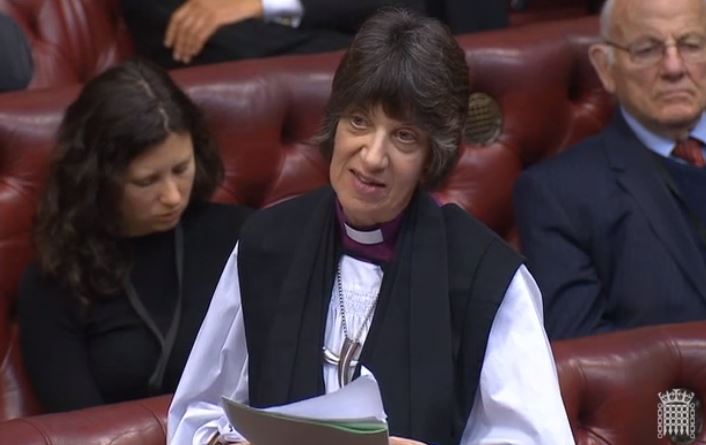
The Lord Bishop of Gloucester: After Clause 4, insert the following new Clause—
“Purposes of imprisonment(1) Where a court is imposing sentence the court must have regard to the purposes of imprisonment.(2) The Secretary of State must have regard to the purposes of imprisonment when exercising the Secretary of State’s duties under this Act.
(3) For the purposes of subsections (1) and (2) the purposes of imprisonment are—(a) the incapacitation of prisoners in order to restrict their ability to re-offend in the community,(b) the rehabilitation of prisoners under safe and decent conditions to reduce re-offending,(c) the deterrence of prisoners and others from committing further offences, and(d) the just punishment of prisoners, including provision to achieve justice for the victims of crime.”Member’s explanatory statement
This new clause would define the purposes of imprisonment in law and require the courts and the Secretary of State to have regard to the purposes of imprisonment.
My Lords, I am bringing back this amendment on Report as I do not think it was adequately addressed in Committee. Amendment 52, in my name and that of the noble Lord, Lord Moylan, would define in law the purposes of imprisonment and require the courts and the Secretary of State to have regard to the purposes of imprisonment.
We know that depriving someone of their liberty is an action taken by courts with caution and care. His Majesty’s Prison and Probation Service’s strategic objective is to carry out sentences given by the courts, in custody and in the community, and to rehabilitate people in our care through education and employment. However, there is no statutory or other provision that directly addresses the fundamental purposes of imprisonment. That is what this amendment seeks to achieve. Indeed, if we had this legislative definition, it would actually have brought into focus issues we have been talking about in debates so far. In Committee, the Government disagreed that a definition in statute was needed. The noble Lord, Lord Lemos, stated:
“The purposes of sentencing, including imprisonment, are already set out in statute and reflected in Sentencing Council guidelines”.—[Official Report, 26/11/25; col. 1399.]
I respectfully disagree that the purposes of imprisonment are set out in law in this way.
At present, the public expresses little confidence in the courts and prisons, in part as a result of the lack of clarity around the purpose and use of imprisonment. A clear parliamentary statement on this issue would serve both prisoners and victims well and provide clarity at all levels of decision-making for those involved with and within the criminal justice system. This amendment holds together clarity around the reduction of offending and justice for victims. With this in mind, I beg to move.
Briefly moving to other amendments in this group, I have added my name in support of Amendments 71, 72 and 73, which I know will be well introduced by the noble Lord, Lord Marks. Suffice it to say, I am in full support of the proposal to set up an independent advisory panel on sentencing and reducing reoffending. I am also in full support of Amendment 98 in this group.
Extracts from the speeches that followed:
Viscount Hailsham (Con): My Lords, I rise very briefly to support what my noble friend has said, and, indeed, to support the right reverend Prelate the Bishop of Gloucester’s amendment. I come, as it were, from a prison background, in the sense that I was Prisons Minister, God help me, 40 years ago. Also, until relatively recently—by which I mean 10 years ago—I was on the monitoring board of one of our local prisons. I agree entirely with my noble friend, and indeed with the right reverend Prelate, about the importance of out-of-cell purposeful activity. I agree too with the noble and learned Baroness, Lady Butler-Sloss, that far too often the prison workshops are not functional. That is a very great misfortune.
There are just two points I will make—a proviso and a question. The proviso, in a sense, is self-evident: if a condition is going to be imposed, it can operate only if the purposeful activity is actually provided within the Prison Service. Although that may be implicit in my noble friend’s amendment, it is not explicit. If the Government, in due time, come forward with an appropriate amendment, I hope that the provision is made explicit.
Baroness Fox of Buckley (Non-Afl): One of the problems I have with the whole of this Bill is that sentencing issues were originally motivated and framed as necessary by the Ministry of Justice because of an overcrowding crisis. We were told that we had to reduce sentences or let people out early from sentences because there were too many prisoners in prison and there were not enough prisons, and that it was all the previous Government’s fault and all of that argument.
In a way, that has felt far too pragmatic to me when discussing the very serious issue of who you put in prison and why, and what the purpose of prison is. This small group of amendments indicates that there is an appetite for that kind of discussion. It is one of the reasons I was particularly pleased to see the amendment tabled by the right reverend Prelate the Bishop of Gloucester and supported by the noble Lord, Lord Moylan.
Lord Marks of Henley-upon-Thames (LD): I will just say a few words on the other amendments in the group. I fully support the right reverend Prelate the Bishop of Gloucester and the noble Lord, Lord Moylan, on the importance of defining and being very clear about the purposes of imprisonment. Our system accepts the concept of imprisonment without, frankly, our being entirely clear on what the purposes of imprisonment are. In that, I agree with one of the points made by the noble Baroness, Lady Fox. I also agree with her that her portrayal of my arguments earlier this afternoon was a caricature and inaccurate. But I do agree with her that we need to be very clear about what the purposes of prison are. In that context, it is right that we have been reminded by the noble and learned Lord, Lord Garnier, of the work of the late Lord Ramsbotham on the purposes of imprisonment.
Lord Keen of Elie (Con): On defining the purpose of imprisonment, as proposed by the right reverend Prelate the Bishop of Gloucester, we welcome the recognition of rehabilitation as one of many purposes. At the same time, we note that the Bill addresses the objectives of sentencing and imprisonment far more generally and question whether it is necessary to place a statutory definition in the Bill.
Lord Timpson (Lab, MoJ): I appreciate the sentiment of Amendment 52 proposed by the right reverend Prelate the Bishop of Gloucester and the noble Lord, Lord Moylan, as well as the thoughtful contribution from my friend, the noble Lord, Lord Carter. However, I respectfully disagree that a definition in statute is necessary. This is because the five existing purposes of sentencing must already be considered by the court when imposing all sentencing disposals, including imprisonment. We are not aware of any gap in law or practice that would justify introducing a separate purpose of imprisonment into statute.
The Lord Bishop of Gloucester: My Lords, I am grateful to all noble Lords who have spoken in this group. I have listened carefully, especially to the Minister, and I am disappointed that he has not accepted my Amendment 52. The purposes of sentencing do not go far enough and bringing clarity to what prison is for would not only assist public understanding but provide clarity in decision-making and purpose for those working with and within the criminal justice system. But, for now, I beg leave to withdraw my amendment.
Amendment 52 withdrawn.
 The Church of England in Parliament
You must be logged in to post a comment.