
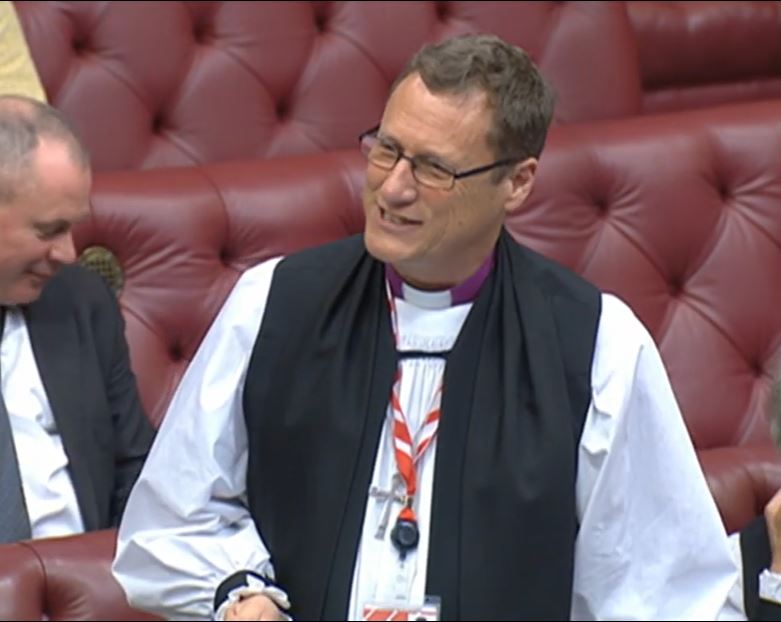
During a debate on the Crime and Policing Bill on 18th March 2026, The Bishop of Leicester spoke in support of his amendment 426D, which would seek “to ensure that a pregnant woman or girl under 18 years old would need to have an in-person consultation before they could be prescribed drugs to end a pregnancy, so that potential safeguarding needs are identified.”
The Lord Bishop of Leicester: My Lords, I shall speak to the amendment in my name, Amendment 426D. I start by thanking the Minister for meeting me a couple of weeks ago to discuss this matter—and I want to be direct at the outset about what the amendment would do and would not do.
The amendment is distinct from Amendment 425, which stands on its own merits, and which your Lordships will consider on its own terms. This amendment says nothing about adult women’s access to abortion, nothing about where medication is taken and nothing about the broader questions that have been part of our debate up till now. It rests entirely on one safeguarding principle—that when a child is the patient, a professional should meet her before prescribing. I believe that that is something that your Lordships can support, regardless of the views that you hold on everything else before the House today.
The amendment is brought on behalf of the National Network of Designated Healthcare Professionals for Children—NHS doctors and nurses who carry statutory safeguarding responsibilities for children across every local safeguarding partnership in England. Its concern is that the needs of children, particularly looked-after children who become pregnant, are not sufficiently accounted for in this clause. Since 2022, a girl of 14 can telephone an abortion service, receive medication by post, take it at home, and no clinician will ever meet her. How does that give confidence that safeguarding risks are being properly assessed? How does the provider of medication know whether there is someone else in the room when they speak to the child on the phone? How do they know whether someone else has suggested that the child should make the phone call? Surely the only safe way to assess risk is to meet in person.
The noble Baroness, Lady Blackstone, says that telemedicine is safe. I fully respect her experience in this field and, in many situations, I would agree, but in the case of children, of which I note she made no mention in her speech, I believe she is wrong. Telemedicine is not safe for children.
Baroness Gerada (CB): Is the right reverend Prelate aware that coercion can also occur in the consultation room, as I have seen many times? It may actually be safer for the girl—or the child, as he is calling her—to be able to choose the place and the time where she has that consultation.
The Lord Bishop of Leicester: I am very aware that there are risks to all forms of consultation. My argument is simply that the risks are minimised by in-person consultation.
The considered view of safeguarding professionals in the NNDHP is that the current guidance put in place by the Royal College of Paediatrics and Child Health in 2022 is simply not robust enough. That guidance, I note, requires an in-person meeting for children under 13. Children under 16 are,
“normally … required to complete their consultation in-person, unless there is a compelling indication to do otherwise”.
Evidence, however, suggests that most providers of abortion care are arguing that the option of telemedicine itself is a compelling indication that an in-person consultation is not required. For those aged 16 or 17, the guidance says only that children—and, of course, 16 and 17-year-olds are still children under the Children Act—should “be encouraged” to attend in person. More fundamentally, guidance can currently be changed unilaterally, without parliamentary scrutiny or public consultation, at the discretion of the body that issued it. I believe, therefore, that legislation is required. What Parliament enacts, only Parliament can remove.
The case for this amendment, however, does not rest on my view or the NNDHP’s alone. The Government’s own consultation found that safeguarding organisations specifically identified under-18s as the group for whom in-person assessment was most critical to reduce the risk from those who sexually exploit children, manipulate the system or force their victims to obtain abortion. Indeed, MSI Reproductive Choices has documented that face-to-face appointments are associated with a significant increase in domestic abuse disclosures compared with telemedicine. This is especially significant given that girls and young women face a higher risk of coercive or abusive relationships than those aged over 24, and are often less equipped to ask for help.
The clinical risks compound this. Beyond 11 weeks’ gestation, home management is not appropriate and the risks to the patient increase significantly. As has been mentioned, accurate gestational age assessment is the foundation on which safe prescribing depends, and it cannot be done reliably by telephone. These are not theoretical risks. We have heard stories already. I would simply add that of a 16 year-old who was estimated by the clinic to be under eight weeks pregnant, but the baby she delivered was in fact 20 weeks. She later said, “If they had scanned me and I knew that I was that far gone, I would have had him”. An in-person appointment would have changed everything for that young woman. This amendment would require such an appointment.
I echo the concerns of the noble Baroness, Lady Stroud, in her amendment. Without an in-person consultation, it is unclear how we will ensure that early medical abortions take place within the law. Indeed, challenges around vulnerability and correct gestational assessment apply to adulthood as well, which is why I fully support Amendment 425.
Although I have been assured that abortion providers will remain subject to the criminal law if Clause 208 is passed, it is hard to see how this will make a meaningful difference in the case of early medical abortion, since providers who carry out telephone assessments will have met the standard of due diligence required of them. My amendment offers a reminder that the needs of children and young people should be paramount in our thinking and in that of all who work with them, including abortion providers. My amendment asks for one proportionate safeguard: that when a child is the patient, a medical professional meets her before prescribing. I invite noble Lords to consider whether that is really too much to ask.
Baroness Fox of Buckley (Non-Afl): Finally, one of the arguments used against telemedicine is that it could lead to non-consensual coerced abortions, with abusive men, or even abusive parents, forcing young, vulnerable women to abort. I was glad to hear from the noble Baroness, Lady Neate, about the issue in relation to domestic abuse. Clause 208 does not change the law on this non-consensual coerced abortion. Non-consensual coerced abortion at any gestation remains illegal and is a crime.
However, it is key to note that since telemedicine became legal there has been a major increase in safeguarding disclosures, especially by young women who have felt able to talk about being victims of domestic abuse or sexual violence precisely because they are doing it remotely. It has allowed abortion providers to offer invaluable pastoral intervention beyond abortion services. Telemedicine also enables those vulnerable to coercion to avoid their abusers being involved in the deliberations about their desperate plight of being pregnant.
I will just finish by addressing the right reverend Prelate the Bishop of Leicester. There are many young girls—I appreciate that they are children—from traditional religious communities. Think of the young Catholic girl, the young Muslim girl and so on, as well as those at risk of honour-based violence. Those kinds of young people actually do not need to be asking their dad to drop them round at the clinic so they can get advice. They are sometimes dependent on other people. With telemedicine, they can go with privacy and talk at their own chosen time and place, without having to answer back to a parent or an abusive partner. In other words, telemedicine offers privacy and can help women stay safe.
Baroness Leavitt (Lab): Amendment 426D, tabled by the right reverend Prelate the Bishop of Leicester, is new, but it carries similar possible operational effects to those I set out in Committee in relation to Amendment 425, about which I spoke a moment ago. The proposed new clause in Amendment 426D may have a detrimental impact on abortion provision and access for under-18s, including those who live in remote areas or who have difficulties in attending a clinic. It should also be noted that it is unclear whether this amendment would require under-18s to have all consultations face to face, including any initial contact with the service. If so, this would further increase the workability concerns, including resourcing constraints on providers and access to abortion provision for young people.
The Lord Bishop of Leicester: 426D: After Clause 208, insert the following new Clause—
“Abortion: requirement for in-person consultation if the pregnant woman or girl is under the age of 18After section 1(3D) of the Abortion Act 1967 (medical termination of pregnancy) insert—“(3E) If the pregnant woman or girl is under the age of 18, any consultation must take place in person.””Member’s explanatory statement
This amendment seeks to ensure that a pregnant woman or girl under 18 years old would need to have an in-person consultation before they could be prescribed drugs to end a pregnancy, so that potential safeguarding needs are identified.
I realise that I am going to make myself very unpopular at this hour, but I will make a very brief comment on the couple of comments that were made regarding the amendment in the course of the debate. I remind noble Lords that this is about children who become pregnant and it is about safeguarding risks. Therefore, I was not entirely happy that it should be contrasted between evidence and anecdote. There is plenty of evidence to support the need for this from professionals in the field. Similarly, to those saying that professionals say that children will not come, I am afraid that the professionals that have advised me on this are very clear that children will come when it is necessary. I therefore invite the House to support the amendment and ask for a Division.
(Amendment lost at division – Hansard)
 The Church of England in Parliament
You must be logged in to post a comment.