
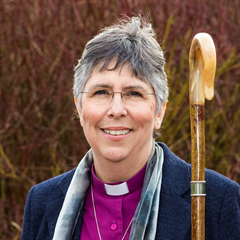
The Bishop of Chelmsford received the following written answer on 6th July 2026:
The Lord Bishop of Chelmsford asked His Majesty’s Government:
- what level of humanitarian assistance they are providing to civilians in need of aid in Iran as a consequence of the war in that country; and which delivery partners they are working with.
- what types of humanitarian assistance they are providing to civilians in Iran requiring aid.
- what plans they have, if any, for increasing humanitarian assistance to civilians in Iran who are marginalised by the Iranian regime.
- how much aid they are providing to (1) Iran, and (2) other countries in the region, on an absolute and per capita basis.
- what assessment they have made of the expulsion of Afghan refugees from Iran since the start of the recent conflict; and whether they intend to increase humanitarian assistance as a result.
Baroness Chapman of Darlington (Con, FCDO): Since the start of the Iran conflict, we have seen a sharp increase in displacement of people and humanitarian need across the region, and the UK has made substantial investments to support responses to that crisis, particularly in Lebanon. The UK is not providing humanitarian aid directly to Iran as part of this response, but alongside a number of other governments, we contribute to the global Disaster Response Emergency Fund managed by the International Federation of the Red Cross and Red Crescent Societies, and to the United Nations’ Central Emergency Response Fund. Both of these funds have in turn made allocations to support humanitarian agencies working in Iran, including the Iranian Red Crescent Society, the UNHCR, UNICEF, the World Food Programme, World Health Organization, and United Nations Development Programme, who are delivering healthcare, food, water, sanitation and hygiene, shelter kits and other essential services to those in need.


You must be logged in to post a comment.