
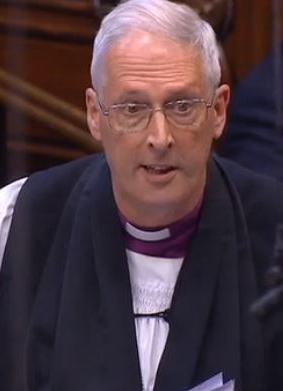
The Bishop of Southwark gave his valedictory speech in a debate on the future capability of the armed forces on 16th July 2026:
The Lord Bishop of Southwark: My Lords, I am grateful to the noble Lord, Lord Harlech, for bringing this debate. Let me begin my valedictory address by making it clear that it is not my intention to advise His Majesty’s Government on the number of dreadnought battleships they should be laying down or what the future of the Blue Streak missile programme should be. I wish to address some wider issues that I believe are directly relevant to our future capability and which arise out of our current situation.
Quoting from the Global Peace Index 2026, the right reverend Prelate the Bishop of Norwich reminded the House during a debate on the Armed Forces Bill on 6 July that
“the world has continued its longstanding trajectory of deteriorating peacefulness”.
It has always been my contention that, since the UK left the European Union, the costs of our security, diplomatic efforts and cultural reach will need to rise, since we no longer benefit from the partnership and pooled resources that the union provides. Instead, our defence spending has stagnated and NATO is in difficulty, with the United States now in unpredictable mode. We are planning to reduce the Diplomatic Service, and the BBC and other major cultural players continue to make cuts.
I appreciate that, as we shall hear, a different trajectory is planned for UK defence. A good deal will be said about the changing nature of warfare in the light of the appalling assault on the territorial integrity of Ukraine by President Putin. However, the continued reduction in what we used to call manpower across all three services is worrying because, at the end of the day, fearful decisions need to be taken by human beings, and some situations should be addressed only by a human presence, not an AI-driven remote response. AI and drones are no substitute for physicality, presence and engagement.
It may seem strange to hint at a moral dimension in a business which is never decorous or happy, but the basis of international humanitarian law in conduct of war finds its origin in the Christian doctrine of a just war with its tests of necessity, proportionality and restraint. The Geneva conventions, our more elaborate and contemporary responses, were themselves born of fearful conflict and barbarity, not wishful thinking. Yet increasingly, in conflicts such as in Sudan, in the Russian invasion of Ukraine, and, I so regret to say it, in the manner in which Israel has responded to the Hamas atrocities of 7 October 2023, international law is set aside for reasons of expediency, and with appalling results and much innocent suffering, not least in Gaza. That is why the other issues I alluded to, such as the size and effectiveness of our diplomatic service, matter, and why good quality journalism matters, including British journalism and British values in the form of the BBC, to help uphold international rules, because when these become degraded, people suffer, and we all become less safe.
Finally, I wish to thank the House for the consideration given to the Lords spiritual and to me, for the great privilege of serving here, for the high calling of your Lordships and for the dedication of our staff, not least the doorkeepers, many of whom served in our Armed Forces. As someone who has led your Lordships in prayer at the beginning of business, I am reminded of the words of the noble and right reverend Lord, Lord Chartres, that “the largest party in this House is the praying party”. I give thanks for that and assure all your Lordships of my continued prayers.
Lord Ahmad of Wimbledon (Con): My Lords, it is always a distinct privilege to rise in your Lordships’ House, particularly when the subject matter before us concerns the key priority of any nation: the defence and security of the realm in an era of unprecedented global volatility and conflict.
However, before I turn to our physical defences, it is my great honour to pay tribute to a defender of a different kind, one who has spent years fortifying the moral and spiritual armour of our nation. I refer of course to the right reverend Prelate—and my dear friend—the Bishop of Southwark, and I congratulate him on a poignant and reflective valedictory speech.
I feel immense warmth towards the right reverend Prelate and his neighbourly affection, for he is the person who is the spiritual guide for many of the good people of Wimbledon—indeed, he is the shepherd, as many remind me. I have always maintained that trying to guide people spiritually, especially when they are quite diverse, including the occasionally highly opinionated folk of south London, requires a level of tactical patience, strategic diplomacy and sheer resilience that would challenge any seasoned peacekeeping commander around the world. Yet, the right reverend Prelate has done so for over 15 years with quiet but effective diplomacy and, as we have seen again today, boundless grace and deep humility.
In this House, the right reverend Prelate has been a reassuring and welcome presence. He has never been one, as we have heard again today, to shy away from what I would call difficult issues. Indeed, over many years in the very place where the Minister sits, I was on the receiving end of his quiet but very effective challenges to the Government of the day. He has consistently championed the homeless, the marginalised, and a cause that we share and which is incredibly close to my own heart. I live by the mantra that the greatest test of our own faith is when we stand by and for the faith and belief of others. He has lived by that. We have stood together on many platforms advocating for human rights, and I have always been struck, as I have already said, by his gentle yet effective moral clarity.
While the Ministry of Defence has frequently struggled with its logistics at times, the diocese of Southwark has operated with enviable precision under the right reverend Prelate’s stewardship. It has proved, perhaps, that faith can not only move mountains but manage complex organisations. We worked together when the right reverend Prelate was the lead bishop on the issues of the Middle East, and again—I quoted that mantra earlier—he stood for justice, not just for Christians or for the Jewish community but for the Muslim community, and he addressed the challenges both in Israel and Palestine with equality and justice.
Together, we worked with Archbishop Hosam of Jerusalem, a friend to us both. I was proud to lead on the issue of Christian persecution, where the support of the right reverend Prelate and others on the Spiritual Benches was vital. I am sure that I speak for all in this House when I say that we will miss deeply his wisdom, his pastoral warmth and his profound service to this House and to the nation. We wish him every blessing for his well-deserved retirement, which is with our sincere prayers.
Lord Hamilton of Epsom (Con): My Lords, I join my noble friend Lord Ahmad in congratulating the right reverend Prelate the Bishop of Southwark on his final speech. I hope he enjoys an excellent retirement and has every opportunity to go on worshipping God and doing his best to swell the congregations in our churches. I think he will find that easier when he is no longer encumbered by the necessary political compromises that have to be made in your Lordships’ House.
Baroness Bennet of Manor Castle (GP): I thank the right reverend Prelate the Bishop of Southwark for, in his valedictory speech, introducing another point that I want to make: that our security is about much more than defence. Soft power, diplomacy and the international service provided by the BBC World Service are crucial, and all this together needs to be treated as a package. Last week, I put to the noble Baroness, Lady Chapman of Darlington, that the FCDO was in turmoil and the noble Baroness denied it fervently. Well, this morning, I was on the picket line in King Charles Street with PCS members who are FCDO staff, expressing their anger and fear about the turmoil—and that very clearly is an accurate word—in the department. That is a workers’ rights issue, disappointing to all there in the light of having a Labour Government, but it is also a security issue for us all.
Baroness Goldie (Con): Last week, in front of the House of Commons Defence Committee, the noble Lord, Lord Robertson of Port Ellen, who obviously is one of the Government’s own, said:
“Quite simply, we are running out of years. The reality is that the challenge is now bigger, more serious and earlier than we had anticipated, yet the defence investment plan does not come up to it”.
His concerns were emphatically endorsed by the noble and gallant Lord, Lord Stirrup, and reflected upon gently and philosophically by the right reverend Prelate the Bishop of Southwark, to whom I also extend my best wishes for a happy and fulfilling retirement. I extend my thanks to him for his reassuring presence on those Benches, to which I often direct a glance at moments of tension.
Lord Coaker (Lab, MoD): I wish the right reverend Prelate the Bishop of Southwark well for the future. In his valedictory speech, he reminded us of the importance of international humanitarian law. That is important to our country and our democracy. We understand the need to use force sometimes, but we question ourselves about whether we have the legal basis to do so, and I think we should commend ourselves for trying to act, sometimes with force, in a legal way. I wish him well for the future. We all struggle with moral dilemmas, so I look forward to him struggling with that and trying to help others with respect to that when he preaches.


You must be logged in to post a comment.