
On 17th October 2019 Lord Watson of Invergowrie asked Her Majesty’s Government “what steps they will take further to the recent survey of local authorities in England which found that since 2014 approximately £400 million has been diverted from mainstream education budgets in order to pay for special needs education.” The Bishop of Coventry, Rt Revd Christopher Cocksworth, asked a follow-up question:
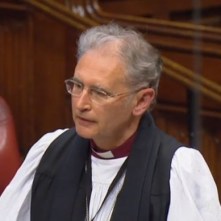 The Lord Bishop of Coventry: My Lords, several heads in Coventry and Warwickshire have told me about the heavy demands on their energies and budgets from, to quote one primary head, children who are not on the SEN register but face horrific circumstances at home and so need extra help; for example, families who are homeless through domestic violence and children whose mental health is so poor—these are nine year-olds—that they threaten suicide. Does the Minister recognise the pressures on schools in mainstream education from children who do not meet the thresholds of special needs but who nevertheless have severe needs and require acute support? Is he confident that there is sufficient funding for them?
 On 15th October 2019 the House of Lords continued their discussion of the Queen’s Speech. The Bishop of Coventry, Rt Revd Christopher Cocksworth, contributed to the debate on the issue of the EU:
 On 15th October 2019 the Parliamentary Under-Secretary of State, Department for Digital, Culture, Media and Sport, Baroness Barran, repeated a Government statement about racism in football. The Bishop of Leeds, Rt Revd Nick Baines, asked a follow-up question:
 This week in the House of Lords the Bishop of London spoke about modern slavery, knife crime, funding for refugees, and rural services. The Bishop of Winchester received written answers to questions about the Apprenticeship Levy and post-16 and adult education. On Tuesday evening Parliament was prorogued in advance of the Queen’s Speech.
  On 8th October 2019 Lord Foster of Bath (LD) moved a motion “that this House takes note of the Report from the Select Committee on the Rural Economy Time for a strategy for the rural economy (HL Paper 330)”. The Bishop of London, Rt Revd Sarah Mullally, contributed to the debate:
 On 8th October 2019 the Minister of State, Department for Exiting the European Union (Lord Callanan) repeated a Government statement about Brexit preparations. The Bishop of London, Rt Revd Sarah Mullally, asked a follow-up question:
 On 8th October 2019 Lord Naseby (Con) asked the Government “what action they are taking to ensure that retailers selling kitchen knives adhere to regulations on the sale of knives”. The Bishop of London, Rt Revd Sarah Mullally, then asked a follow-up question:
 On 8th October 2019 the Bishop of Winchester, Rt Revd Tim Dakin, received two written answers from the Government regarding post-16 and adult education:
 On 7th October 2019 the Bishop of London, Rt Revd Sarah Mullally, asked a question she had tabled to Government on modern slavery.
  On 7th October 2019 the Bishop of Winchester, Rt Revd Tim Dakin, received a written answer from Government regarding the Apprenticeship Levy:

You must be logged in to post a comment.