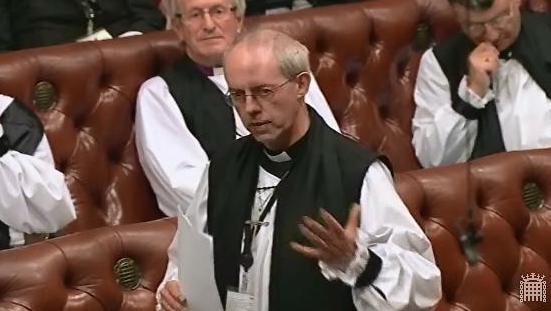
Bishop of Southwark asks Government about Daesh presence in Gaza and West Bank

On 2nd March 2016 the Bishop of Southwark, Rt Revd Christopher Chessun, received an answer to a written question on Daesh in Gaza and the West Bank:
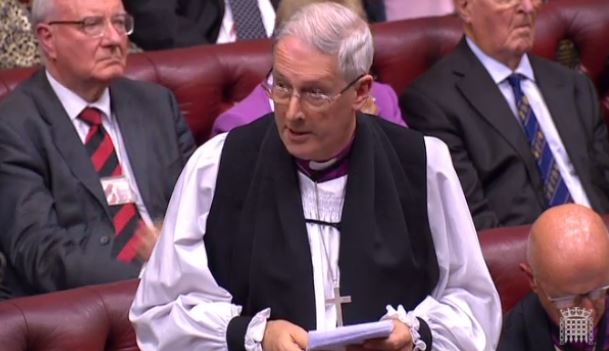
BishSouthwarktaxcreditsThe Lord Bishop of Southwark: To ask Her Majesty’s Government what assessment they have made of the presence of Daesh in Gaza and the West Bank. [HL6280]
Baroness Anelay of St Johns: The Government’s assessment is that there are groups and individuals in the West Bank and (primarily) in Gaza who sympathise with or self-identify as Daesh but are not formally affiliated with them. We remain concerned about a possible Daesh presence and continue to monitor the situation closely.


(via Parliament.uk)
Archbishop calls on Government to do more for unaccompanied children at Calais ‘Jungle’ camp

On 1st March 2016  Baroness Sheehan asked Her Majesty’s Government “what views they have expressed to the government of France about the bulldozing of the south section of the Calais “Jungle” camp.” The Archbishop of Canterbury, Most Revd & Rt Hon Justin Welby, asked a follow up question:


Archbishop of CanterburyThe Archbishop of Canterbury: My Lords, while we would all agree that the situation is difficult for the French authorities, I am sure we also feel that it is significantly more difficult for the 300 unaccompanied children. I recently visited the Marsh Academy near Romney Marsh and saw a school and community fostering and caring with the utmost compassion for significant numbers of unaccompanied children. Given that example, does the Minister agree that issues of compassion should easily trump those of administrative efficiency and tidiness, and narrow definitions of family links, and that we should, therefore, take more children very quickly?
Continue reading “Archbishop calls on Government to do more for unaccompanied children at Calais ‘Jungle’ camp”

Bishop of St Albans asks Government about affordable housing for those on low incomes

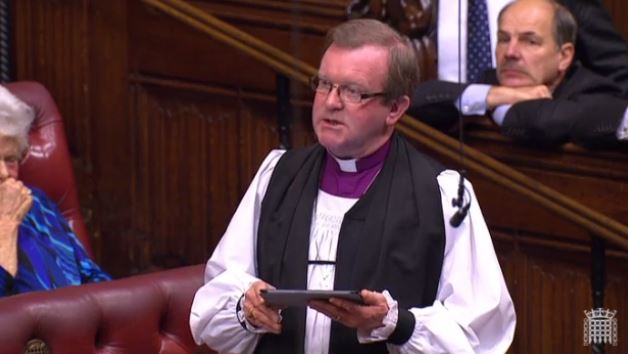
On 1st March 2016 Lord Kennedy of Southwark asked Her Majesty’s Government “what action they are taking to help people on the living wage in London to own their own homes.” The Bishop of St Albans, Rt Revd Alan Smith, asked a follow up question:


StAlbans171115The Lord Bishop of St Albans: My Lords, there is much concern that the focus on starter homes could threaten the provision of alternative housing schemes that are more suitable for those on low incomes, such as shared ownership. Will the Minister assure the House that Her Majesty’s Government’s emphasis on these starter homes will be in addition to other affordable schemes such as shared ownership rather than replacing them?


Continue reading “Bishop of St Albans asks Government about affordable housing for those on low incomes”

Division: Welfare Reform and Work Bill

On 29th February 2016 the House of Lords considered amendments at Report Stage to the Government’s Welfare Reform and Work Bill. Lord Low of Dalston moved an amendment to the Bill to require a delay in implementation of changes to the work related activity component for those on Employment Support Allowance, until a report had been laid before Parliament. A vote was taken on the amendment, in which the Bishop of Durham, Rt Revd Paul Butler, took part. Continue reading “Division: Welfare Reform and Work Bill”

Welfare Reform Bill: Bishop of Portsmouth welcomes child poverty proposals and presses Government on two-child limit

On 29th February 2016, the House of Lords considered changes made in the House of Commons to the Government’s Welfare and Work Reform Bill. Earlier, MPs had voted to reject an amendment to the Bill tabled by the Bishop of Durham and passed by the House of Lords, which made it a duty of the Secretary of State to report annually on income measures of child poverty. In its place Lord Freud, Minister for Welfare Reform, tabled an alternative Government amendment in the Lords, to require government to annually publish the child poverty income measures, without requiring a report to be laid before Parliament. The Bishop of Durham, the Rt Revd Paul Butler, and the Bishop of Portsmouth, the Rt Revd Christopher Foster, both welcomed this concession by Government. Lord Freud’s speech introducing that amendment can be seen here. The Bishop of Durham’s response can be seen here.The Bishop of Portsmouth’s response is below, in which he also pressed the Minister on points he had made at earlier stages about the two-child limit and impact on those who are bereaved or fleeing domestic violence. 

BishPortsspeechtaxcreditsThe Lord Bishop of Portsmouth: My Lords, I, too, am grateful for the Government’s decision to publish under obligation the three HBAI low-income measures, along with the further measure of children in persistent poverty. In welcoming this response to the clear wish of the House, I will not detain the House with my commentary on the tortuous routes to this wise and welcome decision, tempting though that is; we are in Lent and bidden not to succumb to temptation. As we have so powerfully and carefully considered in this House the plight particularly of children in poverty, I recall that the Minister said that he expected the Government to come under further pressure—I paraphrase—and I do not want to disappoint him. Continue reading “Welfare Reform Bill: Bishop of Portsmouth welcomes child poverty proposals and presses Government on two-child limit”

Welfare Reform Bill: Bishop of Durham welcomes commitment to publish child poverty data

On 29th February 2016, the House of Lords considered changes made in the House of Commons to the Government’s Welfare and Work Reform Bill. Earlier, MPs had voted to reject an amendment to the Bill tabled by the Bishop of Durham and passed by the House of Lords, which made it a duty of the Secretary of State to report annually on income measures of child poverty. In its place Lord Freud, Minister for Welfare Reform, tabled an alternative Government amendment in the Lords, to require government to annually publish the child poverty income measures, without requiring a report to be laid before Parliament. The Bishop of Durham, the Rt Revd Paul Butler, and the Bishop of Portsmouth, the Rt Revd Christopher Foster, both welcomed this concession by Government. Lord Freud’s speech introducing that amendment can be seen here. The Bishop of Durham’s response is below. The Bishop of Portsmouth’s response can be seen here.

Bp Durham June 2015 bThe Lord Bishop of Durham: My Lords, throughout our debates on the Bill, we have all consistently expressed our desire to see child poverty in our nation reduced and, ultimately, eradicated. We have different views about how this might best be achieved, and about the impact the Bill will have. I continue to have deep concerns about its impact. I fear that it will lead to more children and families being poor. Continue reading “Welfare Reform Bill: Bishop of Durham welcomes commitment to publish child poverty data”
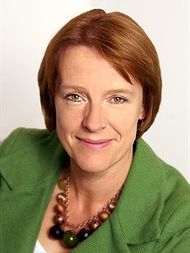
Caroline Spelman praises work of Churches Conservation Trust

On the 29 February 2016 the Second Church Estates Commissioner, Mrs Caroline Spelman, briefly contributed to a debate on the Funding Order for the Churches Conservation Trust.

Caroline SpelmanMrs Caroline Spelman (Meriden) (Con): Early in his remarks my right hon. Friend the Minister mentioned the fact that a few of the churches are isolated, with no natural community around them. Does he agree that the Churches Conservation Trust provides a wider benefit to the local rural community by creating jobs that bring people in to repair and maintain these precious buildings?

Mr Evennett: I thank my right hon. Friend for her question. Before I answer it, I congratulate her on her superb work as a Church Commissioner. She is always hard at work on such matters. I totally agree with her: we want to bring new life into our rural communities, and if we can use churches to do that, we should. I mentioned earlier the innovative champing initiative. In a rural area that might be just what is needed. I welcome my right hon. Friend’s comments. We would warmly welcome and encourage any developments that bring tourism, jobs and opportunities to rural areas.

Bishop of Durham asks about EU regulations for reuniting refugee families

Bp Durham June 2015 bOn 29th February 2016, the Home Office Minister in the House of Lords, Lord Bates, repeated a statement on Child Refugees in Calais. The Bishop of Durham, the Rt Revd Paul Butler, asked a supplementary question.


The Lord Bishop of Durham: My Lords, can the Minister confirm how tight or loose are the parameters on family relationships under Dublin being used in this? That is one of the concerns of those working on this in the NGOs—how tight or how loose the family ties can be defined as. Continue reading “Bishop of Durham asks about EU regulations for reuniting refugee families”

Bishop of Durham highlights the peacemaking role of the Church in Sudan

14.06.10 Bishop of Durham 5On 29th February 2016, Baroness Cox asked the government “what assessment they have made of continuing military offensives against civilians in Blue Nile and Southern Kordofan by the Government of Sudan.” The Bishop of Durham, the Rt Revd Paul Butler, asked a supplementary question. Continue reading “Bishop of Durham highlights the peacemaking role of the Church in Sudan”
Church Commissioners: Bishop George Bell

Caroline SpelmanOn the 29th February 2016 the Second Church Estates Commissioner, Rt Hon Caroline Spelman MP, answered three written questions from Rt Hon Frank Field MP regarding the deceased former Bishop of Chichester, George Bell.

Frank Field: To ask the right hon. Member for Meriden, representing the Church Commissioners, whether the settlement the Church Commissioners made to the complainant against George Bell was made directly in relation to allegations against Bell, or on the basis that a complaint made under a subsequent Bishop, was not handled in a way which would be expected today. Continue reading “Church Commissioners: Bishop George Bell”