BISHOP OF ST ALBANS SPEAKS ON SUNDAY TRADING IN DEREGULATION BILL

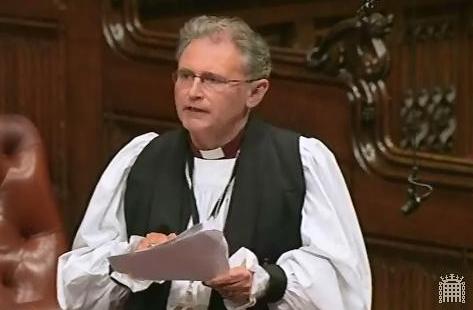
Bishop of St AlbansThe Bishop of St Albans, the Rt Revd Alan Smith, spoke on amendment 11 to the Deregulation Bill, which concerned the extension of the liberalisation of Sunday trading laws to garden centres. The Lord Bishop of St Albans spoke out against this amendment, arguing about the importance for human health and wellbeing of protecting the seven day week cycle. He said that if Sunday trading laws were to be liberalised to this effect, it would be a thin-edge-of-the-wedge effect, and so such considerations should be made in a separate bill, rather than this amendment.

Read the full speech here: Continue reading “BISHOP OF ST ALBANS SPEAKS ON SUNDAY TRADING IN DEREGULATION BILL”

Bishops take part in votes on reforms to Judicial Review

On 27th October 2014, four bishops took part in divisions on the Criminal Justice and Courts Bill, on the third day of its Report Stage. Details of the votes can be seen below.

House of Lords Division Lobby

Amendment 146 – Judicial review in the High Court and Upper Tribunal

Crossbench peer Lord Pannick moved amendment 146, which sought to soften the Government’s proposal that the High Court must refuse permission for a Judicial Review if it is ‘highly likely’ that the decision whose legality is being challenged would be unchanged even if the Review were successful.

Four bishops voted ‘content’ to this amendment. They were the Bishop of Derby, the Rt Revd Alastair Redfern, the Bishop of Lichfield, the Rt Revd Jonathan Gledhill, the Bishop of Rochester, the Rt Revd James Langstaff, and the Bishop of St Albans, the Rt Revd Alan Smith. No bishop voted ‘not content’. There were: Contents: 247 | Not Contents: 181 | Result: Government Defeat

(via Parliament.uk)

Continue reading “Bishops take part in votes on reforms to Judicial Review”

Bishop of Rochester supports amendments on conditions for secure colleges for young offenders

On Wednesday 22nd October 2014, the House of Lords debated amendments to the Government’s Criminal Justice and Courts Bill during the second day of its Report Stage.

The Rt Reverend James Langstaff, Bishop of Rochester, contributed to the debate on Lord Ramsbotham’s amendment 108 to the bill, which was later withdrawn. The amendment sought to ensure that no secure college for young offenders could be established until clear rules on their operation had first been agreed. The Bishop spoke in favour of the amendment, highlighting the need to provide the highest standards of education for children in young offender institutions, especially when it had often been such a lacking feature of their pasts.

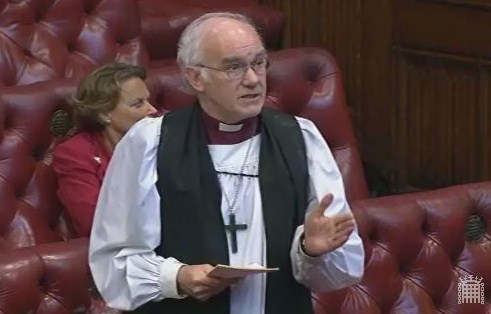
Bishop of RochesterThe Lord Bishop of Rochester:  My Lords, I hope that I am not a flag-waving antagonist but I support the pleas made by the last few noble Lords who have spoken, asking for some thoughtfulness, reflection and time to be taken over this. I am grateful for the consultation about the rules but we need time to take that consultation seriously and reflect upon it. Continue reading “Bishop of Rochester supports amendments on conditions for secure colleges for young offenders”

Votes on the Deregulation Bill

On 21st October 2014 three bishops took part in three votes on the Government’s Deregulation Bill during the House of Lords committee stage . Details on the Bill can be found here. Continue reading “Votes on the Deregulation Bill”

House of Commons approves the Bishops and Priests (Consecration and Ordination of Women) Measure

Bishops and Priests (Consecration and Ordination of Women) Measure

20th October, 2014

[Relevant document: The 233rd Report from the Ecclesiastical Committee, Bishops and Priests (Consecration and Ordination of Women) Measure, HC 622.]

5.07 pm

Green BenchesThe Second Church Estates Commissioner (Sir Tony Baldry):

I beg to move,

That the Bishops and Priests (Consecration and Ordination of Women) Measure (HC 621), passed by the General Synod of the Church of England, be presented to Her Majesty for her Royal Assent in the form in which it was laid before Parliament.

It is now nearly a century since Parliament recognised that it should no longer be the body that initiated legislation concerning the running of the Church of England. However, Church legislation becomes part of the law of England, so it requires parliamentary approval and Royal Assent. A Measure such as the one before us has to have been passed by the General Synod of the Church of England. Most Measures require simple majorities in the Synod, but this one falls in that special category of particularly important instruments that need to have achieved at least two-thirds majorities in each of the Houses of Bishops, Clergy and Laity. Continue reading “House of Commons approves the Bishops and Priests (Consecration and Ordination of Women) Measure”

Criminal Justice and Courts Bill – vote on indeterminate sentences

On 20th October 2014 the House of Lords debated the Government’s Criminal Justice and Courts Bill during its Report Stage. Peers debated an amendment from Crossbench Peer Lord Lloyd of Berwick to Clause 10, relating to treatment of prisoners serving indeterminate sentences. The Bishop of Rochester, Rt Rev James Langstaff, joined several Peers in expressing support for the amendment and he voted for its inclusion during the subsequent Division of the House. Continue reading “Criminal Justice and Courts Bill – vote on indeterminate sentences”

Lords Approves the Bishops and Priests (Consecration and Ordination of Women) Measure

Bishops and Priests (Consecration and Ordination of Women) Measure

14th October 2014

Motion to Direct

5.35 pm

Moved by

That this House do direct that, in accordance with the Church of England Assembly (Powers) Act 1919, the Bishops and Priests (Consecration and Ordination of Women) Measure be presented to Her Majesty for the Royal Assent.Archbishop of Canterbury

The Archbishop of Canterbury:

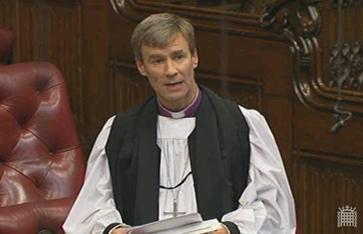
My Lords, it is now 95 years since Parliament conferred on the Church of England the power to initiate legislation, which, following parliamentary approval and Royal Assent, becomes part of the law of England.

Most of the Measures passed by the Church Assembly and, since 1970, by the General Synod have been necessary but modest revisions of the church’s rule book and the law of England. Texts such as the Church of England (Miscellaneous Provisions) Measure 2014 or the Ecclesiastical Fees (Amendment) Measure 2011 were not framed with excitement in mind, but even they sound positively racy compared with that early piece of Church Assembly legislation considered by this House in the days of Archbishop Davidson—the Ecclesiastical Dilapidations Measure 1923. Just occasionally, though, the church brings to Parliament legislation which is of more significance and effect. The Church of England (Worship and Doctrine) Measure 1974 was one such, and so was the legislation passed by Synod in 1992 to enable women to be ordained priests in the Church of England. Continue reading “Lords Approves the Bishops and Priests (Consecration and Ordination of Women) Measure”

Human Trafficking – Question from Bishop of Derby

On 22nd September 2014 the Bishop of Derby, Rt Rev Alastair Redfern, received a written answer to a question on child victims of human trafficking.
Bishop of Derby
Home Office – Human Trafficking (HL1545)
Asked by the Lord Bishop of Derby on 28 July 2014:
To ask Her Majesty’s Government how many child victims of human trafficking were interviewed in 2013 by competent authority staff, as opposed to specialist interviewers.

Continue reading “Human Trafficking – Question from Bishop of Derby”

Bishop of Sheffield calls for development of Armed Forces credit union

On 29th July 2014, the Bishop of Sheffield, the Rt Revd Steven Croft, co-sponsored and spoke in support of an amendment to the Armed Forces (Service Complaints and Financial Assistance) Bill. The amendment, tabled by Lord Kennedy of Southwark, sought to establish a credit union specifically for members of the armed forces and their families. He noted the Church’s own work in setting up the Churches’ Mutual Credit Union, and highlighted the well-developed system of credit unions for service personnel in the United States. He called on the Minister to give an update on the progress made towards the creation of such an institution. Following the debate, Lord Kennedy withdrew his amendment, but indicated that he may bring it back at the Third Reading of the Bill.

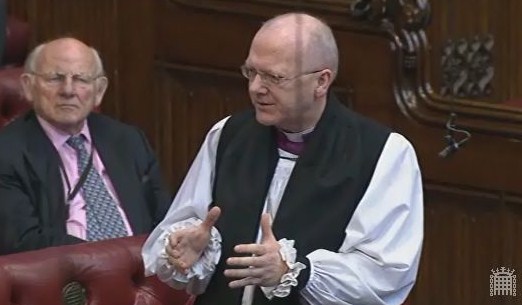
14.03.27 Bishop of SheffieldThe Lord Bishop of Sheffield: My Lords, from these Benches I welcome the amendment in the name of the noble Lord, Lord Kennedy, and give it our full support. The amendment gives strong support to the setting up of a credit union for the Armed Forces and their families in a similar way in which the church is setting up its own credit union—the Churches’ Mutual Credit Union. The Armed Forces, like the clergy and other groups, need a source of affordable credit for short and long-term needs. As a society we have duty of support and care to our Armed Forces. Recent research in a number of strands shows clearly that the ability to obtain credit at reasonable rates of interest is a vital element in building resilience to poverty and debt across our whole society. The inability to obtain such credit in times of need raises the possibility of falling further into debt, of food and fuel poverty and of a downward spiral. Continue reading “Bishop of Sheffield calls for development of Armed Forces credit union”

Bishop of Rochester supports amendment to Criminal Justice and Courts Bill

On 23rd July 2014 the Bishop of Rochester, the Rt Rev James Langstaff, spoke during the Committee Stage of the Criminal Justice and Courts Bill.

Bishop of RochesterBishop James spoke in support of Lord Ramsbotham’s amendment to remove clause 29 relating to the creation of ‘secure colleges and other places for detention of young offenders’  from the Bill. Continue reading “Bishop of Rochester supports amendment to Criminal Justice and Courts Bill”