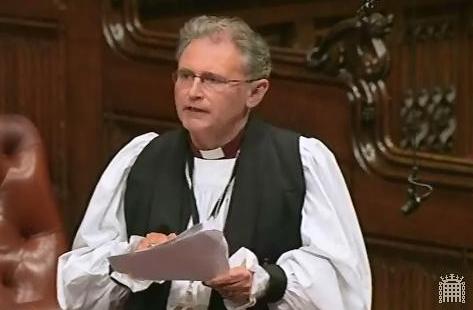
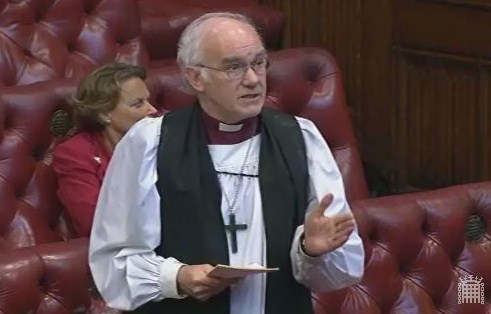
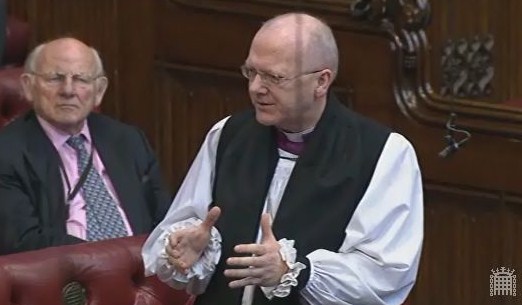
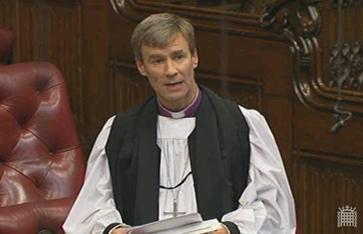
Continue reading “Human Trafficking – Question from Bishop of Derby”
Category: Bills
Legislation before Parliament
Bishop of Sheffield calls for development of Armed Forces credit union
On 29th July 2014, the Bishop of Sheffield, the Rt Revd Steven Croft, co-sponsored and spoke in support of an amendment to the Armed Forces (Service Complaints and Financial Assistance) Bill. The amendment, tabled by Lord Kennedy of Southwark, sought to establish a credit union specifically for members of the armed forces and their families. He noted the Church’s own work in setting up the Churches’ Mutual Credit Union, and highlighted the well-developed system of credit unions for service personnel in the United States. He called on the Minister to give an update on the progress made towards the creation of such an institution. Following the debate, Lord Kennedy withdrew his amendment, but indicated that he may bring it back at the Third Reading of the Bill.
The Lord Bishop of Sheffield: My Lords, from these Benches I welcome the amendment in the name of the noble Lord, Lord Kennedy, and give it our full support. The amendment gives strong support to the setting up of a credit union for the Armed Forces and their families in a similar way in which the church is setting up its own credit union—the Churches’ Mutual Credit Union. The Armed Forces, like the clergy and other groups, need a source of affordable credit for short and long-term needs. As a society we have duty of support and care to our Armed Forces. Recent research in a number of strands shows clearly that the ability to obtain credit at reasonable rates of interest is a vital element in building resilience to poverty and debt across our whole society. The inability to obtain such credit in times of need raises the possibility of falling further into debt, of food and fuel poverty and of a downward spiral. Continue reading “Bishop of Sheffield calls for development of Armed Forces credit union”
Bishop of Rochester supports amendment to Criminal Justice and Courts Bill
On 23rd July 2014 the Bishop of Rochester, the Rt Rev James Langstaff, spoke during the Committee Stage of the Criminal Justice and Courts Bill.
Bishop James spoke in support of Lord Ramsbotham’s amendment to remove clause 29 relating to the creation of ‘secure colleges and other places for detention of young offenders’ from the Bill. Continue reading “Bishop of Rochester supports amendment to Criminal Justice and Courts Bill”
Bishop of Chester supports amendment to Criminal Justice and Courts Bill
On 21st July 2014, the Bishop of Chester, the Rt Revd Peter Forster, spoke during the Committee Stage of the Criminal Justice and Courts Bill. He spoke in support of an amendment to make assault on workers selling alcohol a specific criminal offence. Following the debate on the amendment, it was withdrawn without being put to a division of the House.
The Lord Bishop of Chester: My Lords, I have considerable sympathy for the amendment, although I wonder how it will interact with the remainder of the law on assault if this is criminalised in a specific way. I declare an interest in that I used to be a publican. When I was employed in a university, one of the members of staff had to go down to the magistrates’ court and swear that they were a fit person to keep order. That is the only time when I have been into a court of law in my life, and the magistrates were not quite sure that this young clergyman would be able to do so. My main task was to prevent the students drinking the profits rather than sorting out any brawls. Continue reading “Bishop of Chester supports amendment to Criminal Justice and Courts Bill”
Church of England gives evidence to Modern Slavery Bill Committee
On 21st July 2014, the Church of England’s Foreign Policy Adviser, Dr Charles Reed, gave evidence to the Public Bill Committee for the Government’s Modern Slavery Bill. The transcript of the evidence session, at which Dr Reed and Cecilia Taylor-Camara (Head of the Bishops Conference Office for Migration Policy, Catholic Bishops for England and Wales) gave evidence, is reproduced in full below.

Q 24 The Chair: For this session we have until 4.45 pm. Will the witnesses please introduce themselves for the record?
Cecilia Taylor-Camara: I am Cecilia Taylor-Camara, senior policy adviser to the Catholic Bishops Conference of England and Wales.
The Chair: I ask the witnesses to speak up a little. This is rather a large room and the sound is not brilliant, so please shout if necessary.
Dr Reed: I am Charles Reed, international policy adviser for the Church of England. Continue reading “Church of England gives evidence to Modern Slavery Bill Committee”
Bishop of Carlisle speaks against Assisted Dying Bill – new legislation would destroy balance of current law
“By going down this track we would be sending a clear message to society, and especially its most vulnerable members, about individual lives having a different value according to their circumstances.”
On 18th July 2014, the Bishop of Carlisle, the Rt Revd James Newcome, spoke during the Second Reading of the Assisted Dying Bill. The Bishop spoke against the Bill, raising concerns that the proposed Bill would destroy the balance currently provided by legislation, and highlighting the risks associated with the Bill in relation to the welfare of vulnerable individuals.
The Lord Bishop of Carlisle: My Lords, a word that is frequently used in your Lordships’ House is “balance”. It has already been used several times in this debate—in particular, by my noble and learned friend Lady Butler-Sloss, the noble Lord, Lord Condon, the noble Baroness, Lady Kennedy, and the noble Lords, Lord Kerr of Kinlochard and Lord Wills, and probably many others whom I may have missed. We constantly look for balance in our legislation and in the way that the legislation is applied. Continue reading “Bishop of Carlisle speaks against Assisted Dying Bill – new legislation would destroy balance of current law”
Bishop of Bristol speaks against Assisted Dying Bill: raises concerns about ‘unintended consequences’
“Many of us who are opposed to the Bill are greatly concerned by the unintended consequences that it will inevitably bring into play. It is simply not good enough for those who support the Bill to dismiss out of hand this genuine concern. It is for them to give us consistent evidence that our fears are unfounded. Sadly, the available evidence appears to raise, rather than allay, anxiety.”
On 18th July 2014, the Bishop of Bristol, the Rt Revd Mike Hill, took part in the Second Reading debate of the Assisted Dying Bill. The Bishop spoke against the Bill, focusing on the unintended consequences that the Bill would present, if passed.
The Lord Bishop of Bristol: My Lords, many of us will speak today in the name of compassion, but, as is clear, we shall take very different views in terms of what compassion looks like in relation to those who are suffering unbearably and, in particular, as to whether my noble and learned friend Lord Falconer’s Bill is fit for the purposes he and his supporters pursue with such vigour. Continue reading “Bishop of Bristol speaks against Assisted Dying Bill: raises concerns about ‘unintended consequences’”
Bishop of Durham supports amendements to tackle child abuse and neglect
“My Lords, I support the amendment. I begin by pointing out that, had I been in this House two years ago, I would not have supported it. It is my experience of listening to and hearing stories, not just from within the church sector but from many sectors, that has led me to be convinced that this is a move we need to make” – Bishop of Durham, 15.7.14
On 15th July 2014, the Bishop of Durham, the Rt Revd Paul Butler, co-sponsored two amendments to the Government’s Serious Crime Bill, during its Committee Stage. The first amendment sought to make three small changes to legislation making child neglect a criminal offense – raising the age of those covered by the provisions to 18, and made clarifications to the ways in which neglect would be classed as a criminal offense. The second amendment sought to create a duty to report abuse in institutions and activities where there are children and vulnerable adults. Both amendments were withdrawn after they had been debated, pending assurances from the Government.
Continue reading “Bishop of Durham supports amendements to tackle child abuse and neglect”
Bishop of St Albans calls for action of protection the public forest estate
On 15th July 2014, the Bishop of St Albans, the Rt Revd Alan Smith, spoke in support of amendments to the Government’s Infrastructure Bill, during its Committee Stage. The amendments, the the Bishop’s intervention, focused on forestry and the place of the public forest estate. The amendments were withdrawn at the end of the debate.
The Lord Bishop of St Albans: My Lords, an interest in forestry has brought me along today. I am hugely grateful to the noble Baroness, Lady Royall, for what she said; indeed, she made many of the points that I wanted to make. I will therefore say just one or two things. In starting, I have come hotfoot from the General Synod, where we had a debate last night on Magna Carta, which I had to read. I discovered that three of the clauses there are about bishops and barons bringing the Executive to account on the forests—in those days King John wanted to make them bigger so that he could take more land. I now find myself here as a Bishop among Barons and Baronesses, reflecting on that. Continue reading “Bishop of St Albans calls for action of protection the public forest estate”
Bishop of Oxford raises concerns about access to justice and care of troubled children during debate on Criminal Justice and Courts Bill
“It is disturbing when the Bar Council says that when combined with other recent government measures for changing the law of judicial review, these changes, if enacted in their current form, will immunise government and other public authorities from effective legal challenge” – Bishop of Oxford, 30/6/14
On 30th June 2014, the Bishop of Oxford, the Rt Revd John Pritchard, took part in the Second Reading debate on the Government’s Criminal Justice and Courts Bill. During his speech, he focused on two particular areas of concern – the proper care of troubled children and the role of ‘secure colleges’ and the need for a fair and effective system of judicial review and legal aid to be available to all, regardless of their material situation.
The Lord Bishop of Oxford: My Lords, I am not among those who decry the frequency with which criminal justice Bills come along. The world is changing fast and the shapes assumed by criminality change no less quickly. It is important to respond to change and to take care that the unchanging core of justice—a British value if ever there was one, as well as a Biblical value—is honoured both in the detail and in the overall direction of policy on the criminal law and its enforcement. Continue reading “Bishop of Oxford raises concerns about access to justice and care of troubled children during debate on Criminal Justice and Courts Bill”


You must be logged in to post a comment.