
 On the 24th October 2019 Lord Alton hosted a debate in the House of Lords about the current political situation in Hong Kong. The Bishop of Salisbury, the Rt Revd Nicholas Holtam spoke in the debate about the church in Hong Kong, the importance of identity and the need to stand alongside those to whom we have not just a historic but a present commitment, to encourage the keeping of treaties and international law, and the finding of a peaceful resolution to the present conflicts.
Lord Ahmad responded for the Government and extracts of his remarks and a link to the whole debate can be found below.
Category: Speeches
Speeches delivered in debates in the Lords and Commons
Bishop of London highlights role of church and community groups in improving health and social care
 On 22nd October 2019 Parliament continued to debate the Queen’s Speech, including scrutiny of measures relating to Health and Social Care. The Bishop of London, Rt Revd Sarah Mullally (and formerly Chief Nursing Officer for England), contributed to the debate:
Lord Bishop of London: My Lords, many noble Lords will know that I have a background in health, and I continue to be a great supporter of the National Health Service, so they will not be surprised when I address my comments to health and social care. In doing so, I recognise the contribution of the noble Baroness, Lady Emerton, to nursing and to this House.
I thank the Government for their work to support and strengthen the National Health Service, its workforce and its resources. However, increased investment and reform does not guarantee getting to the root of the problem. Our health and social care issue is what you might call a “village problem”. Our flourishing, mentally, physically and emotionally, occurs best in community. More than that, as Sir Michael Marmot’s research from the Institute of Health Equity indicated, our economic, social and emotional circumstances all play a part in our health and well-being.
Bishop of Leeds responds to the Prime Minister’s Brexit deal statement
 On 19th October 2019 Parliament sat on a Saturday for the first time in 37 years. The Lord Privy Seal (Baroness Evans of Bowes Park) moved a motion to take note of Brexit, and repeated the Prime Minister’s statement on the deal he had negotiated with the EU. The Bishop of Leeds, Rt Revd Nick Baines, commented about issues of trust and humility:
Lord Bishop of Leeds: My Lords, I have ditched the speech that I intended to give because of what I have heard. I particularly want to reinforce the speech of the noble and learned Lord, Lord Judge. His warnings are prescient, although his conclusion reminded me of that of the General Synod on writing liturgy. It was unanimous that there should be only one form of the Lord’s prayer in our new liturgies. Everyone agreed; we ended up with three.
The “how” is a very difficult question.
From what we heard in the Statement earlier, it seems that the question at the root of all of this stuff is trust. Trust cannot be commanded, even by a Prime Minister; it has to be earned.
We have had three years or more of either learning to trust or becoming suspicious about trust, and that goes across the country. We heard in the Statement that we have been half-hearted in our commitment to the EU. We have not just been half-hearted. We have been told lies and there has been gross misrepresentation, including from the current Prime Minister when he was a journalist in Brussels.
Propagated through the media, these lies have been allowed to go on and have formed the way that we see and understand Europe, ourselves and our role. That raises a question about trust.
Continue reading “Bishop of Leeds responds to the Prime Minister’s Brexit deal statement”
Bishop of Bristol makes first speech in House of Lords
During debate on the Queen’s Speech on Thursday 17th October, the Bishop of Bristol, Rt Revd Vivienne Faull, made her first speech in the House of Lords. The transcript is below in full.
The Lord Bishop of Bristol (Maiden Speech): My Lords, it is an honour to be here to speak and, after nearly a year of watching and learning, to begin to find my voice. I am grateful to the noble Lords who have welcomed me so warmly after my introduction today and to the officials and staff who have guided me so well—not least the Church of England Parliamentary Unit.
Much has been unfamiliar but, having spent most of the last 30 years working in cathedrals, for the last 18 years as a dean, there was a certain familiarity on entering a building in need of significant structural attention.
Continue reading “Bishop of Bristol makes first speech in House of Lords”
Bishop of London on need for improved rural services, and role of churches
 On 8th October 2019 Lord Foster of Bath (LD) moved a motion “that this House takes note of the Report from the Select Committee on the Rural Economy Time for a strategy for the rural economy (HL Paper 330)”. The Bishop of London, Rt Revd Sarah Mullally, contributed to the debate:
The Lord Bishop of London: My Lords, you may well ask what the Bishop of London is doing adding her voice to a debate on our strategy for the rural economy. Despite having spent most of my adult life in London, my five years in the West Country and latterly as the Bishop of Crediton in Devon demonstrated to me the challenges of rural life.
Continue reading “Bishop of London on need for improved rural services, and role of churches”
Bishop of Gloucester says more investment and impetus needed in female offender strategy
On 3rd October 2019 the House of Lords debated a motion from Crossbench Peer Lord Ramsbotham, ‘That this House takes note of the case for reforming the management and treatment of offenders in prison and the community.’ The Bishop of Gloucester, Rt Revd Rachel Treweek, spoke in the debate:
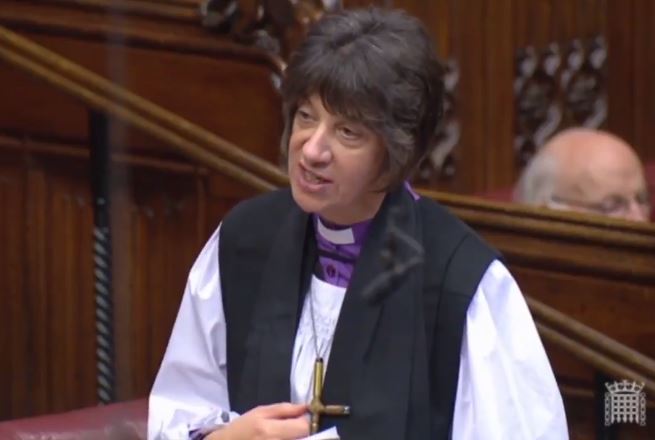 The Lord Bishop of Gloucester: My Lords, I, too, am grateful to the noble Lord, Lord Rambsotham, for bring forward this debate and I am glad to be speaking in it.
I have a particular interest in women’s interaction with the justice system as the lead Bishop on women’s prisons, and I have been carefully following the progress of the female offender strategy. The strategy was published in June 2018, and it prioritised earlier intervention, community-based solutions, and effective, decent custody for women who have to be there. There has been widespread consensus in this House and beyond that community-based provision for most women offenders offers both cheaper and more effective rehabilitation than prison. Continue reading “Bishop of Gloucester says more investment and impetus needed in female offender strategy”
Bishop of Durham responds to spending round with need for focus on society’s most vulnerable
 On 25th September 2019 the House of Lords took note of the Government’s Spending Round 2019. The Bishop of Durham, Rt Revd Paul Butler, contributed to the debate:
Lord Bishop of Durham: My Lords, like others, I welcome the fact that we are able to hold a debate on the spending round 2019. When the political point-scoring is redacted from the Chancellor’s original Statement, as I note it is on the GOV.UK website, there are aspects to welcome in the overall spending increase and some of the specific commitments. I am pleased that the Chancellor recognised in his speech that in the nation there are anxieties and divisions,
“between regions and communities, rich and poor, rural and urban, young and old”,—[Official Report, Commons, 4/9/2019; col. 180.]
and between black and white. The test for me is always around the impact of spending on the most vulnerable in our society. It is this that leads me to ask some questions.
Archbishop of Canterbury: Brexit divisions “shaking this country apart”
On 25th September 2019 the Minister of State in the Department for Exiting the European Union, Lord Callanan, repeated a Government statement on ‘Brexit Readiness and Operation Yellowhammer’. The Archbishop of Canterbury, Most Revd and Rt Hon Justin Welby, spoke in response:
The Lord Archbishop of Canterbury: My Lords, this debate —for want of a better word—demonstrates, I am sure the noble Lord would agree, the total division across Parliament. It is only a shadow of the immense divisions across the country, which the bishops find at every level, as they are immersed in every local community. The divisions are shaking this country apart. They are shaking us apart in all our great institutions, whether it is Parliament or the courts, which are portrayed as having launched a coup d’état—a slightly unlikely idea—and it is causing serious damage to our economy. We are hearing in our debates the incapacity of Parliament not only to make a decision but to find any way through the deadlock. The divisions are so deep that we cannot expect, I fear, as the noble Baroness, Lady Hayter, suggested, that cross-party work could bring a decision on what we do, but can we not at least ask the Government to look for alternative means of setting a path to making a decision?
Continue reading “Archbishop of Canterbury: Brexit divisions “shaking this country apart””
Bishop of Birmingham speaks about banking reform
 On 3rd September 2019 the Bishop of St Albans led a debate on a motion to ask the Government “what assessment they have made of the implementation of the recommendations of the Parliamentary Commission on Banking Standards and the opportunities for further banking reform”. The Bishop of Birmingham, Rt Revd David Urquhart, also made a contribution:
Lord Bishop of Birmingham: My Lords, I am grateful to my right reverend friend for leading this debate and I welcome the Minister to his new role. I want to focus on the recommendations in the original report—the references in paragraph 138 of the summary, volume 1—which looked at culture change. The response of the banking industry to that challenge came through a report produced by Sir Richard Lambert, which said that if the banks didn’t face up to this, there will be further intervention, regulation and direction. As a result, the UK Banking Standards Board was set up in 2015. I declare my interests in that I am a founder member of that board and also part of the ad hoc Financial Exclusion Committee which has been referred to already.
Continue reading “Bishop of Birmingham speaks about banking reform”
Bishop of St Albans leads Lords debate on progress made in banking reform
 On 3rd September 2019 the Bishop of St Albans, Rt Revd Alan Smith, led a debate in the House of Lords on a motion to ask Government “what assessment they have made of the implementation of the recommendations of the Parliamentary Commission on Banking Standards and the opportunities for further banking reform”. The Bishop of Birmingham also made a contribution, which can be found here. The Bishop’s speech introducing the debate is below, as is the Government response:
Lord Bishop of St Albans: My Lords, I add my welcome to the noble Lord, Lord Bethell, in his new role and I look forward to working with him.
I begin by acknowledging that the banks have an important role in our society today. They do many good things—they employ more than 1 million people and pay more than £60 billion in tax annually—but, despite the many good things they do, we are also aware of the history of recent years. We are now 11 years on from the financial crash and six years on from the publication of the report by the Parliamentary Commission on Banking Standards, and it is almost three years to the day since I last secured a debate on this topic.
Continue reading “Bishop of St Albans leads Lords debate on progress made in banking reform”
 The Church of England in Parliament
You must be logged in to post a comment.