Bishop of London responds to the Chilcot Report on the invasion of Iraq

“There is no doubt that someone who dwells on history can be somewhat tedious, but at the same time someone with a sense of destiny and no sense of history can be very dangerous.”- Bishop of London, 12/7/16

On 12th July 2016 the House of Lords debated a Government motion “That this House takes note of the Report of the Iraq Inquiry”. The Bishop of London, Rt Rev and Rt Hon Richard Chartres, spoke in the debate:

Bp London 131015The Lord Bishop of London: My Lords, it is humbling to follow such a powerful and authoritative voice. I am also grateful to the Minister for the constructive way he introduced this debate and invited us to think about the lessons we can apply now. Sir John Chilcot recommends more thorough analysis before military action and a more collaborative approach to policy-making. I imagine that every one of your Lordships would probably agree that the case is well made, but politicians caught up in oppressive events, a rapidly changing situation and a 24/7 news environment, and with an ally who is losing patience, do not have much time for pondering decisions. Therefore—this echoes many of the remarks of the previous noble Lord—the culture and assumptions that leaders bring to the crisis are hugely significant. Continue reading “Bishop of London responds to the Chilcot Report on the invasion of Iraq”

Bishop of St Albans highlights challenges to the rural economy outside the EU

“We can create all the life chances we like, but that is futile if families cannot afford to put food on the table” – Bishop of St Albans, 7/7/16

On 7th July 2016 the House of Lords debated a motion from Lord De Mauley, “That this House takes note of the current and future roles agriculture and horticulture play in Britain’s rural economy and the role that advances in agricultural science can play in the further development of that sector.” The Bishop of St Albans, Rt Revd Alan Smith, spoke in the debate:

StAlbans171115The Lord Bishop of St Albans: My Lords, I add my thanks to those from other noble Lords to the noble Lord, Lord De Mauley, for securing this important debate at this time of significant uncertainty for the agricultural and horticultural sectors. I also declare my interest in the register as president of the Rural Coalition.

As noble Lords have already stated, the agricultural and horticultural industry is an essential feature not only of the rural economy but of the wider national economy. It is often said in this Chamber that the defence of the people is the first duty of government, but I wonder whether feeding the people should be an equally primary duty. Establishing food security is an essential role of all Governments, never more so than in the current climate of global uncertainty. Continue reading “Bishop of St Albans highlights challenges to the rural economy outside the EU”

Bishop of Ely on the challenges for the UK following the EU referendum

On 5th July 2016 the House of Lords debated a motion to take note of the result of the referendum on the UK’s membership of the European Union. The Bishop of Ely, Rt Revd Stephen Conway, spoke in the debate, focusing on leadership, common values, education and the rural workforce.  

Ely 2The Lord Bishop of Ely: My Lords, I cannot match that passion, but I join other noble Lords in saying how much I appreciated the speech earlier of our boss—I mean of my friend, the most reverend Primate the Archbishop of Canterbury. He and I have both worked in the north-east and been welcomed by the people of that area, many of whom voted to leave, just as people in fenland in my current diocese and people in east Kent, beloved of the most reverend Primate, did. These people were not, it seems to me, voting against the European Union but were making a great cry—a lament—about not having been heard for several generations by us, the political class. This was their opportunity to make us listen, after feeling excluded for so long. Continue reading “Bishop of Ely on the challenges for the UK following the EU referendum”

Archbishop of Canterbury on the future for the United Kingdom after the EU Referendum

On 5th July 2016 the House of Lords debated a motion “That this House takes note of the outcome of the European Union referendum.” The Archbishop of Canterbury, Most Revd & Rt Hon Justin Welby, spoke in the debate. His speech is below in full, followed by extracts from the speeches of other Peers. 

2ABCEUdebateThe Archbishop of Canterbury:  My Lords, the events of the past two weeks have led to some of the most traumatic and dynamic changes that we have known. The course of the campaign was robust—as it properly should be on such great issues—but at times veered over the line on both sides: it was not merely robust but unacceptable. Through such comments were created cracks in the thin crust of the politeness and tolerance of our society, through which, since the referendum, we have seen an outwelling of poison and hatred that I cannot remember in this country for very many years. It is essential, not only for this House but for the leaders of both sides and throughout our society, to challenge the attacks, xenophobia and racism that seem to have been felt acceptable, at least for a while.

Just over a week ago, at Lambeth Palace, at the breaking of the fast of Ramadan, I shared an iftar with the new Mayor of London, Sadiq Khan, and the Chief Rabbi. There were more than 100 young people of every faith and of no faith there. That sense of hope and energy for the future carried us through the rest of the week. It is there and we can reach for it. If, however, we are to thicken the crust through which the cracks have come, if we are to move to a place where we are not yet speaking of reconciliation but beginning to get on a path where in future healing and reconciliation will begin to happen, we need to beware. St Paul, in his letter to the Galatians, says to them at one point:

“Love one another, cease to tear at one another, lest at the end you consume one another”.

We are in danger of doing that in the way that our politics is developing at the moment. If we are to tackle that, we have to put in place some fundamental issues to be capable of creating the agile, flexible, creative, entrepreneurial and exciting society—full of the common good and of solidarity and love for one another—which is the only way that this country will flourish and prosper for all its citizens in the world outside the European Union of the future. Continue reading “Archbishop of Canterbury on the future for the United Kingdom after the EU Referendum”

Bishop of Chelmsford on trust in public life and institutions

On 30th June 2016  Lord Fairfax of Cameron led a debate “That this House takes note of the role of openness and transparency in reinforcing confidence in public institutions.” The Bishop of Chelmsford, Rt Revd Stephen Cottrell, spoke in the debate:

Chelmsford 251115The Lord Bishop of Chelmsford: My Lords, I thank the noble Lord, Lord Fairfax of Cameron, for introducing this debate. I am still relatively new to this House, so you may not know that if there is a stick lying on the ground with a label on it saying, “wrong end”, I am prone to pick it up. I was drawn by the title of this debate and therefore went to the Library to read the briefing pack, which was fascinating. Its conclusion opens by saying that overall, the survey suggests that the public continue to have a very poor valuation of current standards in public life; respondents generally gave negative answers. That is something we should be concerned about.

My contribution will be over in 10 minutes and then you can get on with the debate that obviously some of you want to have, but I want to speak about what I see as the moral and spiritual dimensions to this issue. Continue reading “Bishop of Chelmsford on trust in public life and institutions”

Bishop of Chelmsford calls for statutory guidelines on historic abuse allegations, responds to concerns about George Bell case

On 30th June 2016 Lord Lexden led a debate in the House of Lords, “That this House takes note of the case for introducing statutory guidelines relating to the investigation of cases of historical child sex abuse.” During the debate Lord Lexden raised the case of Bishop George Bell, as did Lord Carey and a number of other Peers. The Bishop of Chelmsford, Rt Revd Stephen Cottrell, responded to the points made by those Peers about the Bell case and his speech is reproduced below, with extracts from the frontbench responses. All speeches made in the debate can be read here.

14.06.09 Chelmsford 3The Lord Bishop of Chelmsford: My Lords, I, too, thank the noble Lord, Lord Lexden, for bringing this debate before us and for the considered and careful way in which people have made their contributions. I agree with the noble Lord, Lord Cormack, that this House has an important part to play in setting our moral compass on the issues we are discussing.

I wish to make it clear that I and the Church of England welcome the introduction of some statutory guidelines for responding to historic allegations. As we in the Church are acutely aware, this is a difficult and sensitive area, so responding well to such allegations is extremely important. If there was statutory guidance on such cases, it would be easier to respond well and consistently. That said, we are all aware that the Independent Inquiry into Child Sexual Abuse may make relevant recommendations, and it might be that the Government wish to wait for them before issuing guidance in this area.

The noble Lords, Lord Lexden and Lord Dear, the noble and right reverend Lord, Lord Carey, and others have raised the specific case of Bishop George Bell, and I want to reflect briefly on it. Continue reading “Bishop of Chelmsford calls for statutory guidelines on historic abuse allegations, responds to concerns about George Bell case”

Bishop of Derby asks Government about pastoral care and training for those on zero-hour contracts

On 29th June 2016 Baroness Quin asked Her Majesty’s Government “in the light of the increased use of zero-hours employment contracts nationally and regionally, what assessment they have made of the effects of such contracts on an individual’s chances of gaining full-time salaried employment, and on specific sectors, both public and private, of the UK economy.” The Bishop of Derby, Rt Revd Alastair Redfern, spoke in the debate.

Derby 191115cThe Lord Bishop of Derby: My Lords, I, too, thank the noble Baroness, Lady Quin, for introducing this important event. It does feel lonely over here, and I hope you will not think that I am the Opposition.

I have become interested in this issue in part because of my work on modern slavery. I name that, alongside this issue, because we are in a perfect storm that is making slavery and zero-hours contracts increasing phenomena in our society. We have heard about this perfect storm: this tightness in margins and the shifting of risk; the desire for flexibility; the fact that people are so mobile they do not develop a strong relationship with any employer anyway; and the fact that, as the noble Lord, Lord Monks, and the noble Baroness, Lady Dean, said, economic inequality is increasing so much that people are desperate for work. Then migration, and especially illegal migration, adds another degree of desperation. There is a market to be exploited, both through slavery and through the unscrupulous use of zero-hours contracts, although we know these do suit some people. Continue reading “Bishop of Derby asks Government about pastoral care and training for those on zero-hour contracts”

Bishop of Chelmsford calls for action to counter fear and race hatred after EU referendum

Chelmsford 251115On 27th June 2016, Baroness Stowell of Beeston repeated a statement on the result of the EU Referendum, made by the Prime Minister in the House of Commons. The Bishop of Chelmsford, Rt Revd Stephen Cottrell, asked a follow up question:
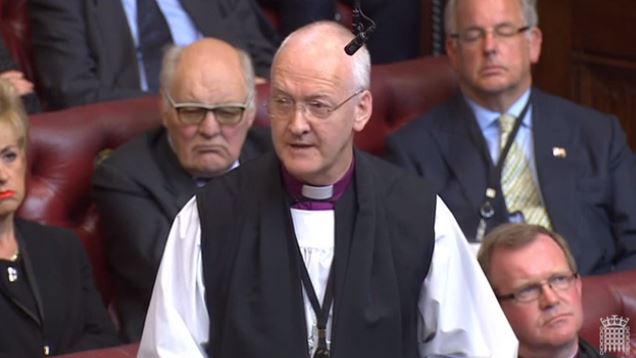

Lord Bishop of Chelmsford: My Lords, some commentators have said that the result of the referendum was a resounding victory for Brexit. I am not sure that I see it that way: 52 to 48 is, to my mind, a rather narrow victory. Where there is no overwhelming consensus, there is an overwhelming need to take account of the views of others. Nobody likes a bad winner. There has been too much hyperbole and spite in this debate. Yes, one side did win, the result is clear and we have to act on it. Those who advocated leave obviously need to take the lead in the negotiations that will take place. But we urgently need the sort of wise leadership that can build consensus. We need some sort of national Government—a coalition of good will where we can work together.

I serve the diocese of Chelmsford, which is, “east London in and Essex out”. Yesterday I spoke to a head teacher who said that the children were frightened when they went to school on Friday and that she had seen an increase in race hatred and intolerance. What plans are there to address the lack of unity in our nation and to counter the fear and race hatred that is on the rise? Can we ensure that those who lost this vote, as well as those who won, can be part of the planning going forward? Continue reading “Bishop of Chelmsford calls for action to counter fear and race hatred after EU referendum”

Bishop of Leeds pays tribute to Jo Cox MP

On 20th June 2016 both Houses of Parliament were recalled to pay tribute to Jo Cox MP.

In the House of Lords the Bishop of Leeds, Rt Revd Nick Baines, spoke on behalf of the Bishops’ Benches. His tribute follows:

Leeds160620The Lord Bishop of Leeds: My Lords, I speak on behalf of the Archbishops and Bishops and the Church of England. I do not want to repeat what has already been said but to associate ourselves with those remarks and offer deep sympathy to Brendan, the children and the wider family, and to the Members of the other place.

We live with our mortality and the fragility of civilisation. It is not very deep, and it can be easily penetrated. When I heard of Jo’s death, in my office in Leeds, I was reminded of those words from “Julius Caesar”:

“Cowards die many times before their deaths. The valiant never taste of death but once”.

There are many cowards around who have died inside, and Jo was the antithesis of that: she was full of life. She was passionate, she was intelligent and she was always generous. Her constituents, among whom I have spent the last few days, are unequivocal about that. Continue reading “Bishop of Leeds pays tribute to Jo Cox MP”

Bishop of Sheffield speaks on Church response to the migrant crisis

On Wednesday 15th June 2016 the House of Lords debated the Report from the European Union Committee The EU Action Plan against migrant smuggling (4th Report, Session 2015–16, HL Paper 46). The Bishop of Sheffield, Rt Revd Steven Croft, spoke in the debate:

14.03.27 Bishop of SheffieldThe Lord Bishop of Sheffield: My Lords, I welcome the two reports before us in all their complexity and I thank the members of the European Union Committee for their expertise, which is already evident in this debate. I particularly welcome the committee’s recommendation in paragraph 8 that the mandate of Operation Sophia is reviewed and renewed, along with the EU’s subsequent decisions. Clearly, this operation alone cannot be the complete answer to the challenges that we face. However, the European Union must not return to the position that it held before the Lampedusa tragedy of apparent indifference to those who seek to cross the Mediterranean in danger of their lives. Nor can we neglect the spread of people-smuggling on and across our borders. Continue reading “Bishop of Sheffield speaks on Church response to the migrant crisis”