Divisions – International Development (Official Development Assistance Target) Bill

On 26th February 2015, bishops took part in three divisions on the Government’s International Development (Official Development Assistance Target) Bill, The Bill proposes to enshrine in Law the commitment to spend 0.7% of UK GDI on International Development. 

House of Lords Division Lobby

Continue reading “Divisions – International Development (Official Development Assistance Target) Bill”

Lords Spiritual (Women) Bill – Lords Committee and Report Stages

On 26th February 2015 the House of Lords considered the Lords Spiritual (Women) Bill in Committee. Continue reading “Lords Spiritual (Women) Bill – Lords Committee and Report Stages”

Archbishop of Canterbury calls for voice of refugees to be heard in Syrian peace negotiations

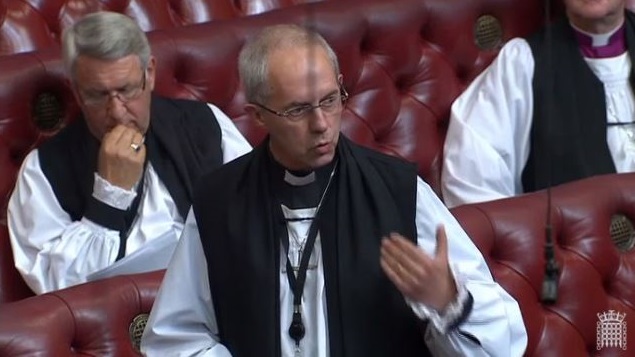
On 26th February 2015, Lord Hylton asked Her Majesty’s Government what measures they and the host states are planning to prevent Syrian refugees becoming permanent residents in those states. The Archbishop of Canterbury, the Most Revd and Rt Hon Justin Welby, asked a supplementary question: 
Archbishop of CanterburyThe Archbishop of Canterbury: My Lords, given that, as the Minister will be aware, peace agreements in this area have been done to the people, from Sykes-Picot nearly 100 years ago onwards, what contacts are the Government making with those who are in the camps and need to have a voice in the peace settlement, and in particular with women’s groups?

Baroness Northover: The most reverend Primate is right to highlight this. There is constant contact with those in the camps, to try to engage them in moving things forward. With regard to support for women and girls, we are acutely aware of how vulnerable they are, and we have a number of programmes to help support them. As he will probably know, we are very concerned about early marriage and so on, and those who are particularly vulnerable to that. We are trying to ensure that we link up to support those girls so that that does not happen, and seeking out leaders to help protect girls and women more widely.

(via Parliament.uk)

Bishop of St Albans – Libraries (Written Answer)

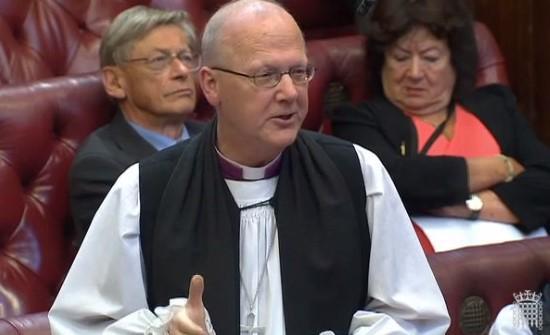
On 26th February 2015, the Bishop of St Albans, the Rt Revd Alan Smith, received an answer to a written question on library closures in the UK.

Bishop of St AlbansThe Lord Bishop of St Albans: To ask Her Majesty’s Government what assessment they have made of the impact of library closures on educational standards across the United Kingdom.[HL5085]

Baroness Jolly (Government Whip): The DCMS has not made any assessment of the impact of library closures on educational standards across the United Kingdom. Every Library Authority has a duty to provide a comprehensive and efficient library service.

(via Parliament.uk)

Bishop of Worcester – Russia and Eastern Europe (Written Answers)

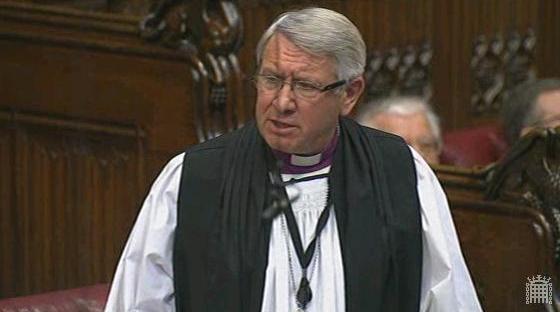
On 26th February 2015, the Bishop of Worcester, the Rt Revd John Inge, received answers to two written questions, on the subject of security in Russia and Eastern Europe.

WorcesterThe Lord Bishop of Worcester: To ask Her Majesty’s Government what steps they are taking, as a member of the Organisation for Security and Co-operation in Europe, to bring about renewed discussions with Russia on a possible Euro-Atlantic security community. [HL5013]  Continue reading “Bishop of Worcester – Russia and Eastern Europe (Written Answers)”

Divisions – Modern Slavery Bill

On 23rd and 25th February 2015, bishops took part in two divisions on the Government’s Modern Slavery Bill, relating to the Independent Anti-Slavery Commissioner and the protection of overseas domestic workers.

House of Lords Division Lobby

Continue reading “Divisions – Modern Slavery Bill”

Bishop of Derby leads call for stronger powers for agencies tackling modern slavery

On 25th February 2015, the Bishop of Derby, the Rt Revd Alastair Redfern, tabled an amendment to the Government’s Modern Slavery Bill, during its Report Stage. The amendment sought to strengthen and improve the resources of enforcement agencies who may be required to deal with groups engaged in modern slavery and human trafficking. The amendment was withdrawn, following assurances from the Minister that the Government would bring forward its own proposals at Third Reading.

The Bishop also spoke in favour of a group of amendments to the Bill relating to the transparency of supply chains. 

Amendment 92 – Enforcement Agencies

DerbyThe Lord Bishop of Derby: My Lords, I thank my colleagues, the noble Lord, Lord Alton, and the noble Baroness, Lady Kennedy, for their support for this amendment. I also place on record my thanks to the noble Lord, Lord Bates. With others, we have been extremely grateful for the patient and kind way he has listened to us, engaged with us and put on special meetings on various subjects. The point of this amendment is to highlight the fact that both the Government and many of us involved in this issue are learning a great deal as we go along. Therefore, there is a proper space for consultation, review and further learning to be done. Continue reading “Bishop of Derby leads call for stronger powers for agencies tackling modern slavery”

Bishop of St Albans speaks in debate on mental health services

On 25th February 2105, the Earl of Listowel led a short debate in the House of Lords, to ask Her Majesty’s Government what plans they have to improve mental health services for infants, children and young people, for care leavers, and for adults with care experience. The Bishop of St Albans, the Rt Revd Alan Smith, spoke in the debate, focusing his remarks on the risk of suicide amongst young people suffering from mental health issues.

Bishop of St AlbansThe Lord Bishop of St Albans: My Lords, the terrible reality of the effects of mental health could not have been more powerfully illustrated than by the story reported in the press last week of 18 year-old Edward Mallen. He was not one of “those unfortunates”—he had 12 A* GCSEs and was predicted to achieve three A* A-levels; he had got grade 8 piano and a place at Girton to read geography—but he rapidly descended, over quite a short time, into depression and died under a train. Not only is it an affront to think of that young life, with all its potential and opportunities, suddenly being lost with his death, but the scars will stay with all the members of his family for the rest of their lives. Continue reading “Bishop of St Albans speaks in debate on mental health services”

Bishop of Carlisle supports amendment to protect domestic workers from slavery

On 25th February 2015, the Bishop of Carlisle, the Rt Revd James Newcome, spoke in support of an amendment to the Government’s Modern Slavery Bill. The Bishop co-sponsored the amendment which sought to provide additional protections for overseas domestic workers at risk of exploitation. The amendment was put to a division of the House and was subsequently accepted. More details on the vote can be found here.

14.06.09 Bishop of CarlisleThe Lord Bishop of Carlisle: My Lords, several of the amendments to this important Bill have been introduced as filling a gap in the legislation. That is especially true of Amendment 90. As the noble Lord, Lord Hylton, and the noble Baroness, Lady Royall of Blaisdon, have said, it will assist all private and diplomatic domestic workers by providing a measure of protection and flexibility otherwise lacking in the Bill. It will also enable those who have been victims of modern slavery to remain in the United Kingdom for a limited period while seeking alternative employment. That is why I am glad to have my name attached to the amendment. Continue reading “Bishop of Carlisle supports amendment to protect domestic workers from slavery”

Bishop of Carlisle calls for broadband access in rural schools

On 25th February 2015, Lord Holmes of Richmond asked Her Majesty’s Government what assessment they have made of broadband speeds, capacity and coverage in rural areas of the United Kingdom and in city technology hubs such as the Old Street roundabout. The Bishop of Carlisle, the Rt Revd James Newcome, asked a supplementary question:

14.06.09 Bishop of CarlisleThe Lord Bishop of Carlisle: My Lords, many small rural schools, for instance in Cumbria, where I come from, struggle to access a high-quality broadband connection. That results in pupils missing out on educational opportunities through not having a good internet-based information supply. Can the Minister tell us what assessment the Government have made of this situation and how they intend to address it?

Lord Ashton of Hyde: My Lords, the right reverend Prelate makes a very good point. We are obviously concerned that schools have the benefit of superfast broadband, which is important if schools are to take advantage of the opportunities offered by learning technology. However, not every school is the same. Schools have the autonomy to buy a connection that meets their needs. Schools’ connectivity needs will vary depending on the size and type of school. The Government’s £780 million investment programme in broadband infrastructure will increase the broadband options available to schools, including to rural schools.

(via Parliament.uk)