Bishop of Sheffield welcomes support for families in Childcare Payments Bill

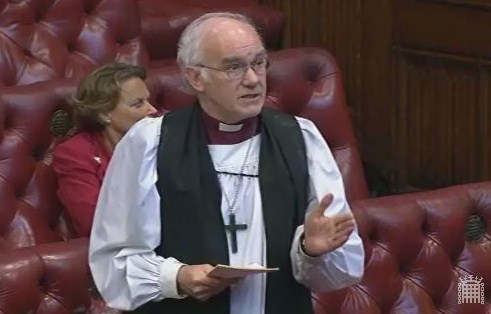
On 9th December 2014, the Bishop of Sheffield, the Rt Revd Steven Croft, took part in the Second Reading debate of the Government’s Childcare Payments Bill. The Bishop welcomed the provisions in the Bill to support low and middle-income families, but pressed the Government to ensure the Bill provided equity of delivery for families in receipt of Universal Credit, and also called on the Government to provide greater support for families with disabled children.

14.03.27 Bishop of SheffieldThe Lord Bishop of Sheffield: My Lords, from these Benches I warmly welcome the Bill, which will provide much needed assistance towards childcare costs for many middle-income and low-income families. I also welcome the careful expansion of the availability of childcare. However, there are two areas which I shall mention briefly where further attention may be needed. Continue reading “Bishop of Sheffield welcomes support for families in Childcare Payments Bill”

Bishop of Chester calls for clarity on mesothelioma research funding

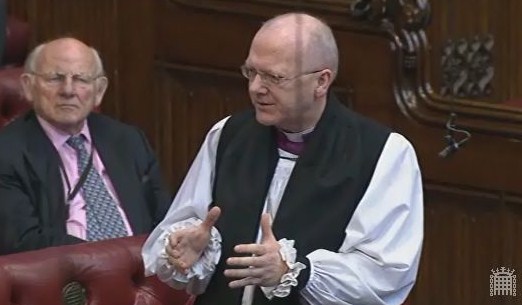
On 9th December 2014, Lord Alton of Liverpool asked Her Majesty’s Government, following the decision of the High Court that the consultation on mesothelioma legal fees was unlawful, and the lack of new funding for mesothelioma research, what is their policy with regard to combating mesothelioma and supporting victims. The Bishop of Chester, the Rt Revd Peter Forster, asked a supplementary question:

14.03 Bishop of ChesterThe Lord Bishop of Chester: My Lords, I encourage the Minister to answer the first part of the Question asked by the noble Lord, Lord Alton, about why the percentage of the precept was reduced from the promised 3% to 2.2%.
Lord Faulks: The position with insurers is that they have provided money. I will have to write to both noble Lords and the right reverend Prelate about what has happened to that particular sum. The question of the use of research funds is difficult. We think that research funds should be spent in the most effective way, and we think that publicly funding research is much more appropriate than hypothecating against insurers’ particular sums.
(via Parliament.uk)

Bishop of Derby commends recommendations of Children’s Commission on Poverty

On 8th December 2014, Baroness Jones of Whitchurch asked Her Majesty’s Government what assessment they have made of the impact of child poverty on children’s early years educational development. The Bishop of Derby, the Rt Revd Alastair Redfern, asked a supplementary question:

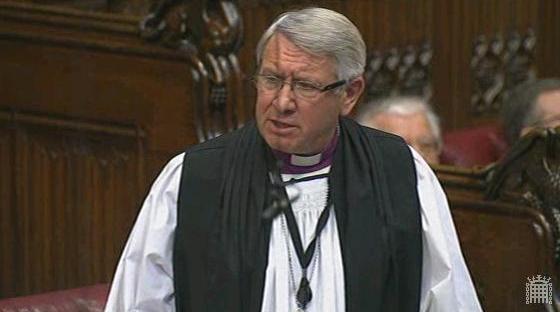
Bishop of DerbyThe Lord Bishop of Derby: My Lords, has the Minister heard of the report At What Cost? produced by the Children’s Commission on Poverty, which is a group of young people supported by the Children’s Society? If the Minister has come across the report, what will the Government do about the recommendations in it?
Lord Nash: Again, I am afraid that I will have to write to the right reverend Prelate on that matter.


Bishop of St Albans receives written answer on international violence against women convention

On 8th December 2014, the Bishop of St Albans, the Rt Revd Alan Smith, received an answer to a written question on the Convention on Preventing and Combating Violence against Women and Domestic Violence

Bishop of St AlbansThe Lord Bishop of St Albans: To ask Her Majesty’s Government by what date they expect that departments and the devolved administrations will have completed their consideration of extra-territorial jurisdiction in respect of offences established in accordance with the Istanbul Convention.[HL3233]

The Minister of State, Ministry of Justice (Lord Faulks): This government takes its international obligations very seriously. That is why we signed the Istanbul Convention on 8 June 2012, to show our strong commitment to tackling violence against women and girls.

The UK has some of the most robust laws in the world against violence towards women and girls. We have criminalised forced marriage but primary legislation will also be needed to comply with the extra-territorial jurisdiction provisions in Article 44 of the Convention before it can be ratified.

Justice Ministers are currently considering the extent to which we need to amend the criminal law of England and Wales for compliance with Article 44 prior to ratification of the Convention.

Any changes necessary to the criminal law in Scotland and Northern Ireland prior to ratification are matters for the devolved administrations. We will consult Ministers in the devolved administrations about whether legislative changes in England and Wales should extend to Scotland and Northern Ireland.

(via Parliament.uk)

Bishop of Coventry – British Nationals Abroad: Armed Conflict (Written Answer)

On 8th December 2014, the Bishop of Coventry, the Rt Revd Christopher Cocksworth, recieved an answer to a written question on British nationals engaged in armed conflict abroad.

13.10 Bishop of CoventryThe Lord Bishop of Coventry: To ask Her Majesty’s Government what assessment they have made of whether the number of United Kingdom based jihadists travelling to the Middle East and North Africa has increased following the decision by Parliament to authorize the use of military force against ISIS in Iraq; and if so, what additional measures they are taking to halt the flow. [HL3102]

The Parliamentary Under-Secretary of State, Home Office (Lord Bates): There is no evidence that the number of UK individuals travelling to the region has increased since the decision by Parliament to join the International Coalition action against ISIL in Iraq.

(via Parliament.uk)

Church of England Week in Westminster, 1st – 5th December 2014

Welcome to the Church of England’s weekly round-up of activity in Parliament.

Westminster-abbeyThis week, bishops in the House of Lords spoke in debates about the Modern Slavery Bill, the Small Business, Enterprise and Employment Bill, the Autumn Statement and the role of soft power and non-military responses to conflict prevention, which was led by the Archbishop of Canterbury.

They also asked questions about South Sudan, Syria and Iran.

Continue reading “Church of England Week in Westminster, 1st – 5th December 2014”

Archbishop of Canterbury leads House of Lords debate on conflict prevention

“I hope that in this debate we will see how the different strands of soft and hard power can be better combined, and there can be a clearer sense of the narrative which sustains this wonderful country which has in the past given so much to the world when at its best, and has the potential to give even more if the advantages of our history, the skills of our institutions and the courage of our people are combined with a clear aim in view.”

Archbishop of CanterburyOn 5th December 2014, the Archbishop of Canterbury, the Most Revd and Rt Hon Justin Welby, led a debate in the House of Lords to take note of the role of soft power and non-military responses to conflict prevention. In his opening speech, he reflected on the UK’s role in the wider world and the soft power assets it has at its disposal – the diplomatic services, the BBC, the British Council, the Commonwealth, overseas development assistance and the Church, particularly through relationships with the Anglican Communion. He spoke of the need to better understand ourselves, so as to be more effective in projecting the values and influence of the UK overseas. He also noted that the next Strategic Defence and Security Review needed to reflect the central relationship between soft and hard power, and called for more joined-up working across Government to ensure this was the case. Following his opening speech, twenty-six other members of the House contributed to the debate, including the Bishop of Derby, whose remarks can be read here. The Archbishop closed with his reflections on the topics discussed in the course of the debate. Continue reading “Archbishop of Canterbury leads House of Lords debate on conflict prevention”

Bishop of Derby calls for hope in the face of conflict, during Archbishop’s debate

DerbyOn 5th December 2014, the Bishop of Derby, the Rt Revd Alastair Redfern, took part in the Archbishop of Canterbury’s debate on the role of soft power and non-military responses to conflict prevention. He noted that for soft power to be successfully exercised, it requires a great deal of trust – particularly trust in a bigger overview, the dignity of all people, a trust in the goodness of heart of people – and a willingness to learn new things. He also reflected on how the Anglican Church at its best is a model for these forms of trust.

The Lord Bishop of Derby: My Lords, I, too, congratulate my colleague the most reverend Primate—or perhaps I should say from these Benches my honourable friend—on his securing this debate. Continue reading “Bishop of Derby calls for hope in the face of conflict, during Archbishop’s debate”

Bishop of St Albans – Sex-Selective Abortion (Written Answers)

On 5th December 2014, the Bishop of St Albans, the Rt Revd Alan Smith, received answers to two written questions on the topic of sex-selective abortion.

Bishop of St AlbansThe Lord Bishop of St Albans: To ask Her Majesty’s Government how they intend to ensure greater accuracy in gathering gender-correlated abortion statistics.[HL3171]

The Parliamentary Under-Secretary of State, Department of Health (Earl Howe) (Con): Sex of the fetus is not recorded on the HSA4 forms submitted to the Chief Medical Officer; the gender of the fetus is not known for most abortions.

The Department’s latest analysis of birth ratios data published in May found no evidence of sex selection taking place in the United Kingdom. However, we will continue to monitor birth ratios and consider any other evidence that comes to light. Continue reading “Bishop of St Albans – Sex-Selective Abortion (Written Answers)”

Bishop of Portsmouth responds to the Autumn Statement

“I pray, and not just hope, that, as we approach further substantial cuts in public spending, the aspiration for the nation will be enjoyed by the many and not just those who now benefit from the welcome but modest steps that the Chancellor has taken.”

14.04.09 Portsmouth maiden speech 1On 4th December 2014 the Bishop of Portsmouth, the Rt Revd Christopher Foster, spoke in a take-note debate in the House of Lords on the Autumn Statement and measures to promote economic growth and to support businesses in the United Kingdom. In his speech, the Bishop welcomed the Chancellor’s wish to back the aspiration of many to save, work and own a home, but noted that there are still many barriers to this being possible for all.

The Lord Bishop of Portsmouth: My Lords, it is a pleasure to add to others’ my welcome to the noble Lord, Lord Rose, in eager anticipation of his maiden speech. The Statement of the right honourable Chancellor of the Exchequer has been welcomed and applauded in some quarters and criticised in others for its emphasis on what it means for individuals and families, as well as for the national economy. I am glad to see specific, though limited, encouragement for some individuals and welcome support for some often overlooked but important groups in society. The most noticeable and eye-catching announcements yesterday highlighted the changes to stamp duty, ISAs, fuel duty and air passenger tax. For some in our communities, these will be welcome news after an extended and extending period of fiscal tightening and often reduced disposable income. There will, however, be changes—as those on these Benches serving all parts of England know—that will make little or no difference to many who would echo the Chancellor’s wish to back the aspiration to save, work and own a home. Continue reading “Bishop of Portsmouth responds to the Autumn Statement”