Bishop of Norwich asks question on Gangmasters Licensing Authority

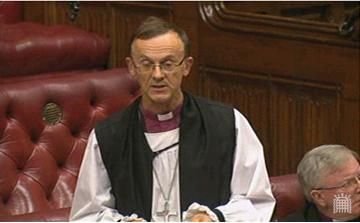
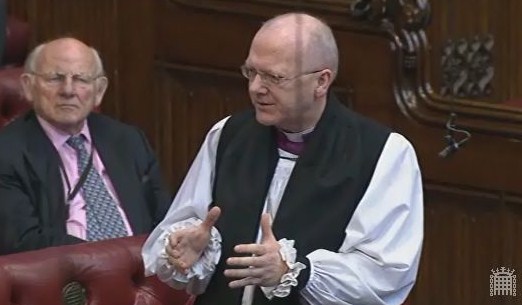
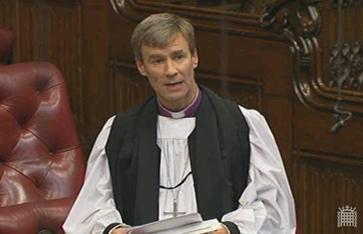
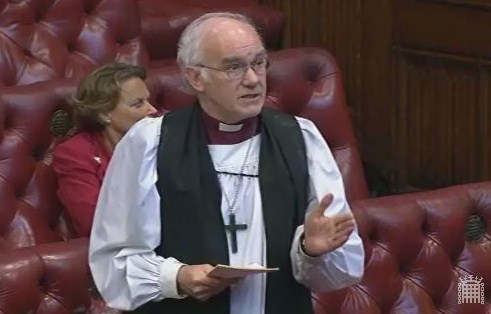
On 17th November 2014, the Bishop of Norwich, the Rt Revd Graham James, received an answer to a written question from the Home Office on the subject of the Gangmasters Licensing Authority.

14.06.12 Bishop of NorwichThe Lord Bishop of Norwich: To ask Her Majesty’s Government whether they have any plans to extend the powers of the Gangmasters Licensing Authority under the Gangmasters (Licensing) Act 2004 in order to regulate gangmasters in sectors such as hand car washes. [HL2564]

The Parliamentary Under-Secretary of State, Home Office (Lord Bates): The Government has no plans to extend the licensing remit of the Gangmasters Licensing Authority to additional sectors such as hand car washes. Licensing can be an appropriate response to particular problems in particular sectors, but that does not mean it is appropriate in all cases. However the Government will keep the Gangmasters Licensing Authority’s remit under review.

(via Parliament.uk)

Church of England Week in Westminster, 10th – 14th November 2014

Welcome to the Church of England’s weekly round-up of activity in Parliament.

Westminster-abbeyIn the two sitting days before the House of Lords rose for the short November recess, bishops spoke in debates about carbon capture in the Government’s Infrastructure Bill and electoral registration in the Government’s Wales Bill. Bishops also took part in votes on both Bills. They also asked questions about the Living Wage and freedom of religion in Egypt. Continue reading “Church of England Week in Westminster, 10th – 14th November 2014”

Bishop of Coventry highlights Church in Wales support for engagement with young voters

On 11th November 2014, the Bishop of Coventry, the Rt Revd Christopher Cocksworth, took part in the the Report Stage of the Government’s Wales Bill. At the request of the Archbishop of Wales, the bishop spoke on behalf of him and the Church in Wales in support of amendments to ensure that electoral registration officers upheld their obligation to engage and support 16- and 17-year olds to ensure they are on the electoral register, and encourage them to vote. Following the debate and comments from the Minister, the amendments were withdrawn.

13.10 Bishop of CoventryThe Lord Bishop of Coventry: My Lords, it is 94 years since the voice of the bishops in Wales has been heard in this House but, as my noble Lord Roberts implied, I thought it right to consult the Church in Wales, and the Archbishop of Wales in particular, about the amendments, which seem to me to have a great deal of merit, to see whether their voice might be heard today indirectly, as it were. As a result, I can say that the Archbishop of Wales has asked me to convey to your Lordships’ House that the bishops of the Church in Wales are very supportive of the amendments. Indeed, I understand that they also support the extension of the franchise, as was proposed and discussed earlier, but I chose to concentrate my consultations on these amendments. Continue reading “Bishop of Coventry highlights Church in Wales support for engagement with young voters”

Wales Bill – Division

On 11th November 2014, the Bishop of Lichfield, the Rt Revd Jonathan Gledhill, took part in a division of the House of Lords, on an amendment to the Government’s Wales Bill.

House of Lords Division Lobby

Amendment 1

Crossbench Peer Lord Elystan-Morgan moved amendment 1, to insert the new clause Reserved powers for the National Assembly for Wales, which sought to requre the Secretary of State to bring forward detailed measures on further legislative steps needed to establish a model of reserved powers for the National Assembly for Wales.

The Bishop of Lichfield voted ‘not content’. No bishop voted ‘content’.

There were Contents: 146 | Not Contents: 215 | Result: Government Win

(via Parliament.uk)

Bishop of Peterborough calls on Government to support adoption of Living Wage

On 11th November 2014, Lord Haske asked Her Majesty’s Government what is their assessment of the report by the Resolution Foundation Low Pay Britain 2014.The Bishop of Peterborough, the Rt Revd Donald Allister, asked a supplementary question:

14.02 PeterboroughThe Lord Bishop of Peterborough: My Lords, now that the economy is picking up, will the Minister comment on the living wage and on whether the Government believe that the minimum wage really is enough?

Lord Ashton of Hyde: The right reverend Prelate is right to bring this subject up. The minimum wage is a minimum as a catch-all; the Government support people and businesses paying above that, if they can pay the living wage, but only when it is affordable and not at the expense of jobs. In BIS, the department I represent, we have recently increased the pay of the lowest-paid workers in the department so that everyone receives the living wage. We support that as long as it is not at the expense of jobs.

(via Parliament.uk)

Bishop of Coventry seeks update from Government on recent meeting with Egyptian Foreign Minister

On 11th November 2014, the Bishop of Coventry, the Rt Revd Christopher Cocksworth, received an answer to a written question on recent meetings between the UK and Egyptian Governments.

13.10 Bishop of CoventryThe Lord Bishop of Coventry: To ask Her Majesty’s Government whether the government of Egypt’s commitment to freedom of religion and the case for political reconciliation in Egypt were amongst the issues raised by the Prime Minister in his meeting with the Egyptian Foreign Minister on 27 October.[HL2567]

The Minister of State, Foreign and Commonwealth Office (Baroness Anelay of St Johns): The Prime Minister, my right hon. Friend the Member for Witney (Mr Cameron) and the Secretary of State for Foreign and Commonwealth Affairs, my right hon. Friend the Member for Runnymede and Weybridge (Mr Hammond), raised international concerns about the human rights situation and political inclusiveness in Egypt with Egyptian Foreign Minister Shukri on 27 October. Continue reading “Bishop of Coventry seeks update from Government on recent meeting with Egyptian Foreign Minister”

Infrastructure Bill – Division

On 10th November 2014, the Bishop of Lichfield, the Rt Revd Jonathan Gledhill, took part in a division of the House of Lords, on an amendment to the Government’s Infrastructure Bill.

House of Lords Division Lobby

Amendment 113G

Labour Peer Baroness Worthington moved amendment 113G, to insert the new clause Underground access: environmental protection, which sought to create new regulations for the extraction of oil and gas through the process known as fracking.

The Bishop of Lichfield voted ‘not content’. No bishop voted ‘content’.

There were Contents: 141 | Not Contents: 237 | Result: Government Win

(via Parliament.uk)

Bishop of Chester presses Government on carbon capture during Infrastructure Bill debate

On 10th November 2014, the Bishop of Chester, the Rt Revd Peter Forster, took part in the Report Stage of the Government’s Infrastructure Bill. He asked the Minister a number of questions regarding the UK’s carbon reduction commitment, carbon capture by power stations, and the UK’s strategy for oil and gas extraction. The amendments that the Bishop spoke to were withdrawn following the brief debate.

14.03 Bishop of ChesterThe Lord Bishop of Chester: My Lords, can I ask the Minister when she responds to comment on two points? First, if we are now to be committed in this legally strengthened way to the maximum economic exploration of our oil and gas reserves, how do the Government see that to be compatible with the commitment under the Climate Change Act to reduce our emissions to only 20% of the 1990 level by 2050 without also having a strategy for carbon capture and storage, which I think lies behind the amendment?

Secondly, the amendment refers to the economic extraction of our hydrocarbons—I have never yet heard any reliable estimate of what the additional cost will be of having carbon capture and storage on a typical power station, be it a coal station or a gas station. What level of increase per kilowatt hour—in a unit that can be easily understood—is anticipated if carbon capture and storage is required on such stations? That impacts on what is economically recoverable. Continue reading “Bishop of Chester presses Government on carbon capture during Infrastructure Bill debate”

Bishop of Bristol takes part in debate on Assisted Dying Bill

On 7th November 2014, the House of Lords held the Committee Stage of Lord Falconer of Thoroton’s Assisted Dying Bill. The Bishop of Bristol, the Rt Revd Mike Hill, spoke to two amendments that he sponsored and co-sponsored. The amendments sought to strengthen the decision-making process surrounding the application and ingestion of the drugs that would be used to enable someone to commit suicide. Following a short debate on the amendments, Lord Falconer agreed to bring back amendments at Report Stage dealing with the period of time between application and ingestion. However, he did not agree to make further changes to his Bill, as he claimed that the Bishop’s concerns were dealt with elsewhere in the Bill.The Bishop did not press his amendments to a vote.

14.03 Bishop of BristolThe Lord Bishop of Bristol: My Lords, I may not be the only one who is a bit confused about what is happening. I stand to speak in support of Amendment 12 tabled by my noble friend Lord McColl, but I would like to address noble Lords’ attention to Amendment 77, which stands in my name. I rather hoped it might have been grouped with Amendment 85, but they stand separately grouped now. I would like to reserve the right to come back to Amendment 85 at a later occasion and I hope a later occasion will occur for that to happen.

Amendment 77 deals with something slightly different. Quite rightly, most of our debate today has focused on the decision to apply for assisted suicide and to sign the declaration. However, it is fair to say that the request for assistance with suicide involves two different and discrete decisions: first, there is the decision to apply for it, and then there is the decision to ingest fatal drugs. The Bill makes it clear that there has to be a minimum of 14 days between the application and the actual ingestion of the drugs, except in the case of somebody who is given a prognosis of a month or less and then the time lag reduces to six days. Continue reading “Bishop of Bristol takes part in debate on Assisted Dying Bill”

Church of England Week in Westminser, 3rd – 7th November 2014

Welcome to the Church of England’s weekly round-up of activity in Parliament.

In the House of Lords over the past week, bishops have proposed amendments to the Assisted Dying Bill, supported amendments to the Government’s Consumer Rights Bill and Infrastructure Bill and spoken about women facing homelessness, domestic violence and social exclusion, and low-income and vulnerable consumers. Bishops have also asked questions about the Chilcot Inquiry, financial advisory services, Iraq, the Central African Republic, Workplace Capability Assessments, and Saudi Arabia.

Continue reading “Church of England Week in Westminser, 3rd – 7th November 2014”