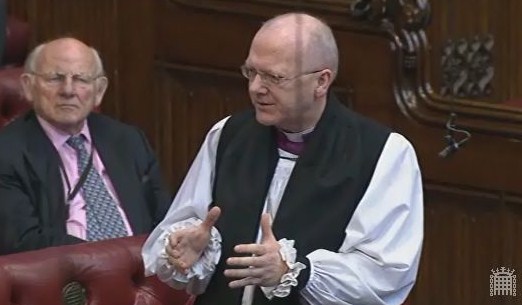
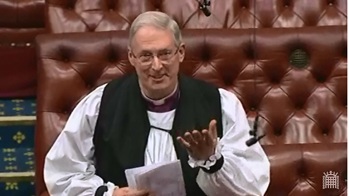
Bishop of Coventry receives answers on Government response to situation in Syria

On 29th October 2014, the Bishop of Coventry, the Rt Revd Christoper Cocksworth, received answers to two written questions from the Minister of State at the Foreign and Commonwealth Office, on the subject of religious and other groups in Syria.

13.10 Bishop of CoventryThe Lord Bishop of Coventry: To ask Her Majesty’s Government what steps they are taking to work with Syria’s religious communities, including the smallest minority communities and their political and civic representatives, to help them reach agreement on what measures are needed to ensure religious freedom and security for all communities in that country.[HL2204]

The Minister of State, Foreign and Commonwealth Office (Baroness Anelay of St Johns): We are supporting non-governmental efforts to promote dialogue between different ethnic and sectarian groups in Syria, with a view to a future political settlement. We are also funding training for Syrian activists to document abuses to a criminal law standard with the aim that this documentation could be used in a future process of accountability.

In the long run the only way to secure the position of Syria’s minority communities is to find an inclusive political solution to the crisis. The UK is determined to support the moderate opposition, who are working for an inclusive political settlement, and are committed to protect all of Syria’s communities and resist, extremists and authoritarian regimes. Continue reading “Bishop of Coventry receives answers on Government response to situation in Syria”

BISHOP OF LICHFIELD SPEAKS IN SHORT DEBATE ON THE SUSTAINABILITY OF MUSIC EDUCATION

14.03.27 Bishop of LichfieldThe Bishop of Lichfield, the Rt. Revd. Jonothan Gledhill, made a speech during the short evening debate on the long term financial sustainability of the National Music Plan in England. In it, he called for an increase in the number of music hubs, as well as greater financial support for them; highlighting the tremendous benefits a high-quality music education can have for children in all aspects of their lives.

Read the full transcript of his speech here:

The Lord Bishop of Lichfield: My Lords, I congratulate the noble Lord, Lord Aberdare, on introducing this important and timely short debate. I welcome the national plan for music education, which emphasises the importance of music and the creation of music education hubs in this country, I also welcome the fact that the report has taken note of the recommendations made in the Henley review, perhaps the most comprehensive and thorough review of the state of music education in England for many years. I thank the noble Lord, Lord Berkeley of Knighton, for his support of church music as well. Continue reading “BISHOP OF LICHFIELD SPEAKS IN SHORT DEBATE ON THE SUSTAINABILITY OF MUSIC EDUCATION”

BISHOP OF DURHAM CO-SPONSORS AMENDMENT TO SERIOUS CRIME BILL ON CHILD PROTECTION

14.06.10 Bishop of Durham 4The Bishop of Durham, the Rt Revd Paul Butler, contributed to the debate on amendment 43 to the serious crime bill, moved by Baroness Walmsley, which places legal obligations on people in positions of power to report allegations of abuse, making failure to do so a serious crime. The Bishop argued in favour of this amendment, highlighting cases over the years where failure to report allegations of abuse had often led to cases of widespread and prolific abuse in institutions of a highly serious nature. Baroness Walmsley the lead sponsor of the amendment decided when concluding her remarks at the end of the debate to withdraw amendment 43 following assurances given by the Government Minister, she said “I am delighted that there will be a public consultation’ … ‘I hope that they will make their voices heard.”

Read the full transcript of his speech here:

The Lord Bishop of Durham: My Lords, I once again support the amendment of the noble Baroness, Lady Walmsley. Indeed, since I last spoke in this place on this matter, the need for an obligation to be placed

on certain individuals to report knowledge or reasonable suspicions of abuse involving the most vulnerable has become more pressing. Continue reading “BISHOP OF DURHAM CO-SPONSORS AMENDMENT TO SERIOUS CRIME BILL ON CHILD PROTECTION”

BISHOP OF ROCHESTER CO-SPONSORS AMENDMENTS TO SERIOUS CRIME BILL ON FEMALE GENITAL MUTILATION

Bishop of RochesterThe Bishop of Rochester, the Rt Revd James Langstaff, co-sponsored amendments 44 and 44a to the Serious Crime Bill, which concerned Female Genital Mutilation. He also contributed to the debate on amendment 44, stressing that the seriousness of harm done to the individual by acts of FGM was too great for it to be allowed in the UK under the principle of tolerance for alternative cultural and religious practices. Baroness Smith of Basildon the lead sponsor of the amendments concluded the debate on amendments 44 and 44a. Following the Ministerial statement reacting to the debate on the amendments Baroness Smith decided ot to press the amendments to a vote on the basis of further discussion before Third Reading.

Read the full transcript here: Continue reading “BISHOP OF ROCHESTER CO-SPONSORS AMENDMENTS TO SERIOUS CRIME BILL ON FEMALE GENITAL MUTILATION”

BISHOP OF ST ALBANS SPEAKS ON SUNDAY TRADING IN DEREGULATION BILL

Bishop of St AlbansThe Bishop of St Albans, the Rt Revd Alan Smith, spoke on amendment 11 to the Deregulation Bill, which concerned the extension of the liberalisation of Sunday trading laws to garden centres. The Lord Bishop of St Albans spoke out against this amendment, arguing about the importance for human health and wellbeing of protecting the seven day week cycle. He said that if Sunday trading laws were to be liberalised to this effect, it would be a thin-edge-of-the-wedge effect, and so such considerations should be made in a separate bill, rather than this amendment.

Read the full speech here: Continue reading “BISHOP OF ST ALBANS SPEAKS ON SUNDAY TRADING IN DEREGULATION BILL”

BISHOP OF ST ALBANS QUESTIONS GOVERNMENT ON YOUTH UNEMPLOYMENT

Bishop of St AlbansOn the 28th October 2014, the Bishop of St Albans, the Rt Revd Alan Smith, asked a supplementary question to Lords Holmes of Richmond’s question about what Her Majesty’s Government made of the recent youth unemployment statistics, asking what the government was doing to ensure the effects of economic growth were felt by those living outside the city of London.

The Lord Bishop of St Albans: My Lords, I congratulate Her Majesty’s Government on these figures, which are very encouraging, not least in London where the number of unemployed young people has declined by 57,000, which is significant. However, the figures also reveal that in the north-east of the country, the figures have declined by only 8,000. There, the levels of unemployment among young people remain stubbornly high. Can the Minister tell us what Her Majesty’s Government are doing to help in these areas, where the problem is much worse?

Lord Freud: My Lords, we have a number of programmes aimed at getting youngsters into the workforce all around the country. There is a mixture of the Work Programme, the flexible support scheme, the sector-based work academies and work experience. We are using a whole range of programmes to help youngsters into the workforce. They are working not just in London but right around the country. Clearly, we just have to stay on the issue and make sure that we get everyone in every part of the country into the workforce.

(via Parliament.uk)

BISHOP OF ST ALBANS RECIEVES WRITTEN ANSWER ABOUT BLASPHEMY LAWS IN PAKISTAN

Bishop of St AlbansBishop of St Albans, the Rt Revd Alan Smith, asked the Minister of State at the Foreign and Commonwealth Office, Baroness Anelay of St Johns, a written question about the discussions the Government had undertaken with Pakistan’s government about the blasphemy laws and human rights commitments.

Read the full transcript here:

The Lord Bishop of St Albans: To ask Her Majesty’s Government what discussions they have had with the government of Pakistan concerning the relationship between blasphemy laws there and that country’s human rights commitments, particularly in the light of the Lahore High Court’s decision to uphold the death penalty passed against Asia Bibi.[HL2276]

The Minister of State, Foreign and Commonwealth Office (Baroness Anelay of St Johns) (Con): We regularly raise at the highest levels Pakistan’s human rights commitments including the misuse of blasphemy laws both against Muslims and against religious minorities. We are concerned to hear about the case of Asia Bibi and reports that a court has upheld the imposition of the death penalty. We have consistently pressed the Government of Pakistan on the issue of the death penalty and expressed our principled opposition to it in all cases and we will ensure that we continue to do so.

(Via Parliament.UK)

BISHOP OF COVENTRY RECIEVES TWO WRITTEN ANSWERS ABOUT JURISDICTION OF ICC IN IRAQ & CREATING NEW PROVINCES IN IRAQ

13.10 Bishop of CoventryThe Bishop of Coventry, the Rt Revd Christopher Cocksworth asked the Minister of State at the Foreign and Commonwealth Office, Baroness Anelay of St Johns two written questions about Iraq.


The Lord Bishop of Coventry: To ask Her Majesty’s Government what representations they have made to the government of Iraq about Iraq either acceding to the Rome Statute of the International Criminal Court or accepting the exercise of the International Criminal Court’s jurisdiction with respect to the current situation facing that country.[HL2202]

Baroness Anelay of St Johns: The UK is a strong supporter of the International Criminal Court (ICC) and the principle of universality. We have consistently raised Iraq’s responsibility to observe international laws and obligations in our contact with the Government of Iraq. The UK has not, to date, made representations to the current Government of Iraq regarding to accession to the Rome Statute or accepting ICC jurisdiction in relation to the current situation in the country. Any decision to involve the ICC must be made on the basis of whether the court would prove an effective means of bringing the perpetrators of atrocities to justice. We will continue to look at every available option for ensuring accountability.

The Lord Bishop of Coventry: To ask Her Majesty’s Government what conversations they have had with the government of Iraq about the implementation of proposals announced by that government in January 2014 to create three new provinces, including one in the largely Christian Nineveh Plains.[HL2203]

Baroness Anelay of St Johns: These proposals have not yet been implemented, but we support the new Government of Iraq’s commitment to decentralised governance and greater sharing of power with the provinces. This will form an important part of efforts to increase political inclusivity, which is necessary if the Islamic State of Iraq and the Levant (ISIL) are to be driven out of Iraq for the long term.

(Via Parliament.UK)

Bishops take part in votes on reforms to Judicial Review

On 27th October 2014, four bishops took part in divisions on the Criminal Justice and Courts Bill, on the third day of its Report Stage. Details of the votes can be seen below.

House of Lords Division Lobby

Amendment 146 – Judicial review in the High Court and Upper Tribunal

Crossbench peer Lord Pannick moved amendment 146, which sought to soften the Government’s proposal that the High Court must refuse permission for a Judicial Review if it is ‘highly likely’ that the decision whose legality is being challenged would be unchanged even if the Review were successful.

Four bishops voted ‘content’ to this amendment. They were the Bishop of Derby, the Rt Revd Alastair Redfern, the Bishop of Lichfield, the Rt Revd Jonathan Gledhill, the Bishop of Rochester, the Rt Revd James Langstaff, and the Bishop of St Albans, the Rt Revd Alan Smith. No bishop voted ‘not content’. There were: Contents: 247 | Not Contents: 181 | Result: Government Defeat

(via Parliament.uk)

Continue reading “Bishops take part in votes on reforms to Judicial Review”

Bishop of Rochester calls for greater co-ordination between Troubled Families programme and young offenders policy

On 27th October 2014, Lord Horam asked Her Majesty’s Government what progress is being made with the Troubled Families programme. The Bishop of Rochester, the Rt Revd James Langstaff, asked a supplementary question:

Bishop of RochesterThe Lord Bishop of Rochester: My Lords, tomorrow morning the Prison Reform Trust will publish the latest edition of its well regarded Bromley Briefings Prison Factfile. Among other things that will show the continuing correlation between exclusion from school, being brought up in care and offending behaviour. In the light of this and of other responses already given, can the Minister give an assurance that the Troubled Families programme is being well co-ordinated with the Ministry of Justice’s young offenders policy?

Lord Ahmad of Wimbledon: I can give the right reverend Prelate that assurance. Indeed, in a previous incarnation when I was the Whip for the justice department, I saw the importance of many rehabilitation programmes directly through visits programmes. He raises an important part of the mix that defines troubled families. As he is well aware, one of the key elements is youth crime and targeting youth crime and anti-social behaviour. Again, what we are seeing, for the first time I believe, is not just departments working together, but people at a local level working well together to ensure that all people involved, whether in youth crime, those involved in not attending school, as my noble friend said, or those who are not in employment, get sustainable solutions for the long term.

(via Parliament.uk)