
On 15th October 2018 the Bishop of London, the Rt Revd Sarah Mullally, asked a question she had tabled to Government on prisons. Her follow up question and those of other Members is reproduced below:
The Lord Bishop of London: To ask Her Majesty’s Government how they plan to ensure that every prisoner can participate in purposeful activity during their sentence.
Lord Keen of Elie: My Lords, the introduction of offender management in custody and the associated staffing means that prisons will be better equipped to run fuller regimes with more opportunities for purposeful activity. Our education and employment strategy, launched in May, will create a system where prisoners are on a path to employment through increased opportunities to gain experience of work in communities while released on temporary licence
The Lord Bishop of London: My Lords, I thank the Minister for his response. In Prisons Week, does he accept that continuous efforts must be made to ensure that our prisons are places of safety for those serving their sentences, and are places of hope for those who intend to avoid reoffending once released? Although I welcome the constructive use of additional staff through the promising new offender management in custody scheme, I invite the Minister to acknowledge the important role that chaplaincies, community chaplaincies, charities and churches can play in the rehabilitation of offenders. Continue reading “Bishop of London asks Government about purposeful activity for prisoners, and role of chaplaincy in rehabilitation”
 On 17th May 2018 Baroness Thornton asked Her Majesty’s Government “what steps the Department of Health and Social Care and the National Health Service are taking to support the mental health of the NHS workforce in England.” The Bishop of St Albans, Rt Revd Alan Smith, asked a follow-up question:
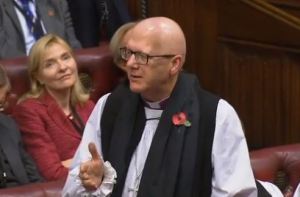 The Lord Bishop of St Albans: My Lords, there are many valuable statistics in the report, but also some quite worrying ones. Apparently 35% of the people interviewed thought that if they had had depression they would be far less likely to get any sort of promotion, while half of those interviewed said that they would not be willing to discuss mental health issues with their line manager. First, in the light of that, is there not a pressing need for a new public mental health awareness campaign? Secondly, will the Minister look into the contribution that workplace chaplaincy can make to addressing this problem?
  The Lord Bishop of Derby: My Lords, I, too, thank the noble Lord, Lord Black of Brentwood, and associate myself with the lovely phrase that it is both a privilege and very humbling to be part of this remembrance.

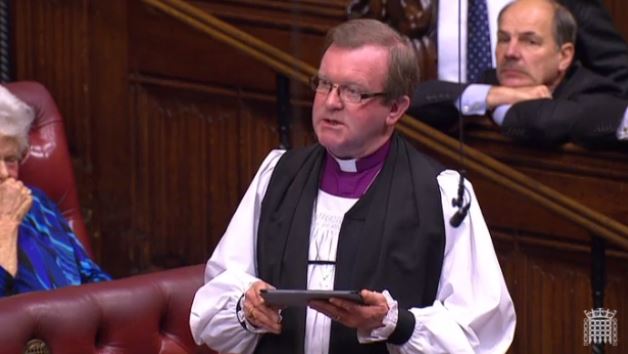 The Lord Bishop of Portsmouth: My Lords, by happy coincidence, this debate takes place almost exactly on the anniversary of the signing of the Armed Forces corporate covenant by the right reverend Primates the Archbishops of Canterbury and York. There has been excellent work with the Minister in developing the impact of that covenant, and it is a pleasure to mark that anniversary today and anticipate the maiden speeches this afternoon.
 The Lord Bishop of Derby: My Lords, I, too, thank the noble Lord, Lord Hanningfield, for his introduction to the debate, especially for linking education with vocation for people in prison. As the noble Lord, Lord Addington, said, it is a very complex territory with very deep needs. A lot of research shows that the prison population represents people with multiple needs. Therefore, the task of education and vocation will be challenging. I see the importance of formal education for literacy and numeracy to help people to get jobs. I am all in favour of that, but I want to look behind that at the informal fashioning of vocation and the development of character and confidence, which allows people to enter formal learning. I will draw on my own experience of going into prisons.
 The Church of England in Parliament
You must be logged in to post a comment.