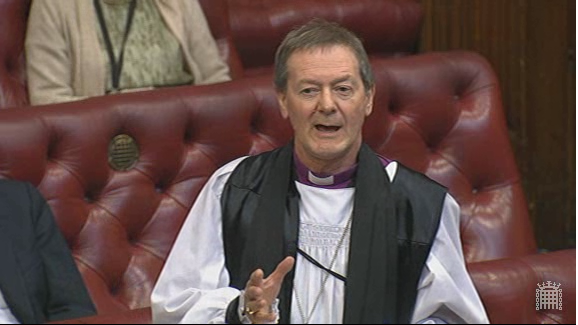
Bishop of Derby takes part in debate on demographic change in the UK

On 17th October 2013, Independent Peer Lord Filkin led a take-note debate in the House of Lord on the Report of the Public Service and Demographic Change Committee ‘Ready for Ageing?’ The Bishop of Derby, the Rt Revd Alastair Redfern, took part in the debate, focusing his remarks on the important role civil society play in supporting the elderly. He also raised concerns about the language used to talk about the elderly and highlighted the very significant contribution played by older people in society.

Bishop of DerbyThe Lord Bishop of Derby: My Lords, I, too, thank the noble Lord, Lord Filkin, and his colleagues on the Select Committee for introducing such a comprehensive and expert report. I shall pursue the theme mentioned of the contribution of civil society.

My first point is about the language that we use and the signals that we give out. The noble Baroness, Lady Tyler, talked about the importance of a public debate. It is easy to use language such as “retirement”, which indicates something negative, about stopping and ceasing to contribute. In the diocese where I work, we have 200 clergy who are retired; 80% of them make an enormous contribution, not just filling in but front-line, active contribution to the life of the church. Some cultures use the word senior rather than the word ageing. We must be very careful how we frame the debate. I invite the Minister to comment on the language that we use and the signals that we give out, so that it is not about a problem of decline and desperation but celebrating life at different stages and in different ways. Continue reading “Bishop of Derby takes part in debate on demographic change in the UK”

Bishop of Derby asks Government about success of national civil service volunteering scheme

On 9th October 2013, the Bishop of Derby, the Rt Revd Alastair Redfern, received an answer to six written questions on the subject of the national civil service volunteering scheme.

DerbyThe Lord Bishop of Derby: To ask Her Majesty’s Government how many civil servants are participating in the national civil service volunteering scheme, broken down by region.

To ask Her Majesty’s Government which government ministries and departments are participating in the national civil service volunteering scheme.

To ask Her Majesty’s Government how they intend to measure the success or otherwise of the civil service volunteering scheme.

To ask Her Majesty’s Government what, if any, criteria they apply to placements offered as part of the civil service volunteering scheme.

To ask Her Majesty’s Government what proportion of the organisations participating in the civil service volunteering scheme are (1) voluntary groups, (2) community groups, and (3) social enterprise organisations.

To ask Her Majesty’s Government how many of the voluntary groups, community groups and social enterprise organisations participating in the civil service volunteering scheme have received government funding.

**

Lord Wallace of Saltaire: The Government encourages all staff to undertake volunteering which can be of benefit to the local community but also allows civil servants to gain valuable insight and career skills. However, there is no formal national civil service volunteering scheme.

Due to the number of civil servants, and the amount who volunteer in their own time, it is not possible to know how many organisations which have worked with civil servants are voluntary groups, community groups or social enterprise organisations which have received government funding.

(via Parliament.uk)

Bishop of Birmingham speaks of shared values of religious and non-religious

“I celebrate today the contribution of humanists and atheists to the common good. I revel in our common humanity, our shared commitment to society and the gift of friendship.”

On 25th July 2013,  Lord Harrison led a debate in the House of Lords to take note of the contribution of atheists and humanists to United Kingdom society. The Bishop of Birmingham, the Rt Revd David Urquhart, welcomed the debate and the contribution of humanists and aetheists to the common good. He hoped that the debate would challenge intolerant tribalism and noted that people of faith, atheists and humanists had in common a desire to explore profound questions about life.

01.04.14 Bishop of BirminghamThe Lord Bishop of Birmingham: My Lords, while I am still privileged to occupy the Bench of the Lords spiritual on behalf of the nation, I am delighted to say that the debate today is most welcome and I am honoured to follow the previous three speakers. They have given us the opportunity to hear the great deal of good that can and should be recognised, wherever we find it, whether in philosophy—the noble Baroness, Lady Whitaker, reminded us of the great traditions of humanist philosophy—or in science. I note the point of the noble Baroness, Lady Meacher, about the very serious business of assisted dying; I am sure that we will work hard on that together to get it right.

There is also the wonderful good that comes from humanists or atheists ringing bells. So often in society we appear to be motivated simply by our own interests, with the consequence that acknowledging good in others is interpreted simply as disloyalty to one’s tribe. Within the church, we are not immune to this problem. None the less, the Christian tradition points to the wider generosity; when Jesus was asked for an example of neighbourliness, he told a story about the Samaritan and not a good religious Jew, such as himself. I hope that, among many other themes, this debate will challenge intolerant tribalism in all walks of life wherever we find it. Continue reading “Bishop of Birmingham speaks of shared values of religious and non-religious”

Bishop of Derby takes part in debate on future of civil society

On 18th July 2013, Baroness Prosser led a debate in the House of Lords on the future of civil society. The Bishop of Derby, the Rt Revd Alastiar Redfern, spoke during the debate. The Bishop concern that as the traditional elements of civil society – family, nation and church – had become weak, civil society had become an elective exercise and that people now had to be persuaded to come together to create the energy and momentum for human flourishing.

Bishop of DerbyThe Lord Bishop of Derby: My Lords, I, too, thank the noble Baroness for securing this debate. I shall pursue the definition that the noble Lord, Lord Hastings, began to open up in his speech with the notion of the three legs of the stool and what civil society means. I start from the presupposition that we live in an age of liberalism in the technical sense; that is, we are very concerned for the individual to be free, and to be liberal about all those freedoms. Those freedoms are very good things, but any good often creates a problem.

I want to preface what I am saying with some words from TS Eliot. He said that the danger in liberalism is that it releases energy rather than accumulates it. It releases energy and then it is difficult to gather it together, because everybody is free, to make the building blocks of a civil society. He said that it relaxes rather than fortifies. The more we create rights, the bigger the problem with what we call cohesion. The more we are concerned about individual good, the bigger the problem with the common good. The more people have individual freedom, the more chance there is of becoming isolated, lonely and marginalised. It is very important to debate the civil society at this time when we desperately need energy to be accumulated around people for their well-being and flourishing and not dissipated into people being atomised on their own. The Government want to work with civil society—for the state to co-operate in accumulating energy for good things to happen. The National Council for Voluntary Organisations defines civil society as when,

“people come together to make a positive difference to their lives, and the lives of others”—

accumulating energy, making a positive difference to their lives and the lives of others. Continue reading “Bishop of Derby takes part in debate on future of civil society”