The Bishop of Chester spoke in a debate on a report on modern slavery on 4th September 2026, highlighting the importance of public awareness and the need to also consider the factor of poverty:
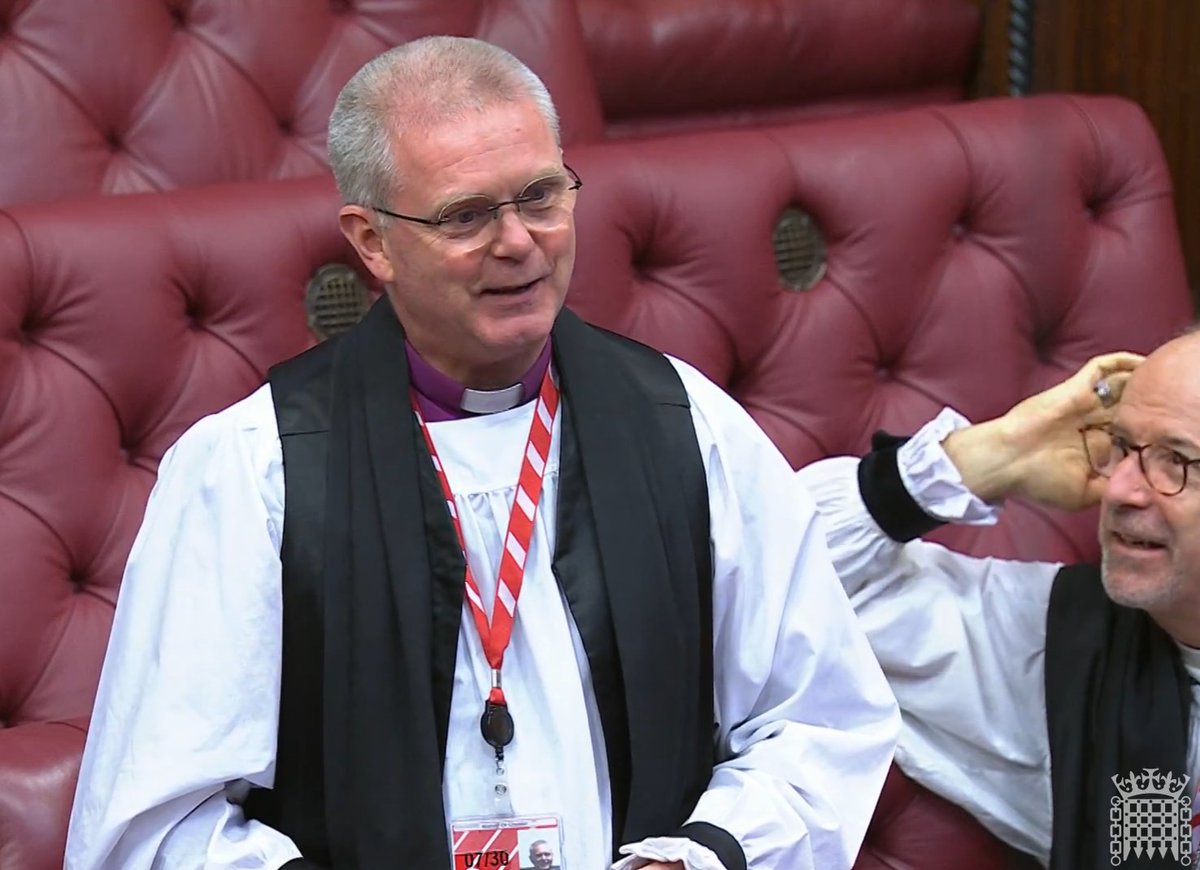
The Lord Bishop of Chester: My Lords, I join others in welcoming the Minister to his seat. I hope that he will not mind my sharing that, before his introduction yesterday, we were chuckling that wandering about this place for the first time felt a bit like wandering around Hogwarts. My hope, if I may say so, is that he will fight as passionately for justice as the heroes of those stories.
I am also not alone in welcoming this report wholeheartedly. I express my gratitude to the noble Lord, Lord Alton, and his colleagues for the extraordinarily good and profound work that has been done here. I am proud to be part of a nation that, 10 years ago, introduced—for the first time anywhere in the world, I believe—ground-breaking legislation. However, we have not gone far enough. This matters, morally, legally, economically and in terms of human rights. I suspect—to think of my day job—that I am preaching to choir in terms of the moral case for this. We have only to glimpse the basics of forced labour to see that this is not good enough. Although that is part of the problem: we do not glimpse it, and we do not have the public outrage that we need.
Others will make the economic case far better than I could. I refer the House to the work of charities such as Unseen, which reckons that around £60 billion a year is added to the British economy by dealing with these issues. Imagine the effect of money being taken out of the criminal economy and put into the mainstream economy. If I may speak up for the Church Commissioners, I am glad that our responsible investment team has been working for a number of years on this.
I would say that I am a bear of little brain, so my reflections are focused on two very clear questions. The first is how, in tackling this injustice, do we make sure that we do not transfer inequity from one group to another? I suspect that to most in this Chamber, it would make very little difference if 10% were added to the cost of a new sweater or other items of clothing, but it would matter hugely to many of the people I am privileged to serve. In researching this, I have been surprised and delighted to find that many of the most cost-effective clothing providers in our society today have some of the strongest policies in this regard. Can the Minister say what the Government are doing in response to these recommendations, but particularly in ensuring that cost is not added to the most impoverished parts of our economy?
My second question, which has really absorbed me, is how do we raise public awareness of this issue, so that people know when there is forced labour in the supply chain when they go to buy a new pair of socks or whatever it happens to be? Where are the Greta Thunbergs or—if you are of a particular generation—the Bob Geldofs who will raise these things and raise public irritation to a point where we must do something about it, not only legislatively but by changing our society?
This question matters morally, legally and economically. It matters to the very soul of our nation. I thank the committee for this report and urge the Government to respond.
Extracts from the speeches that followed:
Lord Hannan of Kingsclere (Non-Afl): The problem that arises from this report is that we should not judge policies only by their intentions. We need to look at their consequences, and there are reasons why we have generally, in trade policy, restricted ourselves to the finished product, rather than trying to police the production of any given good or service, whether it is to do with net zero, animal welfare, or whatever it is. It is an incredibly difficult and intrusive thing to try and police, and it is usually very ineffective.
To the extent that there is an impact, it is very often negative. With a trade sanction of any kind—refusing to buy certain products and then having to go through a bureaucracy to see which products they are is, if you like, the loosest form of trade sanction—who does that hurt? It hurts ordinary people in the other country and, as the right reverend Prelate the Bishop of Chester reminded us, in our own country, and it generally drives support to the regime of which you disapprove. It strengthens its control of the economy and makes it easier for it to put its cronies in positions of power. So there is a real danger that we elide from saying, “I disapprove of this practice”, or “I disapprove of this regime”, whether it is Iran, China or wherever else, into saying, “Therefore, let’s have some kind of trade sanction”. Actually, I think we need stronger sanctions: not commercial sanctions but political and legal sanctions aimed at the individuals responsible.
Lord Sharpe of Epsom (Con): We must also be aware that small and medium-sized British businesses have faced cost after cost and millions of pounds in cumulative regulatory burdens since this Government took office. I fear that further mandatory reporting requirements will do very little to solve the problem they are aimed at while doing much to add to it. It will add cost, complexity and legal exposure to businesses trying, in good faith, to operate responsibly within an imperfect system. In many situations, supply chains are so complex that it would be practically impossible to ensure absolute due diligence and compliance.
This is not to argue for inaction—not at all—but we need to argue that these businesses, particularly SMEs, will need help to ensure that they are able to comply. I ask the Minister to bear this in mind when responding and to ensure that SMEs are taken particular care of and have the necessary support to minimise compliance costs and maximise the efficiency of their practices and solutions to this problem. As the right reverend Prelate the Bishop of Chester reminded us, we do not want to end up in a situation where all we are doing is, in effect, transferring inequity from one group of disadvantaged people to another. Again, I say this not to counsel inaction but to counsel humility about the limits of regulation imposed at a distance.
(…) As others in this debate have noted, and particularly in debates on this sector, we must not overlook the fact that the public sector has a significant role to play in terms of its procurement policies, as pointed out by the noble Baroness, Lady Finlay, and in the education of the public. That point was made extremely well by the noble Lord, Lord Alton, the right reverend Prelate the Bishop of Chester and the noble Baroness, Lady Hamwee. The public need to be educated about the extent of the problem so that they can make better and informed choices. By definition, a lot of that education will have to come from the public sector.
This is not to say that I am arguing against the Government’s energy policy when we are talking about this aspect of the problem, but a serious conversation is still needed about how forced labour ends up in UK supply chains. I was very pleased to hear what the noble Baroness, Lady O’Grady, said on that because sometimes the best of domestic intentions have disastrous unintended consequences thousands of miles away, out of sight, but, I hope, because of this thoughtful and expansive debate, not out of mind.
Baroness Hamwee (LD): In the course of many debates, noble Lords have remarked that, at the time of the 2015 Act, we regarded our country as world leading on modern slavery and that, over the years, we have not kept up with international partners. I recall that, when that legislation was going through, I made the rather naive point that public awareness was valuable. We talked about business following the example of the most ethical and best organised, without properly acknowledging that they cannot be precisely emulated by those with smaller margins. I am not making an excuse for unethical behaviour, but I am taking up a point referred to by other noble Lords. In the context where you can be disadvantaged by doing the right thing—as the noble and learned Baroness, Lady Butler-Sloss, said—the noble Baroness, Lady Young, asks a very pertinent question on this.
Promoting a product on, or partly on, the basis of green credentials is easier than of there being no forced labour, although I was glad to hear what the noble Lord, Lord Alton, said on this, reporting what evidence has shown. The sector still battles the notion that it does not happen here. The noble Baroness, Lady O’Grady, who so skilfully chaired our post-legislative inquiry, brought that out very strongly. It does happen here; it happens here, and it happens there. I agree with the right reverend Prelate that it is difficult when you do not see it starkly and immediately, and it is difficult when you cannot really envisage it, which is perhaps a difference from the green credentials point, which I think we find a bit easier to get our heads around—or perhaps allow ourselves to think about. We do not want to think about modern slavery.
Lord Alton of Liverpool (CB): My Lords, the noble Lord, Lord Sarwar, in giving one of his first ministerial replies, has acquitted himself with some distinction. It is wonderful to hear a Minister describing himself as impatient, and someone who will look at things with fresh eyes. I also agree strongly with what he just said about there being no single outcome. All these different levers have to be applied, and he said that he will look at them carefully. I am very grateful to him.
I thank all noble Lords who have participated in this debate, from left, right and centre. The right reverend Prelate said that we needed a greater sense of outrage; I think that has communicated itself in the speeches today. My noble friend Lady Finlay said that it is our duty to shine a light into dark places. Everyone has done that today.
It struck me, from listening to the references to William Wilberforce, that 200 years ago it was the Select Committee on which he and others appeared—including the slave-trading sea captain from Liverpool, John Newton, who changed his mind and came to describe what he had seen on those vessels—that led to the changes in the law of which this country and Parliament can be so proud. They changed hearts, they changed minds, they changed culture and they changed the law. They did that as an alliance of people who came together from commerce, the law, religious backgrounds and secular backgrounds. They worked with one another. They had campaigners such as Thomas Clarkson, who abandoned his studies at Cambridge University to spend decades trying to bring through the legislation that ultimately made such a difference to the people living in those dark places to which my noble friend referred.
I began by referring to the 50 million people who are victims. That is just a number. Behind every number and every statistic there is a story: a life that is not theirs; a suffering that no one knows about; there is pain, exhaustion and hunger; there are dreams of freedom and dignity. The victims of this blight must remain central to this debate.


You must be logged in to post a comment.