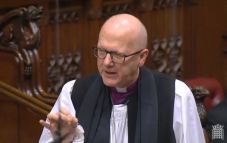
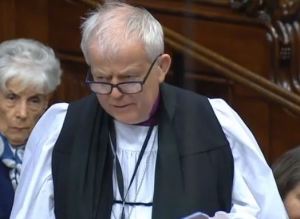
Bishop of St Albans asks Government about legally binding targets on air pollution

On 19th March 2019 the Bishop of St Albans, Rt Revd Alan Smith, received a written answer to a question on air pollution:

The Lord Bishop of St Albans:

HL14478

To ask Her Majesty’s Government what consideration they have given to setting legally binding targets to meet WHO-recommended limit values for particulate matter across the UK, and if consideration has been given, when the targets will be implemented. Continue reading “Bishop of St Albans asks Government about legally binding targets on air pollution”

Bishop of Salisbury asks Government about environmental standards of new homes

On 18th March 2019 the Bishop of Salisbury, Rt Revd Nicholas Holtam, received a written answer to a question on environmental standards for building new homes:

The Lord Bishop of Salisbury:

HL14210

To ask Her Majesty’s Government what action they are taking to support housing developers and homeowners to improve the environmental standards of new homes; and what steps they are taking to improve the environmental impact of existing housing stock. Continue reading “Bishop of Salisbury asks Government about environmental standards of new homes”

Bishop of Salisbury – Climate emergency requires more consistent response from Government

On 4th March 2019 the House of Lords debated the Feed-in Tariffs (Closure, etc.) Order 2018, and a ‘Motion to Regret’ criticising the Order from Baroness Jones of Moulsecoomb. The Bishop of Salisbury, Rt Revd Nicholas Holtam, spoke in support of Baroness Jones’s Motion, and a transcript is below:

Motion to Regret: That this House regrets, in the light of the worsening climate emergency, that the Feed-in Tariffs (Closure, etc.) Order 2018 will end the export tariff for small-scale renewable energy without any replacement scheme in place; will result in new installations having to export their electricity to the National Grid for free; and will harm jobs and investment in the renewable energy industry (SI 2018/1380).

The Lord Bishop of Salisbury: My Lords, I support the noble Baroness’s Motion of regret. It is almost inevitable that a debate such as this will range more widely than the specific issues that the noble Baroness is focused on. I hope your Lordships will forgive me for beginning in Salisbury, my cathedral city, on a day when there has been a considerable amount of reflection about events there a year ago and their significance for the city and internationally.

We were grateful for the Prime Minister’s visit earlier today. I particularly thank the council, Wiltshire Police and the fire and ambulance services, as well as the district hospital, Porton Down and the military, for their commitment through the year. Wiltshire County Council has led a programme of recovery. Although business is still badly affected, we are making progress. We are grateful for the involvement of the noble Lord, Lord Henley.

From those ghastly events that began to unfold a year ago, we have learned not just about the need to recover but about using a crisis as an opportunity to rethink what sort of city Salisbury can be. The same is true of the environmental crisis we face.

Continue reading “Bishop of Salisbury – Climate emergency requires more consistent response from Government”

Bishop of Salisbury asks Government about development of alternatives to plastics

Salisbury231018bOn 13th February 2019 Baroness Neville-Rolf asked the Government “whether they intend to introduce a simple and uniform system for both (1) labelling plastic and (2) bin collections in England, with the aim of reducing the use of plastic and encouraging recycling.” The Bishop of Salisbury, Rt Revd Nick Holtam, asked a follow up question:

The Lord Bishop of Salisbury: My Lords, the issue is not only recycle and reuse but reduce. I was at the celebration of the first anniversary of the Eco Synagogue a few weeks ago and saw real alternatives to plastic being developed by industry, such as Indonesian seaweed to replace 16 billion packets of ketchup, mayonnaise and the like. Alternatives are being produced but industry is so heavily invested in the production of plastic that it is difficult to make the commercial switch. What are the Government doing to fund the development of alternatives to plastic which will help us to make the change that is needed? Continue reading “Bishop of Salisbury asks Government about development of alternatives to plastics”

Bishop of St Albans – resources needed to ensure successful fly-tipping prosecutions

On 31st January 2019 the Bishop of St Albans, Rt Revd Alan Smith, asked a question he had tabled to Government on fly-tipping. The exchanges are below:

Fly-tipping

The Lord Bishop of St Albans: To ask Her Majesty’s Government what assessment they have made of the impact caused by fly-tipping on areas of outstanding natural beauty, following reports that the Woodland Trust has spent over £1 million on cleaning up fly-tipping over the past five years.

The Parliamentary Under-Secretary of State, Department for Environment, Food and Rural Affairs (Lord Gardiner of Kimble) (Con): My Lords, the impact of fly-tipping is grave wherever it occurs. It blights local communities and the environment, and tackling fly-tipping is a government priority. Defra’s recently announced resources and waste strategy outlines our approach to tackling waste crime, including specific proposals to prevent, detect and deter fly-tipping. This month, we gave local authorities and the Environment Agency powers to issue financial penalties to householders who fail in their duty of care and pass waste to fly-tippers.

The Lord Bishop of St Albans: I thank the Minister for his reply. Having said that, the statistics from local authorities show that over half of them have not had one successful prosecution for fly-tipping. They say that it is not about a lack of law, regulation or anything else; it is a lack of resource. They simply do not have the ability to use the powers they have already got. What can Her Majesty’s Government do to break through this impasse and address this terrible problem, which we face right across the country?

Continue reading “Bishop of St Albans – resources needed to ensure successful fly-tipping prosecutions”

Archbishop of York – EU environmental regulations have grown into a jungle

On 22nd January 2019 the House of Lords considered a motion to approve the Floods and Water (Amendment etc.) (EU Exit) Regulations 2019. The Archbishop of York, Most Revd John Sentamu, asked a question of the Minister:

The Archbishop of York: The Minister has been very clear about the benefits of regulation, particularly for the environment, which, as he said, were brought about through sheer hard work, campaigning and persuading other people. Nevertheless, does he agree that EU regulations have grown into a jungle that has become very difficult to penetrate?

Continue reading “Archbishop of York – EU environmental regulations have grown into a jungle”

Bishop of Salisbury welcomes Government waste strategy, calls for more action on plastics recycling

On 19th December 2018 the Lords debated a motion from Baroness Neville-Rolfe, “To move that this House takes note of the threat to the environment posed by plastic and the case for improved recycling.” The Bishop of Salisbury, Rt Revd Nicholas Holtam, spoke in the debate:

The Lord Bishop of Salisbury: My Lords, I add my thanks to the noble Baroness, Lady Neville-Rolfe, for her persistence on plastic and for securing this debate. In the light of the comments of the noble Baroness, Lady Parminter, I observe that I enter the debate after three inspiring women.

I want to say “Well done” to the Government on the resources and waste strategy announced yesterday. It must be a bit of a relief to find an issue around which there is a good level of agreement for us to work on, but it means that there is a danger of complacency in the face of such an urgent task. Continue reading “Bishop of Salisbury welcomes Government waste strategy, calls for more action on plastics recycling”

Bishop of St Albans asks about linking executive pay to carbon emission reduction targets

On 5th December 2018 the Bishop of St Albans, Rt Revd Alan Smith, asked a question he had tabled to Government about linking executive pay to carbon emission reduction targets. The reply, his follow-up question and those of other Members is below:

The Lord Bishop of St Albans: To ask Her Majesty’s Government what steps they are taking to encourage oil and gas companies to link executive pay to carbon emission reduction targets.

Continue reading “Bishop of St Albans asks about linking executive pay to carbon emission reduction targets”

Bishop of Carlisle asks Government about greening of towns and cities

On 5th December 2018 Baroness Randerson asked Her Majesty’s Government “what steps they are taking to raise awareness among the general public of the health impacts of emissions from diesel vehicles.” The Bishop of Carlisle, Rt Revd James Newcome, asked a follow-up question:

The Lord Bishop of Carlisle: My Lords, does the Minister agree that, while electric cars are being developed, trees, plants, shrubs and especially hedges can make a very useful contribution to the absorption of harmful emissions, as well as having a therapeutic value for those who grow them and those who enjoy them? Can he tell us of any plans the Government may have to encourage the greening of our towns and cities? Continue reading “Bishop of Carlisle asks Government about greening of towns and cities”

Bishop of Chelmsford – Budget is missed opportunity for environment

On 13th November 2018 the House of Lords debated the Chancellor’s Budget Statement. The Bishop of Chelmsford, Rt Revd Stephen Cottrell, spoke in the debate to highlight concerns about the environment, the two-child limit and fixed odds betting terminals.  

The Lord Bishop of Chelmsford: My Lords, for many on these Benches there are measures to welcome in this Budget: for instance, the decision to increase the work allowances within universal credit for families with children and people with disabilities, as other noble Lords have mentioned. This goes a substantial way towards reversing the cuts announced in 2015. Likewise, the announcement of measures to aid the transition to universal credit, worth £1 billion over five years, is also welcome, as is the additional and non-repayable run-on support for new claimants to help people manage during the five-week waiting period before their first payment. However, I am disappointed that the run-on support does not cover the child elements of universal credit. Continue reading “Bishop of Chelmsford – Budget is missed opportunity for environment”