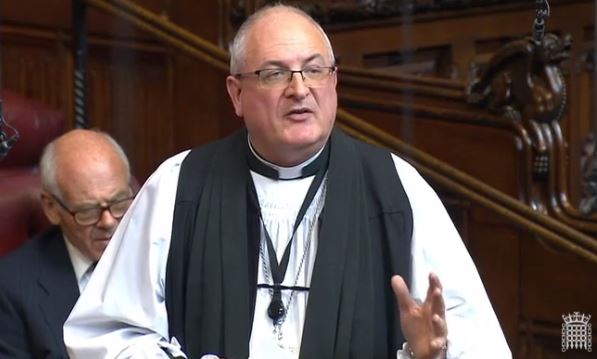
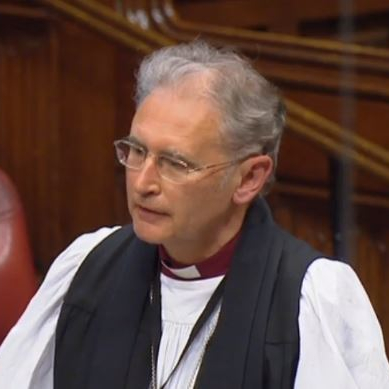
Bishop of Leeds asks about resilience of democracy in Bosnia and Herzegovina

The Bishop of Leeds asked a question on UK government efforts to hold Serbia to account in the public arena during a discussion on democratic resilience in Bosnia and Herzegovina on 25th November 2025:

The Lord Bishop of Leeds: My Lords, it is perhaps salutary to remember that the GDR lasted for only 40 years, that the 30 years since the Dayton accords is not a very long time, and that what can be built up over a period of time can be demolished very quickly. Can the Minister say what the UK Government are doing to hold particularly Serbia to account in the public arena, exposing what is going on and what its influences are—from Russia in particular but not from Russia alone?

Continue reading “Bishop of Leeds asks about resilience of democracy in Bosnia and Herzegovina”

Bishop of St Albans urges creation of new youth mobility scheme for UK and Europe

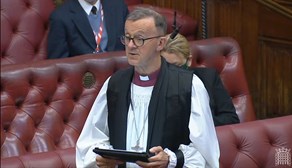
On 30th January 2025, the Bishop of St Albans led a debate on the case for a new youth mobility scheme with European countries:

The Lord Bishop of St Albans moved: That this House takes note of the case for a new youth mobility scheme with European countries.

My Lords, youth mobility schemes are a topical subject in this Parliament at the moment. A Private Member’s Bill on this very subject is making its way through the other place, which yesterday held a debate on youth mobility schemes with the EU. In this Chamber, we had a Question on it from the noble Lord, Lord Balfe, last week and a Question today from the noble Lord, Lord Liddle. I am aware that a number of noble Lords have already asked supplementaries and I look forward to the opportunity for them to develop some of those points more fully in this debate. In particular, I look forward to the maiden speech of the noble Lord, Lord Moraes.

I believe that the need for closer ties with our European neighbours is more pressing now than it has been for some time. There are many reasons for that, but, with the Ukrainian war and increasing geopolitical instability likely to exacerbate existing migration issues, the need for international co-operation is all the more important, especially with those countries that are quite literally our neighbours. I hope this debate will provide an opportunity to think how we might maximise the opportunities for our young people to experience study, work, leisure, sport, music and so on in the wider world beyond our shores.

Continue reading “Bishop of St Albans urges creation of new youth mobility scheme for UK and Europe”

Bishop of Lincoln speaks in debate on European Relations

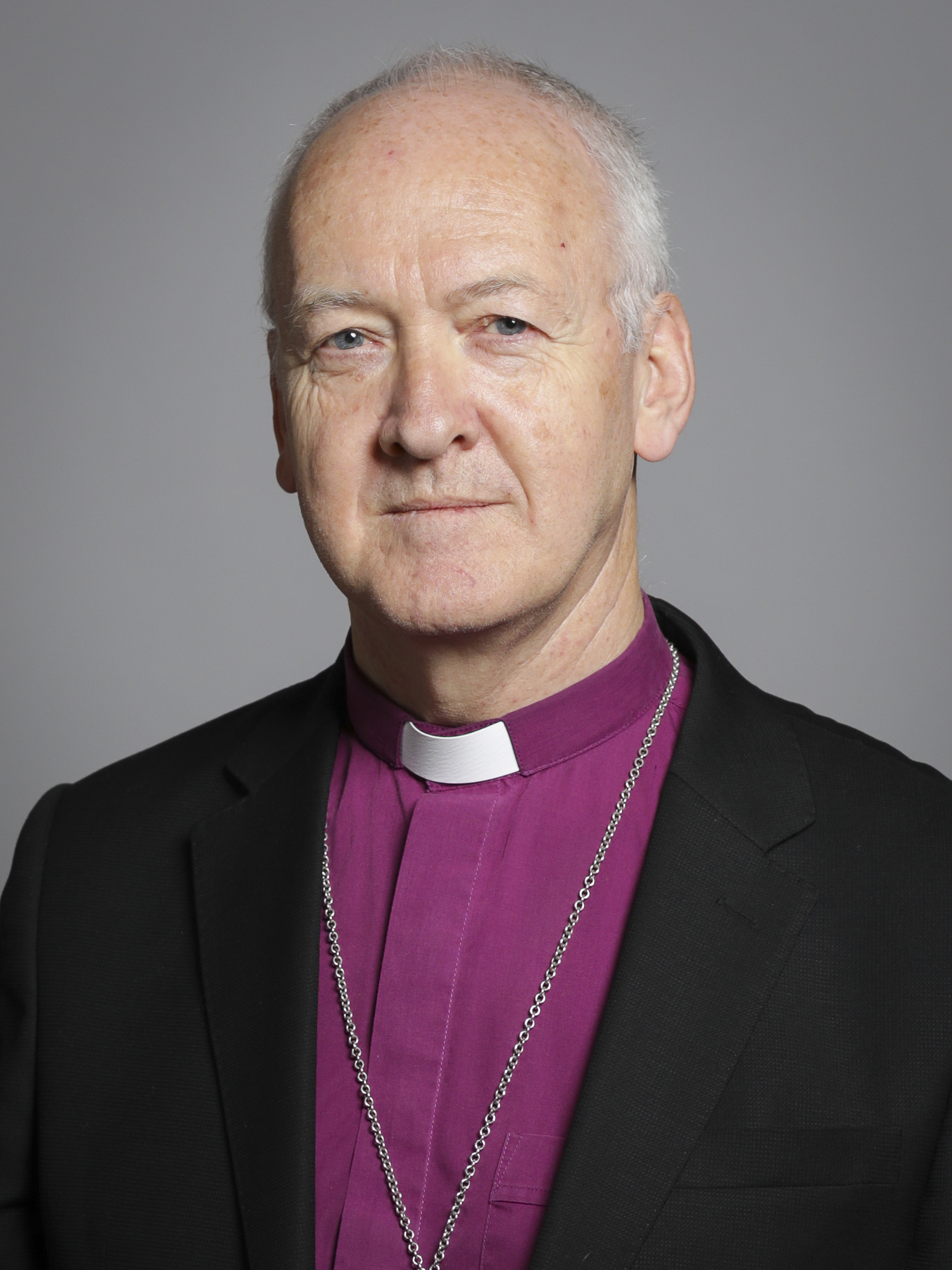
On 10th October 2024, the Bishop of Lincoln took part in a debate on relations between the UK and Europe, highlighting the value in strong community relationships:

The Lord Bishop of Lincoln: My Lords, I am grateful to the noble Baroness, Lady Smith, for having made this debate possible and am looking forward to the speech of the noble Baroness, Lady Hodge, directly after this. Her experience as MP for Barking highlights how important it is that we are alert to the risk that cultural and ethnic diversity in our country can be exploited by extremists, and how important it is for us, as faith communities, not to have our faith and belonging co-opted by extremists in the way that we saw in the summer.

Faith and culture must not be seen as a cause of conflict. Our beliefs and values enrich and inspire us; these are the foundations of both individual and communal strength. Our cultural diversity, moreover, is a source of vitality, creativity and wisdom, but only when we are able to come together in dialogue, study and celebration. Faith remains a key feature of modern society in the UK and across Europe. It is worth remembering that Christianity, Islam and Judaism all have roots in the Middle East and long histories in Europe. It is vital that we build constructive relationships between these significant faith communities as we look towards a more positive future.

Continue reading “Bishop of Lincoln speaks in debate on European Relations”

Bishop of Worcester asks about contradictory nature of the death penalty

The Bishop of Worcester asked a question on the problematic nature of the judicial death penalty during a debate on capital punishment and UK membership of the Council of Europe on 2oth February 2023:

The Lord Bishop of Worcester: My Lords, in view of the comments to which the noble Baroness, Lady Chakrabarti, has drawn attention, does the Minister agree that there is something deeply ironic about a society condemning the taking of a person’s life, and in order to demonstrate exactly how strongly it does so, doing exactly that through a judicial killing?

Continue reading “Bishop of Worcester asks about contradictory nature of the death penalty”

Bishop of Leeds asks about proposal for a European Political Community

The Bishop of Leeds received the following written answer on 12th October 2022:

The Lord Bishop of Leeds asked His Majesty’s Government what assessment they have made of the proposal made by the President of France on 9 May for the creation of a new “European political community” to promote cooperation between the EU and its neighbours; and what conversations they have held with (1) the President of France, and (2) other EU countries, in relation to the attendance of the UK at the first European Political Community Summit in Prague on 6 October.

Continue reading “Bishop of Leeds asks about proposal for a European Political Community”

Bishop of St Albans warns of ‘tinkering with human rights convention’ in debate on the Human Rights Act

The Bishop of St Albans spoke in a debate on the 1998 Human Rights Act, on 14th July 2022:

My Lords, I too thank the noble Baroness, Lady Whitaker, for securing this debate, and for setting out so clearly many of the great benefits that have been achieved through the Human Rights Act. I will not repeat or elaborate any of those here, and perhaps save a moment or two in so doing.

As neither a legal nor constitutional expert, I am not going to delve into the technical side of the matter, but it is clear to me that this is a discussion not simply about the importance of the Human Rights Act 1998 but about many of the concerns—already raised from different Benches in this House—that noble Lords have with the proposed British Bill of Rights. Before I mention some of my concerns, I commend the introduction of the right to a trial by jury in the updated Bill of Rights Bill. But aside from this one welcome measure, it strikes me that there is a very real danger that the new Bill of Rights may remove levels of accountability from government, particularly in areas such as immigration, which I have an interest in.

Continue reading “Bishop of St Albans warns of ‘tinkering with human rights convention’ in debate on the Human Rights Act”

Bishop of Durham asks about support for Ukrainian refugees

On 28th February 2022, the Bishop of Durham asked a question about the UK’s plans to support Ukrainian refugees fleeing conflict, and to assist other European countries in providing that support:

The Lord Bishop of Durham: My Lords, I have every sympathy for the Minister trying to defend the indefensible. He has to do that; that is his job. However, what are we going to say to Poland and Moldova and all the other neighbouring countries about how we will take our share of those who will arrive in the first instance into their country but who they cannot support entirely on their own because they will need the support of other countries to the west, including ourselves?

Lord Sharpe of Epsom (Con): I thank the right reverend Prelate for his sympathy. I do not know, unfortunately, what conversations will be had with those neighbouring countries, but they must, by definition, be ongoing.

Hansard

Bishop of Coventry asks about cooperation with European partners when responding to humanitarian issues

The Bishop of Coventry asked a question on European cooperation in the event of humanitarian crises caused by conflict, climate change, and other issues on 21st February 2023, during a debate on foreign policy and defence cooperation:

The Lord Bishop of Coventry: My Lords, given the Minister for Europe’s comments yesterday that the conflict in Ukraine could lead to 5 million refugees fleeing to neighbouring countries, what forms of co-operation are Her Majesty’s Government preparing with European partners in response to this looming humanitarian crisis and other catastrophes on the world stage, caused through conflict, climate change or whatever?

Continue reading “Bishop of Coventry asks about cooperation with European partners when responding to humanitarian issues”

Bishop of Leeds asks about statements made by Russian foreign minister regarding security in Europe

On 20th January 2022, the Bishop of Leeds asked a question regarding Russian Foreign Minister Sergey Lavrov’s statement regarding the Organisation for Security & Cooperation in Europe (OSCE):

The Lord Bishop of Leeds: My Lords, what assessment have Her Majesty’s Government made of the statement by Sergey Lavrov two days ago that the OSCE used to convene parties on an equal basis but it is now simply a defender of western interests? What impact does that have on our conversations with the Russians?

Lord Sharpe of Epsom (Con): I am sorry but I shall have to write to the right reverend Prelate on that. I have not seen Sergey Lavrov’s statement.

Hansard

Bishop of Coventry asks about UK participation in European crisis-talks on migration

The Bishop of Coventry asked a question urging the government to commit to participation in European crisis talks on migration on 25th November 2021, following a government statement on the recent deaths of migrants crossing the English Channel:

The Lord Bishop of Coventry: My Lords, the sense of grief that has been hanging over this House for most of the afternoon is testimony to our sense of common humanity. I assure the families of those who died—whoever and wherever they are—of the prayers of this Bench, and I am sure that many other prayers have been offered around your Lordships’ House. We have heard, quite rightly, from the Minister, echoing the Home Secretary, that this requires a co-ordinated international effort. It also clearly has a European dimension. Can the Minister confirm that if, as the French President has suggested, high-level European crisis talks take place on migration, the UK will take a full part and even encourage those conversations to happen?

Continue reading “Bishop of Coventry asks about UK participation in European crisis-talks on migration”