
Bishop of Leeds asks about the impact of Brexit on EU nationals living in UK

Leeds160620On 11th January 2017, Lord Lee of Trafford asked the Government “when they will confirm whether those non-British European Union nationals employed in the agriculture, caring and hospitality sectors will be given the right to remain in the United Kingdom following Brexit.” The Bishop of Leeds, Rt Revd Nick Baines, asked a follow up question:

The Lord the Bishop of Leeds: My Lords, I feel a bit naive in this. Perhaps the Minister could explain. Supposing the EU countries decide not to do a deal to protect the interests of British nationals abroad, will the response be to say that those who are here will have to leave? We will face exactly the same problem that has been mentioned by several speakers—that we cannot maintain our agricultural, hospitality, health service and university industries. If that is the case, it does not sound to me like a bargaining point.

Continue reading “Bishop of Leeds asks about the impact of Brexit on EU nationals living in UK”

Bishop of Portsmouth on defence and diplomacy challenges post-Brexit

On 8th December 2016 the House of Lords debated a motion from Lord Sterling of Plaistow, “That this House takes note of the impact of the withdrawal from the European Union on the United Kingdom’s armed forces and diplomatic service.” The Bishop of Portsmouth, Rt Revd Christopher Foster, spoke in the debate:

portsmouth241016The Lord Bishop of Portsmouth: My Lords, there are few constants or certainties in Brexit other than that Britain’s future will be markedly different. Brexit will have far-reaching implications for our place in Europe and the wider world. From a security perspective, the decision to leave the EU represents as significant a shift as the decision in the late 1960s to withdraw from bases east of Suez. If that was not daunting enough, Brexit also represents the biggest administrative and legislative challenge that a Government have faced since 1945, and is likely to shrink government departments’ bandwidth to engage with other issues. Continue reading “Bishop of Portsmouth on defence and diplomacy challenges post-Brexit”

Bishop of Leeds asks about effect of media on understanding of judicial independence

LeedsOn 7th December 2016, Lord Beith asked the Government “what steps they are taking to promote public understanding of the rule of law and the independence of the judiciary.” The Bishop of Leeds, the Rt Revd Nick Baines, asked a follow up question:

The Lord Bishop of Leeds: My Lords, will the Minister define a little further what is meant by public education, as it seems that one of the most powerful shapers of world views is what people see in the headlines of newspapers and what they see in the media, not just what is taught to them rationally, for example in schools?

Continue reading “Bishop of Leeds asks about effect of media on understanding of judicial independence”

Bishop of Chester speaks in debate on online safety

14.03 Bishop of ChesterOn 1st December 2016, Baroness Howe of Idicote led a short debate in the Lords to ask the Government “what steps they are taking in order to achieve compliance with the new European Union net-neutrality Connected Continent requirements in such a way that United Kingdom adult content filtering regimes can be maintained in order to help keep children safe online.” The Rt Revd Dr Peter Forster, Bishop of Chester, took part in the debate.

The Lord Bishop of Chester: My Lords, the House should be deeply grateful indeed to the noble Baroness, Lady Howe, for her persistence in bringing before us the difficult issue of online safety, particularly as it affects our children. I must say, the thickness of the plot as she set it out in her opening speech would be a credit to Agatha Christie herself in this particular aspect of it. We will be returning to the broader aspects when the Digital Economy Bill comes before us shortly. I believe that there is also a forthcoming report by the Communications Select Committee on children and the internet.

Continue reading “Bishop of Chester speaks in debate on online safety”

Bishop of Chester asks Government not to lose sight of cultural and scientific links to Europe in Brexit negiotations

14.03 Bishop of ChesterOn the 1st December 2016 Lord Liddle held a debate on ‘the best options for the United Kingdom’s future relationship with the European Union following the referendum vote to leave’. The Bishop of Chester, the Rt Revd Peter Forster, spoke about the foundations of the idea of ‘Europe’ not just as an economic construct but as a civilisation. 
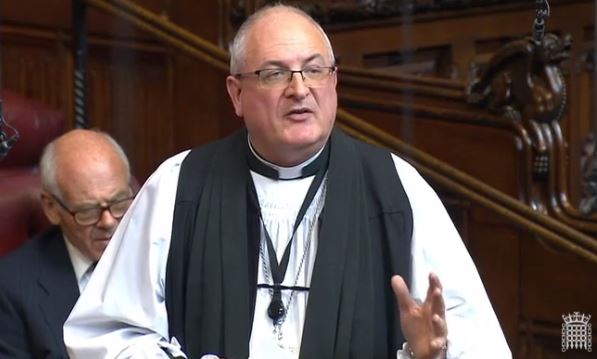
 

The Lord Bishop of Chester: My Lords, the Motion before us is not limited to economic issues, although the debate so far has understandably concentrated on them. I would like to take a slightly broader look at our future relationship with the EU. Of course, the social and economic issues associated with the four freedoms will inevitably take centre stage over the next few years, and it will be an anxious time for many. I hope it will also be a time of opportunity for at least some, perhaps many; we will see. Continue reading “Bishop of Chester asks Government not to lose sight of cultural and scientific links to Europe in Brexit negiotations”

Bishop of Ely calls on Government to “make care work a recognised and valued profession.”

On 24th November 2016 the House of Lords debated a motion from Baroness Finlay of Llandaff “To move that this House takes note of the implications for the health and social care workforce of the result of the referendum on the United Kingdom’s membership of the European Union.” The Bishop of Ely, Rt Revd Stephen Conway, spoke in the debate:

ElyThe Lord Bishop of Ely: My Lords, I am grateful to the noble Baroness, Lady Finlay, for bringing this important matter before the House today. The right reverend Prelate the Bishop of Carlisle, our lead bishop on health and social care, cannot be in his place today, but I am glad to contribute from these Benches on his behalf.

The debate brings to mind two principles central to Christian faith and practice: justice for the stranger in our midst and care for the vulnerable. Mosaic law enjoins us not to withhold justice from the outsider. Only yesterday, in conversation, the Secretary of State for Communities and Local Government sought to check that I had heard the words of Jesus, “Love thy neighbour as thyself”. I am grateful to him. This reminds us that the words of Jesus tell us that every care and service given to others is a service given to God. Continue reading “Bishop of Ely calls on Government to “make care work a recognised and valued profession.””

Bishop of Leeds responds to statement on Article 50 ruling

Leeds160620On 7th November 2016, Lord Bridges of Headley repeated a Government statement on the judicial ruling that Parliament must trigger the process for leaving the European Union (Article 50). The Bishop of Leeds, the Rt Rev Nick Baines, asked a follow-up question.

The Lord Bishop of Leeds: My Lords, it has been said that 17 million people voted in favour of leaving the EU; that still leaves a very divided country. Not everybody who voted to remain can be assumed to be trying to thwart the decision of the British people simply by asking legitimate questions. Continue reading “Bishop of Leeds responds to statement on Article 50 ruling”

Bishop of Portsmouth highlights uncertainties for Higher Education of EU withdrawal

My background covers different sorts of universities: Hertfordshire and Portsmouth, Oxford and Cambridge, and Durham and Manchester. I studied in three, taught economics in two, was a chaplain in another and have been a governor in two. I draw your Lordships’ attention to my entries in the register of interests.

In such very varied universities, the present excruciating uncertainty following the Brexit vote is having a significant impact in a range of areas.

Continue reading “Bishop of Portsmouth highlights uncertainties for Higher Education of EU withdrawal”

Bishop of Bristol asks about the expertise required for exiting the EU

Bristol160226 cOn Monday 24th October 2016, Baroness Evans of Bowes Park, the Lord Privy Seal, repeated a statement on the European Council. The Bishop of Bristol, Rt Rev Mike Hill, asked a follow up question.


The Lord Bishop of Bristol: My Lords, I am very grateful to the noble Baroness for repeating the Prime Minister’s Statement. She has emphasised something that all noble Lords will recognise: this is a matter of huge complexity. To articulate one anxiety, the noble Baroness said that we are the first country to leave the EU—I do not know whether she regards that as a notable first—but, if it is as complex to leave the EU as your Lordships’ House believes, can she assure us that somewhere there is the expertise necessary to enter into negotiations of complexity in such a way that will really benefit the people of the United Kingdom? Continue reading “Bishop of Bristol asks about the expertise required for exiting the EU”

Bishop of Leeds speaks about the importance of peace and stability after the EU Referendum

Leeds160620On 18th October 2016, Lord Collins of Highbury asked the government what assessment they have made of the potential effect on peace and stability in Europe and around the world of the United Kingdom leaving the European Union. The Bishop of Leeds, Rt Revd Nick Baines, spoke in the debate about the importance of continued interdependence for peace and stability.

The Lord Bishop of Leeds My Lords, recognising that this debate and that to come on Thursday belong together, although I cannot be here on Thursday, I offer this statement by the German theologian Jürgen Moltmann in a book that I finished reading on the train today:

“A free society is not an accumulation of independent individuals; it is a community of persons in solidarity”.

I quote this because the same might equally be applied to nations. It bears repetition that the language and discourse of the referendum—shamelessly, in my view, fuelled by misrepresentations and misleading promises, now apparently acceptable in a so-called “post-factual” world—paid little or no attention to the needs or securities of our international neighbours. They focused purely on the national interests of Britain, as if we can live in isolation or that we can be secure without ensuring the security of our neighbours. I invoke the poet John Donne: in a globalised world, Britain cannot simply see itself as an island. Continue reading “Bishop of Leeds speaks about the importance of peace and stability after the EU Referendum”