Bishop of Coventry on ISIS and UK Military Action in Iraq

“Dietrich Bonhoeffer said that when a madman came down the street swinging an axe it was our duty to not just apply plasters to the injured but to stop the madman with whatever means were expedient” – Bishop of Coventry, 26/9/14

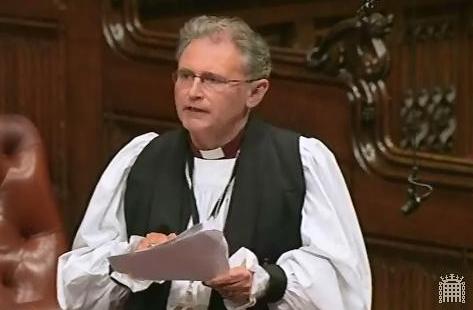
Parliament was recalled on Friday 26th September 2014 in order to debate UK involvement in military action against ISIS/ISIL, following a request for assistance from the Government of Iraq. In the debate that took place in the House of Lords the Bishop of Coventry, Rt Rev Christopher Cocksworth, gave the following speech:

13.10 Bishop of Coventry

The Lord Bishop of Coventry: My Lords, the noble and learned Lord, Lord Howe of Aberavon, referred your Lordships’ House a few moments ago to the parallel in the 1930s and 1940s in Europe. I should like to draw on one figure from that period which I found helpful in thinking about the matters before us. Dietrich Bonhoeffer said that when a madman came down the street swinging an axe it was our duty to not just apply plasters to the injured but to stop the madman with whatever means were expedient.

The Government are seeking to join with others to stop the madman swinging the axe of cruelty, and we agree that stopped he must be. The question is: what are the expedient means for doing so? Continue reading “Bishop of Coventry on ISIS and UK Military Action in Iraq”

Bishop of Derby on ISIS and UK Military Action in Iraq

Besides the current military need, we have to engage with the debate about what a good society is from the ingredients of politics and religion. We have to contribute to that together if we are to stem this tide and create a safer world to live in – Bishop of Derby, 26/9/14

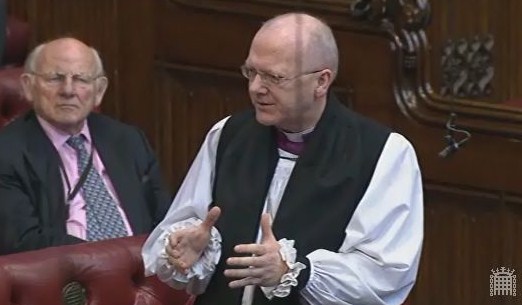
Parliament was recalled on Friday 26th September 2014 in order to debate UK involvement in military action against ISIS/ISIL, following a request for assistance from the Government of Iraq. In the debate that took place in the House of Lords the Bishop of Derby, Rt Rev Alastair Redfern, gave the following speech:

Bishop of DerbyMy Lords, I invite us to think for a moment about the role of government in the wider strategy. A number of noble Lords have pointed out that this is not just a military issue; it is about religious and political matters. We might just note that some of us in a liberal society are in danger of separating religious and political issues. These are mixed up, but we need to look at them together. Continue reading “Bishop of Derby on ISIS and UK Military Action in Iraq”

Archbishop Speaks on ISIS and UK Military Action in Iraq

“We must demonstrate that there is a positive vision far greater and more compelling than the evil of ISIL and its global clones. Such a vision offers us and the world hope and assurance of success in this struggle, not the endless threat of darkness” – Archbishop of Canterbury, 26/9/14

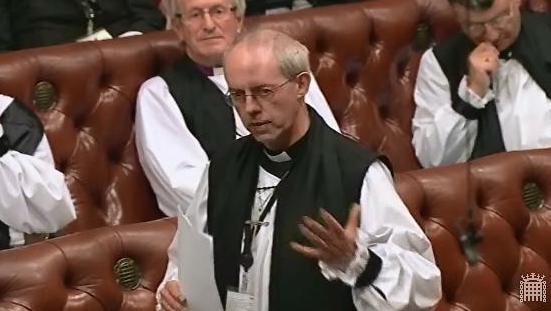
Parliament was recalled on Friday 26th September 2014 in order to debate UK involvement in military action against ISIS/ISIL, in response to requests from the Government of Iraq. In the debate that took place in the House of Lords the Archbishop of Cantery, Most Rev Justin Welby, gave the following speech:

Archbishop of Canterbury

My Lords, the danger of this debate is that we speak only of Iraq and Syria, ISIL, and armed force. ISIL and its dreadful barbarity are only one example of a global phenomenon, as the noble Baroness the Leader of the House mentioned. Continue reading “Archbishop Speaks on ISIS and UK Military Action in Iraq”

Visas for Overseas Church Representatives – Bishop of Chelmsford Question

On 22nd September 2014 the Bishop of Chelmsford, Rt Rev Stephen Cottrell, received an answer to a question on the issuing of visas to representatives of overseas churches.
14.06.09 Chelmsford 2

Home Office – Entry Clearances
Asked by the Lord Bishop of Chelmsford on 01 September 2014 (HL1763):
To ask Her Majesty’s Government what plans they have to review the criteria for giving visas to overseas church representatives in cases where all fares and expenses are guaranteed by a United Kingdom church body.

Refugees from ISIS, Iraq, Syria – Questions From Bishop of Coventry

 On 22nd September 2014 the Bishop of Coventry, Rt Rev Christopher Cocksworth, received written answers to two questions of Government – about UK resettlement for Iraqis displaced by ISIS and about Syrian refugees. The answers are below. The other questions tabled at the same time by the Bishop on similar issues can be viewed here.
13.10 Bishop of Coventry

 Home Office – Asylum: Iraq (HL1591)

Asked by the Lord Bishop of Coventry on 28 July 2014:

To ask Her Majesty’s Government what consideration they have given to resettling in the United Kingdom a proportion of those displaced from ISIS-controlled areas of Iraq.

Continue reading “Refugees from ISIS, Iraq, Syria – Questions From Bishop of Coventry”

Bishop of St Albans – food security in Angola (Written Answer)

On 11th August 2014 the Bishop of St Albans, the Rt Revd Alan Smith, received an answer to a question on food security in Angola.

Bishop of St AlbansThe Lord Bishop of St Albans: To ask Her Majesty’s Government what discussions they have had with the government of Angola regarding food insecurity in that country; and whether they have encouraged that government to undertake an assessment of the situation.

Baroness Northover (LD): Poor seasonal rainfall early in 2014 in parts of Western Angola has affected the harvest and food availability there. However, throughout most of the country production is considered to be good and expected to be higher than normal. This has helped to maintain reasonable food prices for urban populations.

The Government has not had recent bilateral discussions with the Government of Angola regarding the food situation. The Government of Angola is leading the food assistance programme and is best placed to prepare for and lead such a response with the support of UN partners. The Government of Angola has set up an Inter-ministerial Commission to tackle the drought. The Government of Angola is also embarking on infrastructure projects, such as water supply projects, to mitigate drought impact in the future.

(via Parliament.uk)

Bishop of Coventry receives answers to written questions on current situation in Iraq

On 11th August 2014, the Bishop of Coventry, the Rt Revd Christopher Cocksworth, received answers to four written questions on the situation in Iraq. The questions were originally tabled on 28th July 2014. Further questions regarding resettlement of vulnerable groups in the UK are expected to receive answers in due course.

13.10 Bishop of CoventryThe Lord Bishop of Coventry: To ask Her Majesty’s Government what assessment they have made of the state of freedom of religion and belief in Iraq.

Lord Popat (Con): We are deeply concerned about the situation in Iraq including freedom of religion and belief. We condemn the Islamic State of Iraq and the Levant’s (ISIL) threats to ethnic and religious minorities in Iraq, including Christian, Yezidi and Turkomen and the desecration of mosques and churches by ISIL. The Parliamentary Under-Secretary of State for Foreign and Commonwealth Affairs, my hon. Friend the member for Bournemouth East ( Mr Ellwood), met Archbishop Athanasius of the Syriac Orthodox Church in London on 29 July and issued a statement strongly condemning the persecution of Christians and other minorities in Iraq. Our Ambassador in Baghdad has met religious representatives, including Chaldean Patriarch Luis Sako, and the Consul General in Erbil has met the Archbishop of Erbil and the Archbishop of Mosul to discuss the current situation, the needs of the Christian community, and UK humanitarian assistance to those displaced by fighting in Iraq. On Sunday 3 August, the British Chargé d‘Affaires attended a service at St George’s Anglican Church in Baghdad, joined by officials from our Embassy, to highlight the British Government’s continued support to Christians and other minorities affected by recent violence in Iraq. Continue reading “Bishop of Coventry receives answers to written questions on current situation in Iraq”

Bishop of Sheffield on UK trade with Colombia and human rights

On 30th July 2014, Lord Stevenson of Balmacara led a debate in the House of Lords on the motion ‘that the Grand Committee takes note of the Bilateral Agreement for the Promotion and Protection of Investments between the United Kingdom and Colombia’.

The Bishop of Sheffield, the Rt Revd Steven Croft, spoke during the debate, raising the issues of land ownership rights, protection of the human rights of indigenous Colombian people and the need for a monitoring system.

14.03.27 Bishop of SheffieldThe Lord Bishop of Sheffield: My Lords, I shall speak briefly to support and echo the excellent remarks of the noble Lord, Lord Stevenson, and the points made by other noble Lords on the dangers posed by this treaty, in three specific areas. Continue reading “Bishop of Sheffield on UK trade with Colombia and human rights”

Bishop of St Albans raises human rights abuses in South Sudan

On 30th July 2014 the Bishop of St Albans, Rt Rev Alan Smith, received a written reply from Foreign Office Minister Baroness Warsi to a question about human rights in South Sudan.

Bishop of St AlbansThe Lord Bishop of St Albans: To ask Her Majesty’s Government what discussions they are having to ensure that allegations raised in the United Nations Mission in the Republic of South Sudan human rights report of 8 May are being addressed.[HL1307] Continue reading “Bishop of St Albans raises human rights abuses in South Sudan”

Bishop of St Albans asks Government about its humanitarian assistance to South Sudan (Written Answer)

On 29th July 2014, the Bishop of St Albans, the Rt Revd Alan Smith, received an answer to a written question on humanitarian assistance in South Sudan.

Bishop of St AlbansThe Lord Bishop of St Albans: To ask Her Majesty’s Government how they are supporting the role of churches and other civil society groups in the peace and reconciliation process in South Sudan, and in the delivery of humanitarian assistance.

Baroness Northover: The UK is one of six donors funding the United Nations Development Programme (UNDP) Community Security and Arms Control (CSAC) Project, which includes provision of technical support for national and community-level community reconciliation process, including working with faith-based partners. Furthermore, under the Africa Conflict Pool Programmes, the UK is funding civil society organisations to build the capacity of local populations to identify and resolve conflicts that affect them.

Through the Common Humanitarian Fund (CHF), the UK has supported work by national civil society to provide health, education, food security and livelihood, water and sanitation and mine awareness services for the most vulnerable. In addition, some United Nations agencies supported by the UK (such as the Food and Agriculture Organisation (FAO) and the World Food Programme (WFP)) work in close collaboration with local partners. To improve basic services the UK funded Girls Education South Sudan (GESS) project is working through Episcopal Church of Sudan (ECS) in two of South Sudan’s 10 States, and the UK-led Health Pooled Fund (HPF) will support faith-based county hospitals as well as government ones.

(via Parliament.uk)