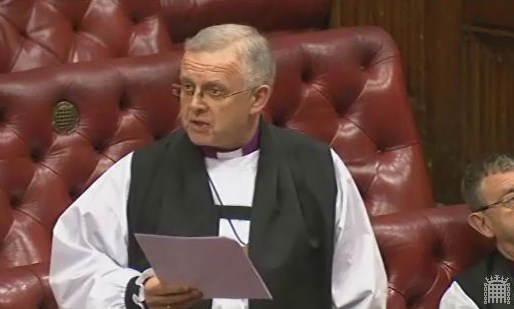
Bishop of St Albans asks Government about UK involvement in South Sudan peace settlement

On 28th July 2014, Conservative Peer Baroness Hodgson of Abinger asked Her Majesty’s Government what steps they are taking to ensure that any future peace settlement in South Sudan is inclusive. The Bishop of St Albans, the Rt Revd Alan Smith, asked a supplementary question:
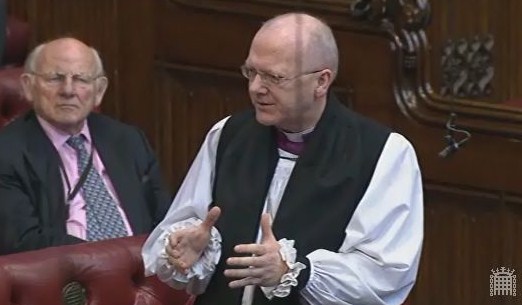
Bishop of St AlbansThe Lord Bishop of St Albans: My Lords, it is evident that the long-term process of finding an inclusive Sudanese-led reconciliation can begin only once hostilities cease and a political settlement and resolution is reached. This is why international diplomacy is so vital. Will the noble Lord tell the House what plans the Government have to address the current understaffing of the UK Sudan unit, which has a role in this?

Lord Wallace of Saltaire: My Lords, the number of staff in the UK Sudan unit has fluctuated over the past few months; my understanding is that it is now rather larger than it was two or three months ago. I do not think that we can wait until the fighting stops to begin negotiations; local fighting is likely to continue for some considerable time and we have to start to move to construct at least the basis of some form of government now.

(via Parliament.uk)
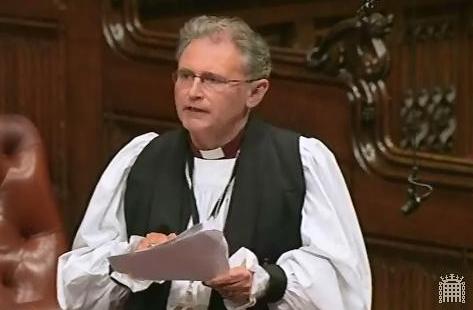
Bishop of Coventry – religious freedom “canary in the mine of human rights”

“Freedom of belief, including the freedom to change one’s belief, is like a canary in the mine of human rights. Abuses of religious freedom are often an early indication that all is not well….Where religious freedom is abused, peace and security often become more elusive.”

On 24th July 2014, Crossbench Peer Lord Alton of Liverpool led a short debate in the House of Lords to take note of international compliance with Article 18 of the Universal Declaration of Human Rights concerning freedom of belief. The Bishop of Coventry, the Rt Revd Christopher Cocksworth, spoke in the debate. He spoke of the role of religious freedom as a marker for other freedoms, and the positive role religious freedom can play in strengthening democracy and countering radicalisation and terrorism. He also spoke of the responsibility held by religious institutions to speak together on the importance of religious freedom for all, and to model these freedoms themselves.

13.10 Bishop of CoventryThe Lord Bishop of Coventry: My Lords, like other Members of your Lordships’ House, I am grateful to the noble Lord, Lord Alton, for securing this debate and pay tribute to his great efforts on this vital issue. I thank him for his reference to the 800th anniversary of the Magna Carta. I have a personal connection with the charter, as one of my predecessors, William, was among the reverend fathers who advised the King to enshrine its principles of justice and freedom, including freedoms of religion. Magna Carta, despite our own failings—to which reference has been made—to live up to its logic, remains the seed of a tree of which Article 18 of the Universal Declaration of Human Rights is part, and under the cover of which all the peoples of the world should be allowed to stand. Continue reading “Bishop of Coventry – religious freedom “canary in the mine of human rights””

Bishop of Coventry asks Government about asylum for Ugandan LGBT people

On 23rd July 2014, Lord Lexden asked Her Majesty’s Government what action they propose to take over the abuse of the human rights of LGBT people in Uganda as a result of the passing of the Anti-Homosexuality Act there. The Bishop of Coventry, the Rt Revd Christopher Cocksworth, asked a supplementary question:

13.10 Bishop of CoventryThe Lord Bishop of Coventry: My Lords, I apologise to the Minister for my enthusiasm. I have not asked a question in this House before so I wanted to get on with it. The Minister will be aware that the most reverend Primates the Archbishop of Canterbury and the Archbishop of York wrote to the President of Uganda in January to reiterate a statement made by all the Primates of the Anglican Communion, in which they said:

“The victimisation or diminishment of human beings whose affections happen to be ordered towards people of the same sex is anathema to us”.

In that spirit, do the Government intend to provide asylum to those who are fleeing the worrying consequences of this law which enshrines such diminishment?

Continue reading “Bishop of Coventry asks Government about asylum for Ugandan LGBT people”

Bishop of Peterborough highlights human rights abuses in North Korea

“There is great evil in the North Korean regime, which the civilised world cannot simply ignore…not to do anything about evil on this scale is to collude with it” – Bishop of Peterborough, 23/7/14

14.02 PeterboroughOn 23 July 2014 Lord Alton of Liverpool tabled a debate to ask Her Majesty’s Government ‘what was their response to the work of the United Nations Commission of Inquiry on Human Rights in the Democratic People’s Republic of Korea’.

The Bishop of Peterborough, the Rt Rev Donald Allister, spoke about the importance of keeping diplomatic channels open, the situation of  the Christian population in North Korea and the need to keep up pressure over human rights abuses. Drawing on his experiences of visiting South Korea, he spoke about the growth of Christianity there and the Anglican Church’s initiative, TOPIK—Towards Peace in Korea. Continue reading “Bishop of Peterborough highlights human rights abuses in North Korea”

Bishop of Coventry responds to statement on MH17 and Gaza

On 21st July 2014, a Government statement on the Ukraine (Shooting Down of MH17) and Gaza was repeated in the House of Lords by the Leader of the House, Baroness Stowell of Beeston. The Bishop of Coventry, the Rt Revd Christopher Cocksworth, asked a supplementary question.

13.10 Bishop of CoventryThe Lord Bishop of Coventry: My Lords, perhaps I may return us to the tragic event of the downing of flight MH17 to join others in expressing deep and profound condolences to the families, friends and colleagues of those who died. In particular, I express the deep sympathies of those of us who spend quite a lot of our time caring for those who are bereaved and, in so doing, I pay tribute to the Protestant, Anglican, Old Catholic and Roman Catholic ministers who have been trying to care for the stricken families at Schiphol Airport. They have a very demanding task. Continue reading “Bishop of Coventry responds to statement on MH17 and Gaza”

Church of England gives evidence to Modern Slavery Bill Committee

On 21st July 2014, the Church of England’s Foreign Policy Adviser, Dr Charles Reed, gave evidence to the Public Bill Committee for the Government’s Modern Slavery Bill. The transcript of the evidence session, at which Dr Reed and Cecilia Taylor-Camara (Head of the Bishops Conference Office for Migration Policy, Catholic Bishops for England and Wales) gave evidence, is reproduced in full below.

Dr Charles Reed, Foreign Policy Adviser, Church of England

Q 24 The Chair:  For this session we have until 4.45 pm. Will the witnesses please introduce themselves for the record?

Cecilia Taylor-Camara: I am Cecilia Taylor-Camara, senior policy adviser to the Catholic Bishops Conference of England and Wales.

The Chair:  I ask the witnesses to speak up a little. This is rather a large room and the sound is not brilliant, so please shout if necessary.

Dr Reed: I am Charles Reed, international policy adviser for the Church of England.  Continue reading “Church of England gives evidence to Modern Slavery Bill Committee”

Bishop of Carlisle urges engagement with Indian Government on violence against women

On 17th July 2014, Lord Harries of Pentregarth asked Her Majesty’s Government what is their assessment of the new Government of India and the challenge presented by poverty in that country. The Bishop of Carlisle, the Rt Revd James Newcome, asked a supplementary question.

14.06.09 Bishop of CarlisleThe Lord Bishop of Carlisle: My Lords, does the Minister agree that while the gender gap in employment and political participation is narrowing in India, there is still much that needs to be done by the Government for the health and safety of girls and women? If that is the case, can the Minister assure us that this matter will be given the attention it deserves at the Girl Summit being hosted by the UK Government next week?

Baroness Northover: The Girl Summit is extremely important. The right reverend Prelate is right about the gender gap in India, but I also notice that in the budget of last week money was put into trying to ensure that girls attend and are safe in school. I have myself seen a major programme which puts money into the hands of families of girls to try to ensure that they stay in school and have the incentives to be there.

(via Parliament.uk)

Bishop of Carlisle calls for Government action to tackle religious persecution in Republic of Sudan

“…the local Christian diocese has to shoulder most of the burden of caring for people who are in desperate need, and of attempting to feed them when its own resources are pitifully small. Have Her Majesty’s Government given any consideration to providing aid, and so helping to meet people’s basic human rights to food and drink, through the church in that part of Sudan? Heroic efforts are being made to alleviate desperate need, but funding is urgently required” – Bishop of Carlisle, 14.7.14

CarlisleOn 14th July 2014, Baroness Cox led a short debate in the House of Lords to ask Her Majesty’s Government what is their assessment of human rights in the Republic of Sudan. The Bishop of Carlisle, the Rt Revd James Newcome, took part in the debate. He spoke about the dire humanitarian situation in the country and the increasing role being played by the church; and also highlighted a number of instances of persecution on the grounds of religious beliefs, urging the Government to put pressure on the Republic of Sudan to respect and promote Article 18 of the UN Declaration of Human Rights.

The Lord Bishop of Carlisle: My Lords, I, too, am most grateful to the noble Baroness, Lady Cox. Unlike her, I cannot claim to be an expert on Sudan, but some of my colleagues who would normally speak on this issue have been unavoidably detained today in another debate of some importance to the church at the General Synod in York. I am very grateful for this opportunity to contribute to this debate because the human rights issues it raises are of such enormous significance, not only for the individuals directly concerned but for the way in which we direct our foreign aid and conduct our foreign policy. Continue reading “Bishop of Carlisle calls for Government action to tackle religious persecution in Republic of Sudan”

Bishop of Coventry asks questions on democratic reform in Egypt

On 10th July 2014, the Bishop of Coventry, the Rt Revd Christopher Cocksworth, received answers to two written questions on elections and democratic reform in Egypt.

13.10 Bishop of CoventryThe Lord Bishop of Coventry: To ask Her Majesty’s Government what assessment they have made of the preliminary assessment of the European Union’s election observation mission to Egypt on 29 May, which claimed that the presidential election in Egypt was administered in an environment that fell short of the principles of the new constitution.

The Senior Minister of State, Department for Communities and Local Government & Foreign and Commonwealth Office (Baroness Warsi): The European Union election observation mission to Egypt issued a preliminary statement on 29 May. Their headline assessment was “Presidential elections administered in line with the law, in an environment falling short of constitutional principles”. We followed the presidential election closely and staff from our Cairo Embassy took part in the EU’s Electoral Observation Mission. The EU Observation Mission will issue its full report in due course. Continue reading “Bishop of Coventry asks questions on democratic reform in Egypt”

Bishop of St Albans asks Government what support they are giving to Churches in South Sudan

On 8th July 2014, Labour Peer Baroness Kinnock of Holyhead asked Her Majesty’s Government what assessment they have made of the concerns expressed by the Disasters Emergency Committee over the prospect of famine in South Sudan. The Bishop of St Albans, the Rt Revd Alan Smith asked a supplementary question.

Bishop of St AlbansThe Lord Bishop of St Albans: My Lords, the situation is dire. As well as the 4 million people in need of humanitarian aid, more than 10,000 people have already been killed and 1.4 million people have been displaced. When we are facing such terrible problems it is important not to underestimate the role played by various agencies already on the ground, including many Anglican and ecumenical agencies working with the Anglican Alliance. Indeed, Archbishop Daniel Deng has been a leader in the efforts to bring peace. How can Her Majesty’s Government support the churches working on the ground in their humanitarian and peace efforts and in delivering aid?

Baroness Northover: I too pay tribute to those who are working in these extremely difficult circumstances. The right reverend Prelate will know that the United Kingdom is a leading donor. We are meeting about 7.5% of the total appeal at the moment and working to support all the agencies that are managing to get in. We do not underestimate the difficulties.

(via Parliament.uk)