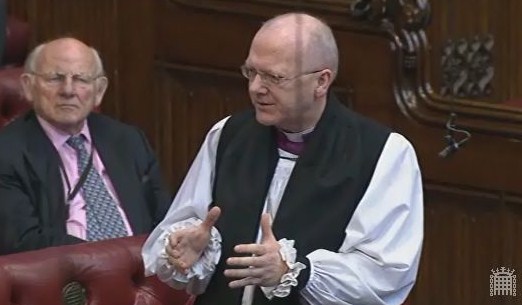
Bishop of Leicester calls for greater access to renewable heating technologies for those most in need

On 29th January 2015, The Earl of Courtown asked Her Majesty’s Government what they are doing to ensure that the benefits of lower oil prices are passed on to consumers, particularly in rural areas. The Bishop of Leicester, the Rt Revd Tim Stevens, asked a supplementary question:

14.04.01 Bishop of Leicester
The Lord Bishop of Leicester: My Lords, will the Minister tell us what Her Majesty’s Government are doing to ensure that those on low incomes and living in the coldest homes are able to benefit from renewable heating technologies?
The Parliamentary Under-Secretary of State, Department of Energy and Climate Change (Baroness Verma): I am grateful to the right reverend Prelate for his question, because this Government have, through many measures, not only tried to respond to people living in very inefficient homes in urban areas, but also looked at how to reach out to people who are often off grid and help support them through the renewable heat incentive and other measures. I am very happy to write to the right reverend Prelate about a number of measures undertaken by this Government.

Bishop of St Albans asks Government about fuel costs and pre-payment meters

On 23rd October the Bishop of St Albans, Rt Rev Alan Smith, received a written answer to a question about addressing the higher fuel costs imposed by pre-payment meters.

Bishop of St AlbansAsked by The Lord Bishop of St Albans

To ask Her Majesty’s Government what were the outcomes of the round-table discussions convened by Ofgem over the summer with suppliers, consumer representatives, parliamentarians and the Government, particularly in relation to addressing the higher fuel costs imposed by pre-payment meters.[HL2157] Continue reading “Bishop of St Albans asks Government about fuel costs and pre-payment meters”

Bishop of St Albans: Energy Meters (Written Answers)

On 18th August 2014, the Bishop of St Albans, the Rt Revd Alan Smith, received answers to two written question on energy meters for lower income households.

Bishop of St AlbansThe Lord Bishop of St Albans: To ask Her Majesty’s Government what assessment they have made of the impact of the use of prepayment meters on the ability of lower income households to pay their energy bills.

Baroness Northover: Since 2010, all major suppliers have voluntarily equalised tariffs between prepayment customers and standard credit customers but the price differential between customers using pre-payment meters (PPM) and those paying by direct debit can be more than £100 for a dual-fuel customer.

Whilst paying by PPM is more common among fuel poor than non-fuel poor households, a majority of fuel poor customer pay by other payment methods.

Of households who were fuel poor in England in 2012, around 27% paid for their electricity and 22% paid for their gas through PPM. Continue reading “Bishop of St Albans: Energy Meters (Written Answers)”

Bishop of St Albans asks Government for update on ‘smart meter’ policy and efforts to tackle fuel poverty

On 17th July 2014, Lord Ezra asked Her Majesty’s Government whether, in the light of the recently published statistical report on fuel poverty indicating a rising trend in 2014, they intend to expedite the announcement of their policy for dealing with the matter. The Bishop of St Albans, the Rt Revd Alan Smith, asked a supplementary question.

Bishop of St AlbansThe Lord Bishop of St Albans: My Lords, those who keep a close eye on this area point out that issues of fuel poverty depend on which groups you look at. Clearly, in some groups this is a growing area. Indeed, they assert that there is a connection between the increase in fuel poverty of certain groups and the increase in the number of pre-paid meters that have been installed, partly because it is believed that they are the most expensive way to pay for fuel. In the light of that, can my noble friend tell us what consideration Her Majesty’s Government have given to promoting the five principles on the use of pre-paid meters which were agreed between Consumer Focus and the big six energy companies back in March 2011, to ensure consistency in their installation and use?

Baroness Verma: I am extremely grateful to the right reverend Prelate for his question, which enables me to reassure him and the House that we have looked very seriously at the pre-paid meter issue. We think that people on very low incomes must be among the greater beneficiaries of this policy, which is why we will make sure that through smart meters they are able to top up their meter as if they are topping up a mobile phone, so they have no chance of being cut off when they need their electricity the most.

(via Parliament.uk)