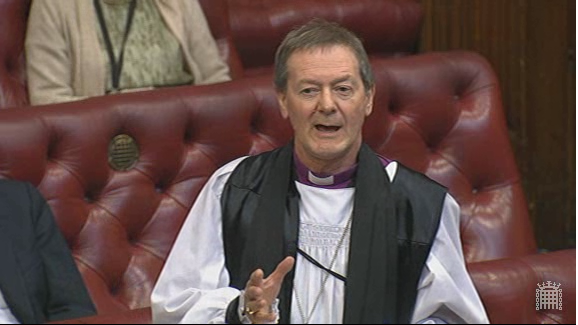
Religious Freedom- Written Questions from Bishop of Coventry

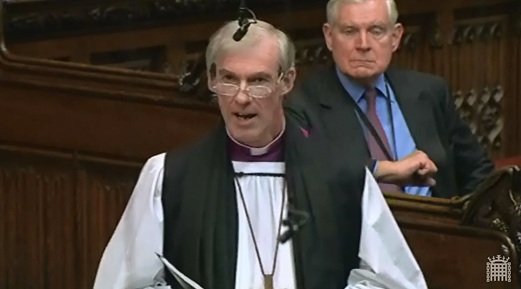
13.10 Bishop of CoventryOn 10th June 2014 the Bishop of Coventry, Rt Revd Dr Christopher Cocksworth, received a response to  three written questions on religious freedom:

Continue reading “Religious Freedom- Written Questions from Bishop of Coventry”

Iran – Written Question

On 13th May 2014, the Rt Revd Christopher Cocksworth, Bishop of Coventry, received an answer to a written question on Iran.

13.10 Bishop of CoventryThe Lord Bishop of Coventry: To ask Her Majesty’s Government whether the question of human rights and freedom of religion and belief was amongst the range of international issues discussed by the Foreign Office’s Political Director, Sir Simon Gass, when he met senior Iranian officials whilst visiting Iran in April.

Baroness Warsi: Human rights were not amongst the issues discussed by Sir Simon Gass on his visit to Iran in April: his interlocutors did not have responsibilities in this area. However, the UK’s non-resident Chargé d’Affaires discussed human rights with a range of Iranian government officials during his visit to Iran on 12 March 2014. He raised the use of the death penalty, freedom of religion and the workings of the criminal justice system. Prior to that, the Secretary of State for Foreign and Commonwealth Affairs, my Rt. Hon. Friend the Member for Richmond (Yorks) (Mr Hague), raised Iran’s human rights records with Iranian foreign minister Zarif at the UN General Assembly on 23 September 2013.

(via Parliament.uk)

Prisons and the problem of indeterminate sentences – speech by Bishop of Lichfield

“I spent some time recently with an intelligent and engaging Somali prisoner …This man was given an 18-month tariff, but last Christmas was his ninth in prison. What an injustice, and what a huge expense.” – Bishop of Lichfield

On 27th March 2014 the Bishop of Lichfield took part in a debate tabled by Lord Wigley, ‘to ask Her Majesty’s Government what steps they are taking to address the position of individuals serving indeterminate sentences on public protection grounds who have already passed their tariff’.

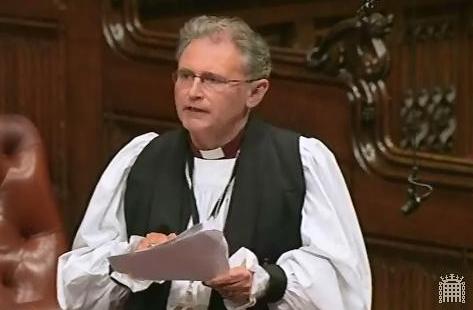
The Lord Bishop of Lichfield: My Lords, I am most grateful to the noble Lord, Lord Wigley, for his initiative and to the noble Lord, Lord Dholakia, and the noble and learned Lord, Lord Phillips, for their very helpful introductions.14.03.27 Bishop of Lichfield

As a general principle, it is accepted in this country that people should be sent to prison because they have been convicted of an offence rather than because of the risk that they will offend. Indeterminate tariffs are even now available for the most serious offences, in the form of life sentences, and extended sentences now provide a way to manage and contain risk in relation to those convicted of serious violent and sexual offences which do not call for a life sentence. Continue reading “Prisons and the problem of indeterminate sentences – speech by Bishop of Lichfield”

Iran: Human Rights

Written Question, answered on  20th March, 2014:

14.03 Bishop of St Albans

The Lord Bishop of St Albans:

To ask Her Majesty’s Government what representations they have made to the government of Iran regarding that country’s human rights record.[HL6021]

The Senior Minister of State, Department for Communities and Local Government & Foreign and Commonwealth Office (Baroness Warsi) (Con): The UK’s non-resident Chargé d’Affaires discussed human rights with a range of Iranian government officials during his most recent visit to Iran on 12 March 2014. He raised the use of the death penalty, freedom of religion and the workings of the criminal justice system. Prior to that, the Secretary of State for Foreign and Commonwealth Affairs, my Rt. Hon. Friend the Member for Richmond (Yorks) (Mr Hague), raised Iran’s human rights records with Iranian foreign minister Zarif at the UN General Assembly on 23 September 2013.

(via Parliament.uk)

Iran: Written Question from Bishop of St Albans

On March 19th 2014 the Bishop of St Albans, Rt Rev Dr Alan Smith, received an answer to a written question about human rights abuses in Iran.

14.03 Bishop of St AlbansThe Lord Bishop of St Albans: To ask Her Majesty’s Government what is their assessment of the human rights situation in Iran following the election of President Rouhani.

The Senior Minister of State, Department for Communities and Local Government & Foreign and Commonwealth Office (Baroness Warsi): The human rights situation in Iran remains dire. We are particularly concerned by reports that the rate of executions has increased in 2014. We urge Iran to take concrete action to improve its human rights record. However, President Rouhani’s government has taken some positive steps on human rights, including the release of a number of political prisoners in September 2013.

(Via Parliament.uk)

Bishop of Wakefield raises concerns about Islamophobia in Georgia

The Lord Bishop of Wakefield asked Her Majesty’s Government: what representations they are making to the Government of Georgia regarding Islamophobia in that country; and what steps they are taking to ensure freedom of religion and the rights of minority groups there.

Baroness Warsi: My Lords, the UK raises human rights issues on a regular basis with the Georgian Government, both bilaterally and through multilateral institutions such as the EU, the OSCE and the Council of Europe. We have not made any recent representations regarding Islamophobia, but we continue to follow minority rights closely, including through our embassy’s work in Tbilisi and its regional travel. We fund a local NGO to maintain an inter-religion working group, which involves a variety of faith groups, including Muslims.

The Lord Bishop of Wakefield: My Lords, last year, I was fortunate to spend a couple of nights with a Muslim family in Batumi, and the next morning I met the president of the semi-autonomous region there, Mr Archil Khabadze. I pressed the question to him of why there was only one mosque for something like 110,000 out of the 150,000 people, that being the number of Muslims in the city. He said that at that time they would take immediate steps to find more land made available for Muslims in that city. I said that I would be coming back in the next three months to open the mosque with other religious groups. Would Her Majesty’s Government please press the authorities to make sure that the local administration there is asked to fulfil the promise that they made; otherwise, these very open Muslims will soon become radicalised.

Baroness Warsi: The right reverend Prelate raises a really important issue. His Question prompted me to go away and do some research, and I was quite intrigued to find out that just over 10% of Georgia’s population are indeed Muslim—a much larger percentage than in our own communities. The right reverend Prelate will be aware that one of the challenges in Georgia is that the Muslim community is not particularly well engaged politically and therefore does not really put its head above the parapet. I have become aware of low-level discrimination and tensions towards the Muslim community there, but as Georgia moves towards closer EU integration part of its requirement is to fulfil its obligation to bring in anti-discrimination laws.

(via parliament.uk)

Bishop of Wakefield raises concerns about human rights abuses in Tanzanian mine

On 26th of November 2013, the Bishop of Wakefield, the Rt Revd Stephen Platten, asked Her Majesty’s Government what representations they have made to the government of Tanzania regarding allegations of human rights violations at the North Mara Mine.

Bishop of Wakefield Platten

The Lord Bishop of Wakefield: My Lords, I beg leave to ask the Question standing in my name on the Order Paper. In doing so, I declare an interest as the joint leader of the Wakefield-Tanzania Diocesan Link.

Lord Ahmad of Wimbledon (Con): My Lords, the UK’s high commissioner to Tanzania visited the North Mara mine in March 2013 to raise concerns directly about the alleged human rights violations with African Barrick Gold, the mine owner, and also discussed a range of issues with the local authorities. We are, of course, working closely with the Tanzanian Government on improving respect for human rights and also encouraging them to sign up to the voluntary principles on security and human rights in the extractive sector. Continue reading “Bishop of Wakefield raises concerns about human rights abuses in Tanzanian mine”

Bishops of Derby and Wakefield take part in debate about Human Rights

On 21st November 2013, the Bishop of Derby, the Rt Revd Alastair Redfern, and the Bishop of Wakefield, the Rt Revd Stephen Platten, took part in a debate on human rights, led by Lord Alton of Liverpool. The Bishop of Derby spoke about the role of women within society and religious institutions. He particularly focused on the objectification of women in magazines and the treatment of women in India. The Bishop of Wakefield spoke of the need for a greater engagement on the subject of the right to the freedom of religion, calling on the Government to develop a more positive approach towards religious freedom.

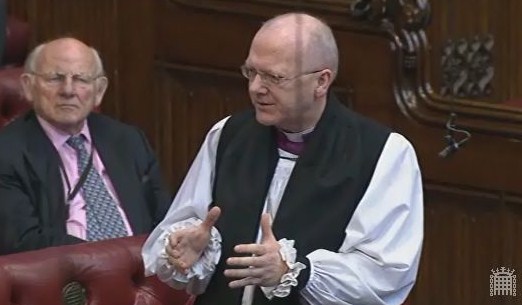
DerbyThe Lord Bishop of Derby: My Lords, I, too, congratulate the noble Lord, Lord Alton, on securing this debate, and I also associate myself with the remarks of the noble Lord, Lord Selkirk.

Many of the pictures painted are dramatic and challenging, and I invite the House to think a little about the context that we are in and how we might approach some of these huge issues. The Government have identified six key priority areas, including women and freedom of religion, and those are the two things that I will look at in particular. We are in a world where we have ideals and fall short of them, and need to negotiate between the two. Continue reading “Bishops of Derby and Wakefield take part in debate about Human Rights”

Bishop of Coventry receives answer to written question on Israel

On 31st October 2013, the Bishop of Coventry, the Rt Revd Christopher Cocksworth, received an answer to a written question on Israel. 

13.10 Bishop of CoventryThe Lord Bishop of Coventry: To ask Her Majesty’s Government, further to the Written Answer by Baroness Warsi on 10 October (WA 47), and in the light of the first progress report from UNICEF (14 October 2013) on the treatment of children in Israeli military detention, what representations have they made to the Government of Israel about the conformity of such practice with international standards.

The Senior Minister of State, Department for Communities and Local Government & Foreign and Commonwealth Office (Baroness Warsi): Ministers at the Foreign and Commonwealth Office, and our Ambassador to Tel Aviv, have spoken and written to both the Israeli Justice Minister and the Israeli Attorney General to make representations on the treatment of Palestinian child detainees and the need for Israel to abide by its obligations under international law. Most recently, our ambassador in Tel Aviv wrote again to the Israeli Justice Minister, Tzipi Livni, on 14 October and Embassy officials discussed the issue with the Israeli Ministry of Justice on 16 September.

I can assure the Most Reverend and Noble Lord Bishop that we will continue to press for further progress on this important subject.

(via Parliament.uk)

Bishop of Ripon and Leeds speaks during debate on UK-Iran relations

“I am not yet convinced that a change in Iran’s human rights agenda will come with the Rouhani presidency, because critical decisions continue to be made by the Supreme National Security Council. This remains populated by a cohort of people who spent much of their careers in the military and security services.”

On 24th October 2013, the Bishop of Ripon and Leeds, the Rt Revd John Packer, took part in a short debate led by Baroness Afshar to ask Her Majesty’s Government, in the light of the recent elections in Iran, what steps they are taking to facilitate closer commercial and educational ties with that country. The Bishop asked what the Government considered a normalisation of relations between Iran and the UK to look like. He also raised concerns about human rights abuses in Iran and the importance of the respect of religious freedom and noted the need for strengthening of relations between UK and Iranian Churches. 

R_LThe Lord Bishop of Ripon and Leeds: My Lords, I am very grateful to the noble Baroness, Lady Afshar, for initiating this debate and for introducing it so comprehensively. I am aware, through contacts, of Iranian students in Leeds and of some of the difficulties of which noble Lords have been speaking in terms of their education and the way that that has developed, and of the struggle to keep them at Leeds University.

Like others, I have been heartened by the change of political rhetoric following the elections in Iran, and share the high expectations that a more pragmatic stance from Tehran will see progress made on a range of issues, not least the nuclear issues. In view of the speed of recent diplomatic developments and the ambitious timetable set at this month’s talks in Geneva—the six to nine months to which a number of noble Lords have already referred—it would be helpful to have some idea from the Minister as to what she understands to be the end game. What would a normalisation of relations look like? What might be the trade-offs that each party might be required to make? That seems to be at the heart of the question that the noble Baroness has put before us today. Continue reading “Bishop of Ripon and Leeds speaks during debate on UK-Iran relations”