
On 13th July Lord Chidgey asked Her Majesty’s Government “what assessment they have made of the impact of (1) the COVID-19 pandemic, and (2) desert locusts, on food security in countries in east Africa, and in particular in (a) Sudan, and (b) South Sudan”. The Rt Revd Nick Holtam, Bishop of Salisbury asked a follow up question, focusing on overseas aid.

The Lord Bishop of Salisbury: With the economy of Sudan collapsing and inflation rocketing, the Anglican Archbishop of Khartoum said recently that people would rather die of Covid-19 than of hunger. In South Sudan the Anglican Archbishop of Juba said that mortality rates were already high and, in response to the virus, hygiene and social isolation are difficult—indeed, almost impossible. The diocese of Salisbury has a long-standing partnership with the Anglican churches in those countries and we have launched an emergency appeal this month for at least £50,000 for hygiene and food. What are the British Government doing to support the improvement of hygiene and food in those countries? What does the Minister think we are learning about the motivation for our giving aid to these countries?
Continue reading “Bishop of Salisbury asks Government about overseas aid for Sudan and South Sudan” The Lord Bishop of Peterborough: My Lords, I thank the Leader of the House for answering questions on this matter. On these Benches, we affirm the Government’s right to organise themselves as they think best for the common good. We look forward to greater integration between foreign and development policy and values, and we warmly commend the continued 0.7% commitment. I am grateful to have heard the noble Baroness’s assurance that the Government will remain committed to the OECD DAC rules—it would be lovely to have that repeated. Can we have another assurance that the Government will preserve the primary focus of UK aid as poverty reduction?
  The Lord Bishop of Durham: My Lords, thankfully, the virus appears to be spreading slowly in most African countries, with Lesotho declaring its first case only last week. However, the World Bank forecasts
  On 13th May, the Rt Revd Nick Baines, Bishop of Leeds, received a written answer from Lord Agnew of Oulton on the debt of developing countries.
 The Lord Bishop of St Albans: I thank the noble Baroness for her reply. It is perhaps appropriate that a Member on these Benches is raising issues about plagues of locusts, but a humanitarian crisis is unravelling in front of us. In some parts of Ethiopia, 90% of the crops have already gone and 20 million people face no food. Last Thursday, the UN said that we need $76 million now to begin to address the problems. What are Her Majesty’s Government doing to ensure immediate food aid if it is required and, in the longer term, that there is seed for next year’s crops so that people have security?
 On 25th September 2019 the House of Lords took note of the Government’s Spending Round 2019. The Bishop of Durham, Rt Revd Paul Butler, contributed to the debate:
 On 25th July 2019 the Bishop of St Albans asked the Government “what steps they are taking to help those areas affected by the latest outbreak of Ebola which has been declared a Public Health Emergency of International Concern by the World Health Organization”. He then asked a follow-up question:
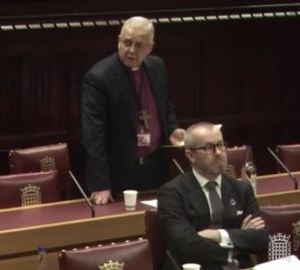 The Lord Bishop of Peterborough: My Lords, I am most grateful to the noble Lord, Lord McInnes, for raising this important Question. I draw attention to my non-financial interest as a vice-president of the Leprosy Mission. I hasten to add that, to the best of my knowledge, that excellent organisation has not been infected by the scourge of corruption.

You must be logged in to post a comment.