Bishop of Worcester “stigmatising Muslim communities not conducive to community cohesion”

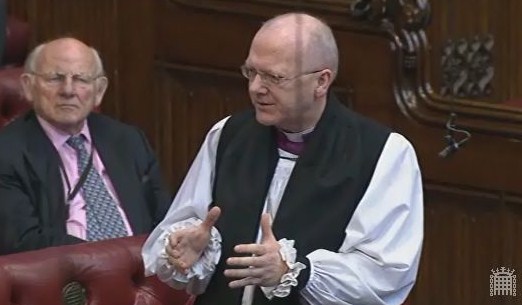
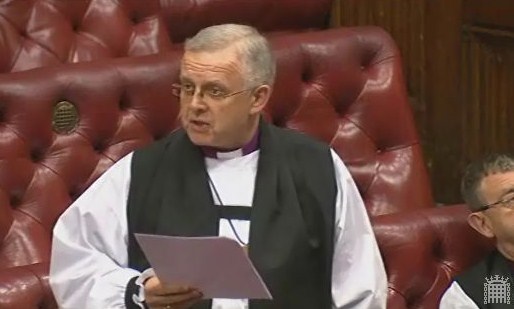
worcesterOn the 27th January 2016 Lord Pearson of Rannoch asked the Government “what assessment they have made of the risk that Christians could be recorded as having committed an anti-Muslim hate crime from April 2016 by preaching the divinity of Christ or by reading aloud sections of the Bible in public, such as 1 John, Chapter 4, verses 1 to 3.” The Rt Revd John Inge, Bishop of Worcester, asked a follow-up question criticising the phrasing of Lord Pearson’s question and highlighting the  contribution of religion to the enrichment of public life. The transcript in full is available below.

The Lord Bishop of Worcester: My Lords, does the Minister agree with me that Questions phrased in this manner are not conducive to building positive relations between faith communities, in particular with Muslim communities, as we are endeavouring to do in the church at a time when Muslims are feeling unfairly stigmatised? Does he further accept that Muslims, and people of all faiths, greatly enrich our society and make a significant contribution to the common good? Continue reading “Bishop of Worcester “stigmatising Muslim communities not conducive to community cohesion””
Bishop of Peterborough highlights importance of social cohesion in countering terrorism

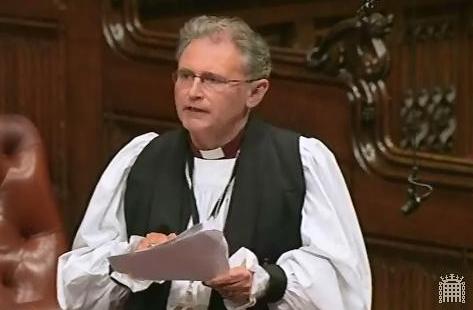
14.02 PeterboroughOn 21st December 2015 Lord Pearson of Rannoch asked Her Majesty’s Government “whether, as part of their antiterrorism strategy, they will encourage leaders of the United Kingdom’s Muslim communities to identify, confront and expose their violent co-religionists.” The Bishop of Peterborough, Rt Revd Donald Allister, asked a follow up question: Continue reading “Bishop of Peterborough highlights importance of social cohesion in countering terrorism”

Bishop of St Albans asks about preventing violence against Muslims and raises negative media coverage

On 1st December 2015 the Bishop of St Albans, Rt Revd Alan Smith, asked a question in the House of Lords about violence against Muslims and other minority groups following the terrorist attacks in Paris. He followed up with a question about negative media coverage of British Muslims.

StAlbans171115The Lord Bishop of St Albans: To ask Her Majesty’s Government what steps they will take to prevent violence against Muslims and other minority groups following the attacks in Paris on 13 November.


The Parliamentary Under-Secretary of State, Department for Transport and Home Office (Lord Ahmad of Wimbledon) (Con): My Lords, the Government take the safety of all our citizens and communities very seriously; indeed, this is at the core of counterextremism strategy. Following the tragic events in Paris, we are working to take all necessary action: police have increased their presence at important locations and events; advice has been given to places of worship; and we are working with organisations such as Tell MAMA to confront anti-Muslim hatred. The Prime Minister has also announced new funding for the security of mosques.


The Lord Bishop of St Albans: I thank the Minister for his reply and am grateful for all that Her Majesty’s Government are doing already. Perhaps I may focus on one particular area. Since those terrible events on 13 November in Paris, some of our national newspapers have run some very disturbing stories about the treatment of British Muslims and minority groups, such as asylum seekers, here. Does the Minister agree that, in modern, democratic Britain, there is no place for misleading headlines and scurrilous cartoons designed to demonise minority groups? Many of us on these Benches have been involved in face-to-face meetings during the past three weeks with members of the Muslim community, who are deeply dismayed and angry at what has happened. What are Her Majesty’s Government doing to counter such unhelpful stories and narratives and to strengthen community relations between minorities and the wider British public?

Continue reading “Bishop of St Albans asks about preventing violence against Muslims and raises negative media coverage”

Bishop of Sheffield asks about the Government’s counter extremism strategy

On the 5th November Lord Pearson of Rannoch asked Her Majesty’s Government “whether, as part of their counter-extremism strategy, they will encourage a national debate about the nature of Islam, including whether the Muslim tenet of abrogation remains valid today.” The Bishop of Sheffield, Rt Revd Steven Croft, asked if the Government planned for education and faith dialogue to form part of the strategy. Lord Ahmad responded for the Government highlighting the work of the Near Neighbours scheme.

14.03.27 Bishop of SheffieldThe Lord Bishop of Sheffield: My Lords, I strongly agree with the question raised by the previous speaker and the Minister’s reply. Does the Minister agree that encouraging education and dialogue across a broad front should be a key part of our strategy, including: encouraging relationships not only between the faith communities but between all the faith communities and civil society; encouraging agencies such as the Islamic Society of Britain—which does such powerful good work in education in schools and other areas; raising the levels of religious literacy at all levels; further analysis of why people of faith do, in a minority of cases, resort to violence; and building on the excellent work of the noble Lord, Lord Sacks, in his recent book Not in God’s Name? Continue reading “Bishop of Sheffield asks about the Government’s counter extremism strategy”

Bishop of Coventry raises religious freedom in Saudi Arabia

On 30th October 2015 the Bishop of Coventry, Rt Revd Christopher Cocksowrth, received a written answer to a question on religious freedom in Saudi Arabia.


Bp Coventry May 2015The Lord Bishop of Coventry: To ask Her Majesty’s Government what assessment they have made of steps taken by Saudi Arabia to revise textbooks, curricula, and teaching methods to remove
content disparaging religions other than Islam. Continue reading “Bishop of Coventry raises religious freedom in Saudi Arabia”

Bishop of St Albans asks Government about plans to investigate Sharia law in Britain

On 24th September 2015 the Bishop of St Albans, Rt Revd Alan Smith, received a written answer to a question of Government about the proposed independent investigation of Sharia law in Britain.


Bishop of St AlbansThe Lord Bishop of St Albans: To ask Her Majesty’s Government when the undertaking by the Home Secretary, made in a speech on 23 March, to set up an independent investigation into the application of Shari’a law in Britain will be fulfilled; and when that investigation is expected to report.

Continue reading “Bishop of St Albans asks Government about plans to investigate Sharia law in Britain”

Bishop of Birmingham in Lords Debate on Religion and Belief in Public Life

On 27th November 2014 the House of Lords debated a motion from the Crossbench Peer and former Bishop of Oxford, Lord Harries of Pentregarth, on ‘the role of religion and belief in British public life’. The Bishop of Birmingham, Rt Rev David Urquhart spoke in the debate:

The Lord Bishop of Birmingham: My Lords, I am grateful to my colleague, the noble and right reverend 01.04.14 Bishop of BirminghamLord, Lord Harries, for shaping this debate and for the remarks just offered by the noble Baroness. It may be a great surprise to many of our fellow citizens that public religious figures should be asked to play a part at all in 21st century society. However, the least surprised in the city of Birmingham are my interfaith colleagues. They expect the leaders and members at a local parish level and at a national level in what they regard as the indigenous national religion to play a full part in society and to articulate the needs, values and beliefs of those who have faith on things that are a matter of importance to the whole of society, whether they are faithful or not. Continue reading “Bishop of Birmingham in Lords Debate on Religion and Belief in Public Life”

Bishop of Coventry on ISIS and UK Military Action in Iraq

“Dietrich Bonhoeffer said that when a madman came down the street swinging an axe it was our duty to not just apply plasters to the injured but to stop the madman with whatever means were expedient” – Bishop of Coventry, 26/9/14

Parliament was recalled on Friday 26th September 2014 in order to debate UK involvement in military action against ISIS/ISIL, following a request for assistance from the Government of Iraq. In the debate that took place in the House of Lords the Bishop of Coventry, Rt Rev Christopher Cocksworth, gave the following speech:

13.10 Bishop of Coventry

The Lord Bishop of Coventry: My Lords, the noble and learned Lord, Lord Howe of Aberavon, referred your Lordships’ House a few moments ago to the parallel in the 1930s and 1940s in Europe. I should like to draw on one figure from that period which I found helpful in thinking about the matters before us. Dietrich Bonhoeffer said that when a madman came down the street swinging an axe it was our duty to not just apply plasters to the injured but to stop the madman with whatever means were expedient.

The Government are seeking to join with others to stop the madman swinging the axe of cruelty, and we agree that stopped he must be. The question is: what are the expedient means for doing so? Continue reading “Bishop of Coventry on ISIS and UK Military Action in Iraq”

Bishop of Derby on ISIS and UK Military Action in Iraq

Besides the current military need, we have to engage with the debate about what a good society is from the ingredients of politics and religion. We have to contribute to that together if we are to stem this tide and create a safer world to live in – Bishop of Derby, 26/9/14

Parliament was recalled on Friday 26th September 2014 in order to debate UK involvement in military action against ISIS/ISIL, following a request for assistance from the Government of Iraq. In the debate that took place in the House of Lords the Bishop of Derby, Rt Rev Alastair Redfern, gave the following speech:

Bishop of DerbyMy Lords, I invite us to think for a moment about the role of government in the wider strategy. A number of noble Lords have pointed out that this is not just a military issue; it is about religious and political matters. We might just note that some of us in a liberal society are in danger of separating religious and political issues. These are mixed up, but we need to look at them together. Continue reading “Bishop of Derby on ISIS and UK Military Action in Iraq”

Archbishop Speaks on ISIS and UK Military Action in Iraq

“We must demonstrate that there is a positive vision far greater and more compelling than the evil of ISIL and its global clones. Such a vision offers us and the world hope and assurance of success in this struggle, not the endless threat of darkness” – Archbishop of Canterbury, 26/9/14

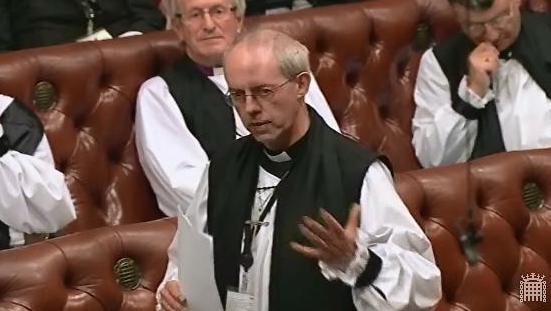
Parliament was recalled on Friday 26th September 2014 in order to debate UK involvement in military action against ISIS/ISIL, in response to requests from the Government of Iraq. In the debate that took place in the House of Lords the Archbishop of Cantery, Most Rev Justin Welby, gave the following speech:

Archbishop of Canterbury

My Lords, the danger of this debate is that we speak only of Iraq and Syria, ISIL, and armed force. ISIL and its dreadful barbarity are only one example of a global phenomenon, as the noble Baroness the Leader of the House mentioned. Continue reading “Archbishop Speaks on ISIS and UK Military Action in Iraq”