
Archbishop of Canterbury speaks during debate on use of chemical weapons in Syria

“In civil wars, those who are internal to the civil conflict fight for their lives, necessarily. Those who are external have a responsibility, if they get involved at all, to fight for the outcome. That outcome must be one that improves the chances of long-term peace and reconciliation.”

On 29th August 2013, the House of Lords was recalled to take note and debate the use of chemical weapons in Syria. The Archbishop of Canterbury, the Most Revd and Rt Hon. Justin Welby, spoke during the debate. He urged that all intermediate steps before opening fire should be taken and expressed concern that intervention from abroad would declare open season on Christian communities in the country and wider region, which have already been devastated. He argued that such a consequence needed to be balanced against the consequences of inaction and that intervention would have  to be effective in preventing any further use or promotion of chemical weapons and make it more possible for Syria and the Middle East to be places without millions of refugees.
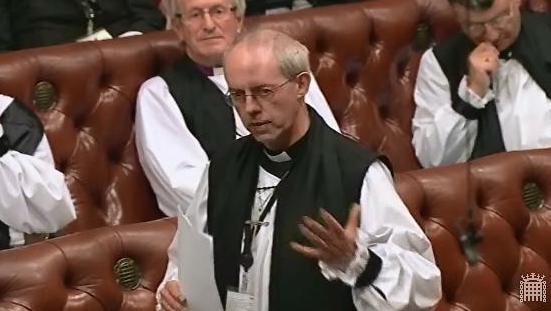
Archbishop of CanterburyThe Archbishop of Canterbury: My Lords, I welcome very much the opportunity to speak later in this debate because of the extraordinary quality of many of the contributions that have been made and how much one can learn by listening to them. Like many noble Lords I have some experience in the region, partly from this role that I have and from recent visits and contact with many faith leaders of all three Abrahamic faiths, and through 10 years of, from time to time, working on reconciliation projects.

I do not intend to repeat the powerful points that have been made on international law, which is itself based on the Christian theory of just war. That has been said very eloquently. However, I want to pick up a couple of points. First, it has been said, quite rightly, that there is as much risk in inaction as there is in action. In a conflict in another part of the world—a civil conflict in which I was mediating some years ago—a general said to me, “We have to learn that there are intermediate steps between being in barracks and opening fire”. The reality is that, until we are sure that all those intermediate steps have been pursued, just war theory says that the step of opening fire is one that must only be taken when there is no possible alternative whatever under any circumstances. As the noble Lord, Lord Alli, just said very clearly and very eloquently, the consequences are totally out of our hands once it has started. Continue reading “Archbishop of Canterbury speaks during debate on use of chemical weapons in Syria”

Bishop of Wakefield – Lebanon and Syria (Written Answers)

On 24th July 2013, the Bishop of Wakefield, the Rt Revd Stephen Platten, received written answers to questions on Lebanon and Syria.

Bishop of Wakefield PlattenThe Lord Bishop of Wakefield: To ask Her Majesty’s Government what steps they are taking to build the resilience of the Lebanese army to respond to the security situation on its border with Syria.

The Senior Minister of State, Department for Communities and Local Government & Foreign and Commonwealth Office (Baroness Warsi): The UK is providing an additional £10 million of assistance to support the Lebanese Armed Forces (LAF) in their mission to secure Lebanon’s border with Syria. The package of non-lethal assistance includes mobility, communications, protection and observation equipment and associated training. The package was discussed by the then Chief of Defence Staff, General Sir David Richards, with the LAF commander during his visit to Lebanon on 4-5 July.

(via Parliament.uk)

** Continue reading “Bishop of Wakefield – Lebanon and Syria (Written Answers)”

Bishop of Derby – Written Answers

On 24th July 2013 the Bishop of Derby, the Rt Revd Alastair Redfern, received written answers to questions on Egypt and the Gulf States.

Bishop of DerbyThe Lord Bishop of Derby: To ask Her Majesty’s Government what assessment they have made of the prospects for political reconciliation in Egypt.

The Senior Minister of State, Department for Communities and Local Government & Foreign and Commonwealth Office (Baroness Warsi):We are in contact with all sides in Egypt, and have urged all to resolve their differences through dialogue, and avoid violence. The Secretary of State for Foreign and Commonwealth Affairs, my right hon. Friend the Member for Richmond (Yorks) (Mr Hague), was in regular contact with former Foreign Minister Amr, most recently on 8 July to discuss the situation in Egypt. We have requested contact with the new interim government and continue to be in contact with the army and Muslim Brotherhood. It is important that Egypt makes an early return to democratic processes, including free and fair elections, and that those processes are inclusive.

(via Parliament.uk)

Continue reading “Bishop of Derby – Written Answers”

Bishop of Birmingham raises concerns about community instability in Lebanon

On 23rd July 2013, Lord Risby asked Her Majesty’s Government what assessment they have made of the current social and economic situation in Lebanon. The Bishop of Birmingham, the Rt Revd David Urquhart, asked a supplementary question on what is being done to ease tensions between communities affected by the movement of refugees:

01.04.14 Bishop of BirminghamThe Lord Bishop of Birmingham: My Lords, Lebanese communities have shown incredible generosity in coping with refugees but the flow is reaching breaking point. Will the Minister accept that, in addition to providing support for refugees, more work should be done to alleviate tension between communities and to strengthen the resilience of host families?

Baroness Warsi: I completely agree with the right reverend Prelate that there has been a huge show of generosity and a real welcome from the Lebanese people. Noble Lords may be aware that the population of Lebanon is about 4 million. The number of registered refugees is 600,000 but it is estimated that the real number could be a lot higher—somewhere around 1 million. That is the equivalent of the whole of the Romanian population arriving on British shores over a very short period. A huge amount of pressure has been put on local resources, which has of course caused tensions. It is for that reason that we are supporting not just the refugee communities but the host communities as well.

(via Parliament.uk)