
Bishop of Norwich asks Government to support initiatives to bring together Christian and Muslim communities

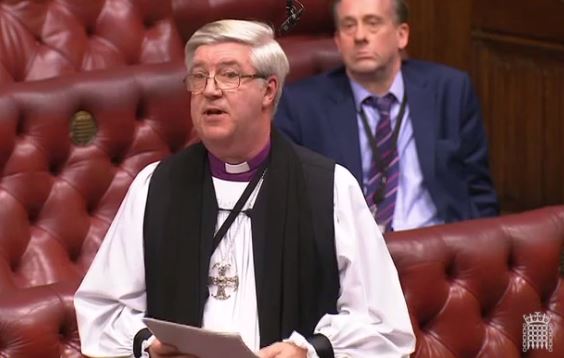
On 17th October 2017 Baroness Warsi asked Her Majesty’s Government “whether they have a definition of Islamophobia; and, if so, what it is.” The Bishop of Norwich, Rt Revd Graham James, asked a follow up question:

The Lord Bishop of Norwich: My Lords, does the Minister agree that, whatever our definition of Islamophobia, one of the most effective ways of preventing it is by good relationships between the different faith communities, exemplified by the new church/mosque twinning programme promoted by the Christian Muslim Forum? That is already established in Oldham, Rochdale, Walsall and Wolverhampton. What can the Government do to encourage those local community initiatives, which can transform the way in which a local community views Muslims in their midst? Continue reading “Bishop of Norwich asks Government to support initiatives to bring together Christian and Muslim communities”
Bishop of Norwich raises need for integrated health and social care service

On 16th October 2017 Lord Dubs asked Her Majesty’s Government “what is their estimate of the number of people currently in hospital waiting to be discharged to care homes when places become available.” The Bishop of Norwich, Rt Revd Graham James, asked a follow up question:

The Lord Bishop of Norwich: My Lords, since the difficulties of hospital patients awaiting discharge to care homes is but one of a number of bottlenecks in the present system, does that not suggest that we need a fully integrated national health and social care service and that, until we achieve such integration, these problems are bound to recur—as the National Audit Office report in February this year so clearly and vividly illustrated? Continue reading “Bishop of Norwich raises need for integrated health and social care service”

Votes: Armed Forces (Flexible Working) Bill

On 11th October 2017 the House of Lords voted on an amendment to the Government’s Armed Forces (Flexible Working) Bill [HL]. Two bishops took part in the vote. Continue reading “Votes: Armed Forces (Flexible Working) Bill”

Bishop of Norwich says Lords reform should enhance civil society voice, not that of established political parties

On 3rd February 2017 Peers debated the House of Lords Reform Bill, a private member’s bill from Green Party Peer Baroness Jones of Moulsecoomb. The Bishop of Norwich, Rt Revd Graham James, spoke in the debate. He set out why the central objectives of the Bill – to elect members of the Lords and create a new category of non-voting Peer – were flawed. 

norwich121016bThe Lord Bishop of Norwich: My Lords, I wondered whether to speak in this debate, but since the Bill makes specific reference to the Lords Spiritual, it seemed important to give a view from these Benches. I am grateful to the noble Baroness, Lady Jones, for recognising the continuing place for Bishops, even if an altered capacity—I will comment on Clause 12 in a little more detail later on.

We on these Benches are on record as being in favour of reform of your Lordships’ House provided it enhances our existing role and function. There are two aspects of the Bill on which I wish to focus and which have already been commented on. The first is the principle of elections as against appointment; the second is the concept of non-voting Members of your Lordships’ House. Continue reading “Bishop of Norwich says Lords reform should enhance civil society voice, not that of established political parties”

Bishop of Norwich welcomes Technical and Further Education Bill

norwich121016bOn 1st February 2017, the House of Lords debated the Government’s Technical and Further Education Bill at its Second Reading. The Bishop of Norwich, Rt Revd, Graham James welcomed its proposals.

The Lord Bishop of Norwich: My Lords, I am glad to add my voice to the chorus of welcome for the Bill—on these Benches we are professionally interested in choruses.

Those who read the City & Guilds report Sense & Instability, which was published just over a couple of years ago, will remember the bleak picture painted there of three decades of skills and employment policy. The authors pointed out—with a degree of sardonic humour, I think—that, in 30 years, there have been 13 major Acts of Parliament dealing with these issues, enough reports to fill a medium-sized bookcase, no fewer than 61 Ministers and 10 occasions when skills and employment have shifted between government departments. “Tinkering”, “amnesia” and “disruption” were among the milder terms employed in that very powerful report. Continue reading “Bishop of Norwich welcomes Technical and Further Education Bill”

Bishop of Norwich questions Government on links between universal credit and homelessness

norwich121016bOn 31st January 2017, Lord Beecham asked Her Majesty’s Government “what steps they plan to take, in addition to their support for the Private Member’s Homelessness Reduction Bill, to tackle the growing problems of homelessness and rough sleeping.” The Lord Bishop of Norwich, the Rt Revd Graham James, asked a follow up question about the eviction of tenants on universal credit. Continue reading “Bishop of Norwich questions Government on links between universal credit and homelessness”

Bishop of Norwich speaks on educational selection and grammar schools

norwich121016bOn 13th October 2016 Baroness Andrews led a debate in the House of Lords “that this House takes note of the Government’s proposals for the extension of grammar schools and selection in education”. The Bishop of Norwich, the Rt Revd Graham James spoke in the debate:
The Lord Bishop of Norwich: My Lords, I am grateful to the noble Baroness, Lady Andrews, for securing this debate. The right reverend Prelate the Bishop of Ely, our lead bishop on education, cannot be in his place today, but I am glad to contribute from these Benches and to hear an excellent maiden speech from the noble Baroness, Lady Vere.

Like many others in your Lordships’ House, I attended a grammar school. I was also the first in my family to receive a university education. At Northampton Grammar School for Boys, as it then was, you imbibed an ethos and culture which simply assumed you would seek university entrance. My grammar school was hierarchical, full of petty rules and almost entirely male—the perfect preparation for a career in the Church of England. Continue reading “Bishop of Norwich speaks on educational selection and grammar schools”

Bishop of Norwich asks Government about Christian refugees from Syria

norwich121016bOn the 13th October 2016 Baroness Cox asked the Government “what is their assessment of recent developments in Syria”. The Bishop of Norwich asked a follow up question.

The Lord Bishop of Norwich: My Lords, the Minister will be aware that just 1.5% of those admitted so far under the Government’s Syrian refugee resettlement scheme from refugee camps are Christians, despite Christians making up 10% of the Syrian population, largely because Christians find the refugee camps themselves far from safe for them. What will the Government do to prevent their own scheme unfairly discriminating against one of Syria’s most persecuted and desperate and fastest-disappearing minorities? Continue reading “Bishop of Norwich asks Government about Christian refugees from Syria”

BBC needs to promote religious literacy, Bishop of Norwich tells Peers

On 12th October 2016 the House of Lords debated a Government motion “that this House takes note of the drafts of the BBC’s new charter and the agreement between the Secretary of State for Culture, Media and Sport and the Corporation.” The Bishop of Norwich, Rt Revd Graham James, spoke in the debate about the need for well-resourced and informed coverage of religion. 

norwich121016bThe Lord Bishop of Norwich: My Lords, I have been pondering what interest to declare in this debate. I have never been employed by the BBC, but have received very modest remuneration for occasional broadcasts; I listen to Radio 4 more than any other channel; I fall asleep when watching “Newsnight”, despite my best intentions; and I belong to a generation for whom, in our childhood and early life, television and radio were the BBC—in my native Cornwall in the late 1950s, there was no ITV. I say all this because I realise that the BBC is so much part of the fabric of my life that I can be an incurable romantic about it.

In some ways, the BBC is rather like the Church of England: it is both national and local, and everyone in the BBC, as in the Church of England, imagines that power is being exercised somewhere but they always believe that it is somewhere else and that they do not have any. Continue reading “BBC needs to promote religious literacy, Bishop of Norwich tells Peers”

Division: Investigatory Powers Bill

On 11th October 2016 a vote took place on an Opposition amendment to the Government’s Investigatory Powers Bill, in which three bishops took part. Continue reading “Division: Investigatory Powers Bill”
