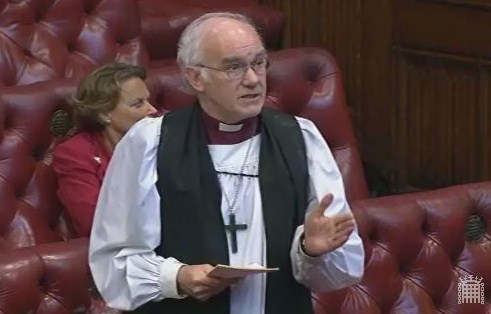
Bishop of Southwark asks about regulation of identity tracing agencies used in debt recovery

The Bishop of Southwark received the following written answer on 9th May 2024:

The Lord Bishop of Southwark asked His Majesty’s Government what plans they have to regulate identity tracing agencies in relation to the recovery of debt.

Baroness Vere of Norbiton (Con, Treasury): The Government wants to see fair treatment of individuals in problem debt, and there is a range of work underway across government and regulators to promote responsible practices for debt recovery.

Continue reading “Bishop of Southwark asks about regulation of identity tracing agencies used in debt recovery”

Police, Crime, Sentencing and Courts Bill: Bishop of Manchester supports amendments on data protection

On 8th December 2021, the House of Lords debated the Police, Crime, Sentencing and Courts Bill in its first day of the report stage. The Bishop of Manchester spoke in support of amendments to ensure data protection regulations are maintained when data is shared under the bill:

The Lord Bishop of Manchester: My Lords, I rise to support the amendments in my name and those of the noble Baroness, Lady Meacher, and the noble Lord, Lord Paddick. I draw your Lordships’ attention to my interests in policing ethics and my work with the National Police Chiefs’ Council, as set out in the register. I trust that those interests assure your Lordships that I am a strong supporter of effective policing, not its adversary.

As an occasional statistician, I am also well aware of the power and utility of data. Good data, including on the risks of serious violence, can provide the evidence that allows the limited resources of our police forces to be directed to the particular challenges faced in different contexts and localities. Perhaps it is because I trained not as a lawyer but as a mathematician that I hold firmly to the maxim that, before one can begin to find the right solution, one has to have clearly defined the problem. I am not sure that these clauses, as presently drafted, fully pass that test.

Continue reading “Police, Crime, Sentencing and Courts Bill: Bishop of Manchester supports amendments on data protection”

Votes: Police, Crime, Sentencing and Courts Bill

On 8th December 2021, the House of Lords debated Commons Amendments to the Police, Crime, Sentencing and Courts Bill. Votes were held on further amendments to the bill, in which a Bishop took part:

Continue reading “Votes: Police, Crime, Sentencing and Courts Bill”

Police, Crime, Sentencing & Courts Bill: Bishop of Bristol supports amendment to limit data extraction powers of immigration officers

On 27th October 2021, during a committee debate on the Police, Crime, Sentencing and Courts Bill, the Bishop of Bristol spoke in support of an amendment tabled by Lord Rosser which would seek to remove immigration officers from lists of people authorised to carry out data extraction from personal devices:

The Lord Bishop of Bristol: My Lords, some common themes are emerging. I rise in support of Amendment 107, which was tabled by the noble Lord, Lord Rosser, and to which I have added my name, alongside that of the noble Baroness, Lady Jones.

The inclusion in this Bill of immigration officers among those authorised to undertake digital extractions strikes me as extremely troubling, particularly in the absence of significantly more detail on the safeguards, including the meaning of “agreement” and the specificity of the data sought, and the relevant training and expertise of these officers. Voluntary provision and agreement to extract data must surely rely on a level of informed consent. If it is not, then “voluntary” and “agreement” are just empty words.

Continue reading “Police, Crime, Sentencing & Courts Bill: Bishop of Bristol supports amendment to limit data extraction powers of immigration officers”

Bishop of Carlisle asks about informed consent in collection of medical information

On 8th June 2021, during a discussion on collection of patient care records by the NHS, the Bishop of Carlisle asked a question on the issue of informed consent for patients to opt out of having their data collected and stored:

The Lord Bishop of Carlisle: My Lords, informed consent is at the heart of good patient care. Can the Minister tell us what plans Her Majesty’s Government have to inform patients that they have the right to opt out of having their personal medical information collected in this way? How will this be advertised?

Continue reading “Bishop of Carlisle asks about informed consent in collection of medical information”

Bishop of Chelmsford questions plan to set legal age of consent at 13 for giving personal information online

On 10th October 2017 the Bishop of Chelmsford spoke during the Second Reading debate of the Government’s Data Protection Bill. He questioned the part setting the age of consent at 13 for giving personal information online in exchange for products and services, suggesting there needed to be more consultation on this.

The Lord Bishop of Chelmsford: My Lords, I thank the noble Lord, Lord Jay, for enabling us to discuss the EU data protection package alongside the Data Protection Bill, but I will address my comments to the Bill.

Although I also welcome the rights and protections for children that the Bill offers, not least the right to be forgotten, there is one very important point of detail where reconsideration is urgently needed, which has already been mentioned by the noble Lord, Lord Stevenson, namely the age of consent for children to give their personal information away online in exchange for products and services without a parent or guardian needing to give their permission. Continue reading “Bishop of Chelmsford questions plan to set legal age of consent at 13 for giving personal information online”

Votes: Investigatory Powers Bill

On 2nd November 2016 the House of Lords considered the Government’s Investigatory Powers Bill at its Third Reading. The Bishop of Truro, Rt Revd Tim Thornton,  took part in a vote on an amendment to the Bill tabled by Crossbench Peer Baroness Hollins about the unlawful interception of telephone call:

Continue reading “Votes: Investigatory Powers Bill”

Investigatory Powers Bill – Bishop of Chester speaks on amendment on bulk retention of internet connection records

On 19th October 2016 the House of Lords considered the Government’s Investigatory Powers Bill at its Report Stage. The Bishop of Chester, Rt Revd Peter Forster, spoke during debate on a Liberal Democrat amendment. Introducing the amendment Lord Paddick said “it seeks to remove internet connection records from the type of communications data that can be acquired in bulk.” 

14.03 Bishop of ChesterThe Lord Bishop of Chester: My Lords, I am sure we do not want to prolong this debate. As I said on Monday, I was a member of the pre-legislative scrutiny group. You might wonder why a Bishop was invited to be part of that exercise, but I think it was because of this point—the ethics of interference with privacy. I am sorry that the discussion so far has almost become too polarised, because the noble Lord, Lord Paddick, is making a serious point, which I demonstrate by quoting David Anderson in his evidence to the Joint Committee on Human Rights. Continue reading “Investigatory Powers Bill – Bishop of Chester speaks on amendment on bulk retention of internet connection records”

Investigatory Powers Bill: Bishop of Chester speaks on amendment about Internet use monitoring

ChesterOn 17th October 2016, the House of Lords considered the Government’s Investigatory Powers Bill at Report Stage. The Bishop of Chester, Rt Revd Peter Forster, took part in the debate on an amendment from the Liberal Democrat Peer Lord Paddick on the retention of internet connection records. Introducing the amendment, Lord Paddick said: “the effect of Amendment 118A, tabled in my name and that of my noble friend Lady Hamwee, would be to remove internet connection records from any notice requiring the retention of communications data by telecommunications operators.”

The Lord Bishop of Chester: My Lords, I was a member of the Joint Committee conducting pre-legislative scrutiny of the Bill, along with the noble Lord, Lord Strasburger—I am not sure whether anyone else in the Chamber was. I remember a discussion which was genuinely open and uncertain about the practicality of this above all. The issue of privacy has been raised very powerfully by the noble Lord, Lord Oates, and others from the Liberal Democrat Benches. Continue reading “Investigatory Powers Bill: Bishop of Chester speaks on amendment about Internet use monitoring”

Bishop of Chester speaks in a debate about the Anderson Report into Investigatory Powers

14.03 Bishop of Chester

On the 8th July 2015 the Bishop of Chester, the Rt Revd Peter Forster spoke in a debate about the Anderson Report into investigatory powers. The Bishop focused his comments on the nature of privacy in a digital age and said that the limits set to our privacy must be proportionate and genuinely intended to benefit society as a whole.

Continue reading “Bishop of Chester speaks in a debate about the Anderson Report into Investigatory Powers”