Bishop of Sheffield asks about public feedback on House of Lords sessions

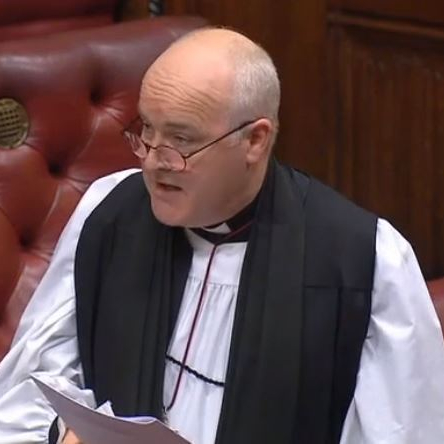
The Bishop of Sheffield asked a question on the public reception and feedback on recorded sessions of the House of Lords on 14th October 2024, during a discussion on behaviour and courtesy in the House:

The Lord Bishop of Sheffield: My Lords, it is surely a very good thing that the dealings of this Chamber are broadcast live, but it does mean that our interactions with one another are witnessed far beyond this place. Can the noble Baroness tell the House whether any attempt is made to monitor or record comments from the public in reaction to the broadcasts and, if so, what use is made of that feedback?

Continue reading “Bishop of Sheffield asks about public feedback on House of Lords sessions”

King’s Speech Debate: Archbishop of York raises importance of faith and representation in public life

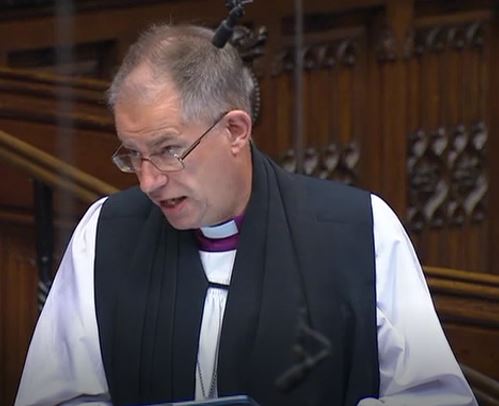
During the King’s Speech debate on 23rd July, 2024, the Archbishop of York gave a speech on the topic of the constitution, devolution and trust in democracy, raising the importance of faith in public life and the potential for other faith communities to be better represented in the House of Lords:

The Lord Archbishop of York: My Lords, it is an honour to respond to the gracious Speech. I, along with others on these Benches, welcome the noble and learned Lord, Lord Hermer, the Attorney-General, and thank him for a really moving maiden speech—not least his desire that we listen to and respect one another and work consensually.

Like others, I want to focus on one thing, which is rebuilding trust in democracy itself. The turnout on 4 July was shockingly low. Research also shows a 13% gap in turnout between constituencies with the highest and lowest proportions of home ownership. Furthermore, an estimated 400,000 people were turned away at the polling station because they did not have the right ID. These are alarming statistics, and I look forward to the changes outlined in the Government’s manifesto that could start to address them, including reducing the voting age to 16.

Continue reading “King’s Speech Debate: Archbishop of York raises importance of faith and representation in public life”

Media Bill: Bishop of Leeds emphasises importance of broadcasting in introducing new and challenging ideas to the public

The Bishop of Leeds spoke in a debate on amendments to the Media Bill on 20th May 2024, during a discussion on sports broadcasting, raising the importance of audiences encountering content that challenges preconceptions and introduces new ideas:

The Lord Bishop of Leeds: My Lords, surely at a time when we want children to get away from the telly and actually do sports, it is right that they be confronted by sports that they may know nothing about. Was it not curling, whatever that is, which became very popular and captured the imagination? Most of us could not believe that there was a sport where you push something along in that way.

Continue reading “Media Bill: Bishop of Leeds emphasises importance of broadcasting in introducing new and challenging ideas to the public”

Bishop of Chelmsford reiterates calls for rediscovery of standards in public life

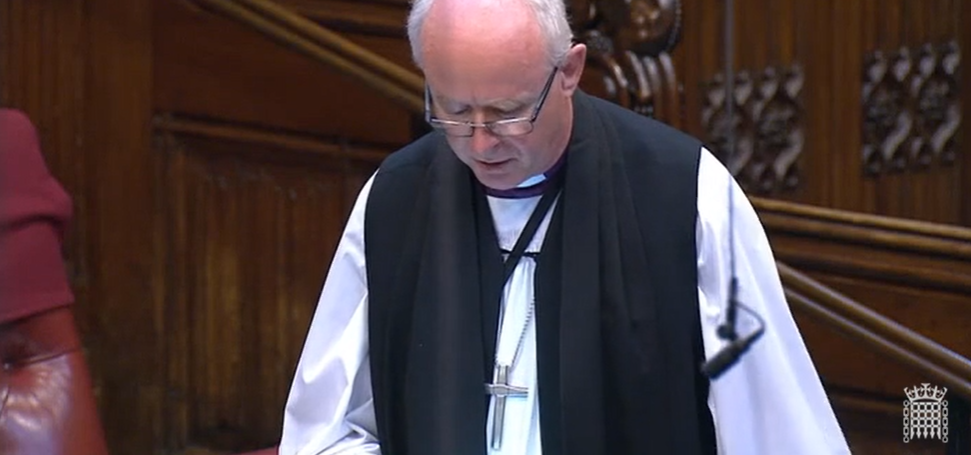
On 11th January 2024, the Bishop of Chelmsford spoke during a debate on Parliamentary Democracy and Standards in Public Life, reiterating the Archbishop of Canterbury’s call for a rediscovery of standards:

The Lord Bishop of Chelmsford: My Lords, like others, I contribute to this discussion with a great amount of feeling, because the debate goes right to the heart of the integrity of public institutions, including both Chambers of our Parliament. After Sue Gray’s report on parties in Downing Street during lockdown, my most reverend friend the Archbishop of Canterbury described standards in public life as

“the glue that holds us together”

and called for a “rediscovery” of these standards. That was in May 2022, but since then, it can feel like little has changed.

Continue reading “Bishop of Chelmsford reiterates calls for rediscovery of standards in public life”

Bishop of Leeds asks about parliamentary leadership

The Bishop of Leeds asked the following question on 16th June 2022:

The Lord Bishop of Leeds: My Lords, we know that the Prime Minister deems the Nolan principles vital. Why has he not really responded to Sue Gray’s report, where the question of leadership was raised?

Continue reading “Bishop of Leeds asks about parliamentary leadership”

Bishop of St Albans asks about integrity in public life

The Bishop of St Albans asked the following question on 16th June 2022:

The Lord Bishop of St Albans: My Lords, at a time when public trust in the integrity of the Government and public life is being deeply damaged, would it not make sense for the successor of the noble Lord, Lord Geidt, to be appointed by an independent body rather than by the Prime Minister?

Continue reading “Bishop of St Albans asks about integrity in public life”

Bishop of Oxford speaks in debate on ethics and standards in public life

On 9th September 2021, the Bishop of Oxford spoke in a debate on ethics and standards in public life, emphasising the need for support, education and training in order to for those in public life to meet standards:

The Lord Bishop of Oxford: My Lords, it is a great privilege to take part in this debate and to follow the noble Lords who have spoken. I thank the noble Lord, Lord Blunkett, for his leadership and introduction. I learned a great deal from the noble Lord while Bishop of Sheffield.

I suggest that improving standards in public life is a three-cornered stool. One leg of that stool is being neglected in the public conversation. It is right that we have the highest possible principles and standards. The Nolan principles have stood the test of time and I support their application to people and their extension to areas of technology. They are the first important leg. The second leg is the way in which we hold one another to account on those principles, which is where I guess that the majority of this debate will be focused. Others are better qualified to speak on this than me. Those ways need to be thorough and consistent with the Nolan principles.

There is an important third leg to this stool, which I want to call formation and support. How do we intentionally grow a community of diverse public servants who are ethically formed and equipped, and have the inner capacity to be honest, open, objective, accountable and selfless? How do we form boards and cultures which are able to work in those ways? They do not simply happen. How do we offer ongoing support and learning to those who exercise high public office and have to cope with greater and greater complexity, pressure and temptation?

Continue reading “Bishop of Oxford speaks in debate on ethics and standards in public life”

Bishop of Leeds asks about online abuse of public representatives

The Bishop of Leeds tabled a question on the proliferation of online abuse of public representatives on 16th June 2021, raising issues of security and the need for regulation:

The Lord Bishop of Leeds: To ask Her Majesty’s Government, further to the fifth anniversary of the murder of Jo Cox MP, what assessment they have made of (1) the security needs of public representatives subjected to online abuse, and (2) the need for regulation to tackle such abuse.

Baroness Barran (Con): My Lords, I think that this is a very solemn day for all of us as we remember Jo Cox’s tragic murder five years ago. I am sure that the House joins me in acknowledging the courage of her sister, whatever our party affiliations, in standing as a candidate in the by-election in Jo’s former seat.

Continue reading “Bishop of Leeds asks about online abuse of public representatives”

Bishop of Rochester asks about standards in public office

The Bishop of Rochester asked a question on the need to uphold standards in public office on 27th April 2021, following a Commons statement on dealing with potential breaches of the ministerial code:

The Lord Bishop of Rochester: My Lords, I will not advise on internal decorations, but I observe that, by virtue of being here, we are all inhabitants of glass houses. We note the adage that being in a glass house makes us visible, so it is wise to behave in ways that do not disgrace this place or ourselves. We often hear words from or about Ministers and others in public office to the effect that he or she did not “break the rules”. Is that not to set the bar fairly low? Does the Minister agree that, while we are all fallible human beings, we, in public office, should aspire to the highest possible standards of probity and behaviour and not simply settle for keeping the rules? If we do not, public opinion will lead to ever tighter rules.

Continue reading “Bishop of Rochester asks about standards in public office”