Bishop of St Albans Raises Impact of Floods on Food Security

The Earl of Shrewsbury asked Her Majesty’s Government what measures they are taking to improve flood defences in agricultural areas.

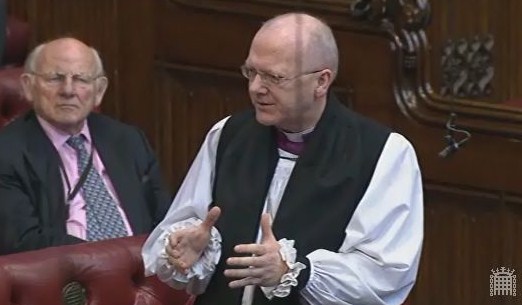
The Bishop of St Albans asked a supplementary question:

The Lord Bishop of St Albans:

My Lords, the noble Lord will be only too aware of the huge contribution that British agriculture makes to food security. Could he therefore tell us what assessment Her Majesty’s Government have made concerning the risk to food security due to poorly planned flooding amelioration and prevention schemes, which are allowing considerable areas of high-grade agricultural land to be taken out of production due to flooding?

Lord De Mauley:

I am grateful to the right reverend Prelate for coming to see me the other day to talk about these things. There is currently no evidence that flood events such as those experienced in 2007, 2009 or 2012—or, so far, in recent events—represent a threat to food security in the United Kingdom. According to the UK food security assessment, the UK enjoys a high level of food security as a developed, stable economy. I think it is more likely that disruption to transport links could impact access to food supplies, but we are watching this carefully.

(via Parliament.uk)

Rural Affairs: Church Commissioners’ Written Answer

Second Church Estates Commissioner, Rt Hon Sir Tony Baldry MP, answered a written question from Anne McIntosh MP about rural affairs.

Miss McIntosh: To ask the right hon. Member for Banbury, representing the Church Commissioners, when he last met the Rural Affairs Group of the Church of England.
Sir Tony Baldry: I have not att14.01 CCQ Baldryended a meeting of the Rural Affairs Group of the Church of England. I am kept fully informed about the relevant issues concerning the committee when needed by the National Rural Officer and the Church of England’s Parliamentary Unit.

(via Parliament.uk)

Bishop of St Albans raises concerns about the impact of closing rural schools

Lord Storey asked Her Majesty’s Government what support is given to young people living in rural areas to enable them to travel to school or college.

The Bishop of St Albans asked a supplementary question:

The Lord Bishop of St Albans: My Lords, the Church of England is deeply involved with hundreds of tiny rural schools in sparsely populated areas and is acutely aware of some of the financial difficulties that they face. When such a school has to close, what advice do Her Majesty’s Government give on the educational, financial and environmental issues—to do with sustainability—of transporting these pupils, sometimes very long distances, to the next nearest school?

Baroness Northover: I will write to the right reverend Prelate with details about what happens when these schools are closed. There is a special premium for rural schools of the type that he describes, which have fewer pupils than you might find elsewhere, but I will write with further details.

(via parliament.uk)

The Bishop of Worcester speaks in debate on Independent Panel on Forestry

My Lords, I am grateful to the noble Baroness, Lady Royall, for securing this debate. Like her, I am a great lover of the Forest of Dean, which until recently was part of the diocese of Worcester. When I say “recently”, I mean the 16th century, but what are a few centuries in the life of the church or, indeed, in the life of a forest? I pay tribute to her for her work, as I do, along with other noble Lords, to the recently retired Bishop of Liverpool for his significant contribution to the welfare of our forests made as chairman of the Independent Panel on Forestry. Continue reading “The Bishop of Worcester speaks in debate on Independent Panel on Forestry”

The Bishop of St Albans speaks in debate on Independent Panel on Forestry report

My Lords, I was eager to participate in this debate and I, too, thank the noble Baroness, Lady Royall, for raising this vital issue, which has touched the nerves of so many people right across the country, in every part of our nation. I want to pick up four details of the Government’s response. They are minor, not major, points but I hope that they will be helpful. The first is to build on the point made by the noble Baroness, Lady Parminter, about the unprecedented levels of flooding that we are having in the UK. Continue reading “The Bishop of St Albans speaks in debate on Independent Panel on Forestry report”

Bishop of Worcester responds to Government statement on flooding

The Lord Bishop of Worcester: My Lords, I am grateful for the Minister’s Statement. As we all know, attention has rightly focused on the Somerset Levels and the terrible plight that people are enduring there, but when I left Worcester this morning the city was gridlocked as a result of the closure of the main bridge across the river and the situation remains acute. I do not want to apportion blame; I want to pay tribute to those who are working very hard and to the understanding and graciousness of the inhabitants of Worcester. However, it is true that the implications of this will be enormous, economically and from a human point of view. Can the Minister confirm that a coherent policy will be forthcoming for all the affected areas, not just those most terribly affected?

Lord De Mauley: The right reverend Prelate is absolutely right—I can confirm that. We have finite resources and must apportion them in a proper way, in accordance with priorities, and the priorities must be human life and property. While I am at the Dispatch Box, can I say that, although I have not given them credit, I know that the churches in Somerset in particular are playing a major part in helping people affected by this dreadful tragedy?

(via parliament.uk)

Bishop of St Albans asks questions on affordable energy for rural households

The Lord Bishop of St Albans: To ask Her Majesty’s Government what discussions they have had with the Office of Fair Trading about securing an affordable energy supply for rural households that are off the gas grid.

The Parliamentary Under-Secretary of State, Department of Energy and Climate Change (Baroness Verma):
Representatives of the Office of Fair Trading attend the Roundtable meetings chaired by my Rt. Hon. Friend the Minister of State for Energy. The Roundtable brings together Government, regulators, advisory and charitable bodies, the fuel supply industry and others to work together to improve the security and affordability of off-grid fuel supply.14.03 Bishop of St Albans

The Lord Bishop of St Albans: To ask Her Majesty’s Government what discussions they have had with the energy companies about reducing the price of electricity paid by households that are not dual fuel customers because they do not have access to the gas grid.

Baroness Verma: DECC Ministers regularly meet with energy supply companies to discuss a range of energy issues. Electricity prices for household consumers are a commercial matter for the companies concerned.

(via Parliament.uk)

Bishop of Wakefield urges Government to support pupils in areas of rural deprivation

Lord Horam asked Her Majesty’s Government what plans they have to increase the Pupil Premium for the most disadvantaged primary school children.

The Bishop of Wakefield asked a supplementary question:

The Lord Bishop of Wakefield: My Lords, can the Minister tell us whether the Government are considering ways in which an increase in the pupil premium can be targeted at the forms of deprivation most difficult to address? Rural deprivation, for example, particularly in church schools, is very significant in our part of West Yorkshire, in the Diocese of Wakefield.

Lord Nash: The right reverend Prelate is quite right to point out the problems with rural deprivation; it is similar to coastal deprivation. There are particular schemes that schools follow: mentoring; systemic feedback; much more involvement of parents; early intervention, particularly using the better teachers; and peer tutoring. Much can be learnt from groups like Ark, whose academy in Portsmouth, for instance, which is in a classic coastal town, has improved results in four years from 24% to 68%.

(via parliament.uk)

The Bishop of St Albans raises concerns about affordable energy in rural areas (Written Questions)

The Lord Bishop of St Albans asked Her Majesty’s Government what discussions they have had with the Office of Fair Trading about securing an affordable energy supply for rural households that are off the gas grid.

The Parliamentary Under-Secretary of State, Department of Energy and Climate Change (Baroness Verma): Representatives of the Office of Fair Trading attend the Roundtable meetings chaired by my Rt. Hon. Friend the Minister of State for Energy. The Roundtable brings together Government, regulators, advisory and charitable bodies, the fuel supply industry and others to work together to improve the security and affordability of off-grid fuel supply.

The Lord Bishop of St Albans asked Her Majesty’s Government what discussions they have had with the energy companies about reducing the price of electricity paid by households that are not dual fuel customers because they do not have access to the gas grid.

Baroness Verma: DECC Ministers regularly meet with energy supply companies to discuss a range of energy issues. Electricity prices for household consumers are a commercial matter for the companies concerned.

Bishop of St Albans calls for extension of discretionary housing payments to rural areas

Baroness Quin asked Her Majesty’s Government what recent discussions they have had with local authorities about the costs associated with implementing the underoccupancy charge.

The Bishop of St Albans asked a supplementary question:

The Lord Bishop of St Alba14.03 Bishop of St Albansns: My Lords, as affordable rental properties in rural areas are in such shortage, will the Government extend the scheme, which currently applies only to the 21 most sparsely populated districts, and allow more local authorities to use discretionary housing payments to help retain more couples and families in their homes?

Lord Freud: My Lords, that is exactly what the discretionary housing payment is for. It is for local authorities to take decisions, based on their local knowledge, so that they get the funds to the right people. The emerging signs are that we will not spend all the discretionary housing payments this year. I am, however, making sure that a substantial amount of discretionary housing payment goes out next year, for which the total figure will be £165 million.

(via Parliament.uk)