Bishop of Ely questions Government about teacher recruitment in rural areas

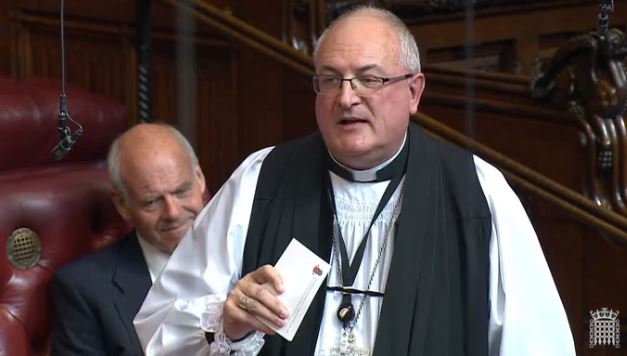
Ely 2On the 12th April the Bishop of Ely, the Rt Revd Stephen Conway received a written answer to his question about teacher recruitment in rural areas.


Continue reading “Bishop of Ely questions Government about teacher recruitment in rural areas”

Bishop of Durham – all children in poverty should have free school meals

Durham161117On 26nd February 2018, Baroness Benjamin asked Her Majesty’s Government ‘what plans they have for publicising a detailed evaluation of stage one of the National Child Obesity Strategy; and when a publication timetable for stage two will be produced’. The Bishop of Durham, the Rt Revd Paul Butler, asked a follow up question about free school meals.

The Lord Bishop of Durham:
My Lords, the relationship between childhood obesity and poverty is well evidenced. In the light of warnings by the Children’s Society and others that 1 million children in poverty will miss out on a free school meal under the current proposals for changes to entitlement under universal credit, does the Minister agree that all children in poverty should receive a free school meal to combat child malnutrition by ensuring that they receive a healthy meal at lunchtime? Continue reading “Bishop of Durham – all children in poverty should have free school meals”

Education debate – Bishop of Gloucester on early needs, children’s mental and physical health and self-esteem

On 8th December 2017 the Archbishop of Canterbury, Most Revd and Rt Hon Justin Welby, led a debate in the House of Lords, ‘That the House takes note of the role of education in building a flourishing and skilled society.’ The Bishop of Gloucester, Rt Revd Rachel Treweek, spoke in the debate and her speech is below. The Archbishop’s opening and closing speeches can be seen here.

 The Lord Bishop of Gloucester: I too thank the most reverend Primate for bringing forward today’s debate, and indeed for naming the recently established Church of England Foundation for Educational Leadership, of which I am privileged to be a trustee.

In my own diocese, I am delighted that we have 116 Church of England schools—not single-faith schools but centres of community cohesion in urban and rural areas, committed to offering each child the opportunity to discover life in all its fullness, as spoken about by Jesus Christ. The Church of England’s vision for education highlights the ideas of wisdom, hope, dignity and community, and we aim to make our schools places where fulfilling academic potential is not separated from our children’s spiritual, physical, emotional, moral and social development. Continue reading “Education debate – Bishop of Gloucester on early needs, children’s mental and physical health and self-esteem”

Archbishop leads Lords debate on the role of education in building a flourishing and skilled society.

On 8th December 2017 the Archbishop of Canterbury, Most Revd and Rt Hon Justin Welby, led a debate in the House of Lords, ‘That the House takes note of the role of education in building a flourishing and skilled society.’ The Archbishops’ opening and closing speeches are below in full:
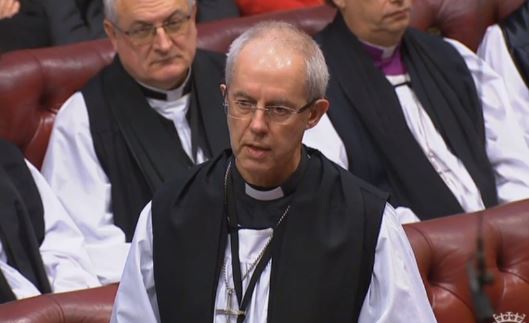
The Archbishop of Canterbury: My Lords, I am grateful to the usual channels for making time once again for me to lead a debate in your Lordships’ House. It is now something of a tradition for an Archbishop’s debate to be held in early December. Though a little later and less well established than the John Lewis advert, the appearance of an Archbishop on the order paper is a sure sign that Christmas is just around the comer.

Last year, I led a debate on shared national values, which featured some extremely impressive and thoughtful speeches. I am sure that today’s debate will be equally impressive, and I am grateful to so many of your Lordships for making time to attend. I look forward to your contributions, and it will be an especial pleasure to hear the first speech from the noble, reincarnated and right reverend Lord, Lord Chartres. I am also delighted that the noble Lord, Lord Sacks, will be speaking today. He has told me—and obviously we all understand—that he will have to leave before the wind-up to get home in time for the Sabbath. But it is very good that he has come here at all.

There is a link between today’s debate on education and the previous one on shared values. What I hope to give today is an outline of the sort of values that we suggest, from these Benches especially, should underpin our education system, and the structures that might support them, so that we might create a society where individual and mutual flourishing become the norm.

Continue reading “Archbishop leads Lords debate on the role of education in building a flourishing and skilled society.”

Church Commissioners’ Written Answer: Transphobic Bullying

On 7th December 2017 the Second Church Estates Commissioner, Rt Hon Dame Caroline Spelman MP, answered a written question from Ranil Jayawardena MP about guidance to schools on transphobic bullying. 

Mr Ranil Jayawardena (North East Hampshire): To ask the right hon. Member for Meriden, representing the Church Commissioners, what assessment has been made of the merits of the Church of England’s recent guidance to nursery and primary school teachers on transphobic bullying. Continue reading “Church Commissioners’ Written Answer: Transphobic Bullying”

Bishop of Coventry asks about role of schools in helping disadvantaged families

On 22nd November 2017 Lord Lennie asked Her Majesty’s Government “what action they have taken to address the concerns raised in the Social Mobility Commission’s State of the Nation report published in November 2016.” The Bishop of Coventry, Rt Revd Christopher Cocksworth, asked a follow up question:

The Lord Bishop of Coventry: My Lords, on my visits to primary schools in Coventry in Warwickshire, I am often struck by head teachers in poorer areas telling me that they cannot help their children without also helping the families, who often face very complex issues. The Minister referred to the opportunity areas. Can he confirm that there is a plan to involve parents and guardians in that work of uplift and that there will be help for head teachers in that task? Continue reading “Bishop of Coventry asks about role of schools in helping disadvantaged families”

Bishop of Ely on the need for schools to tackle deprivation and disadvantage

On Thursday 16th November 2017 Lord Bird led a debate in the House of Lords, “to ask Her Majesty’s Government what new resources and strategies they will implement to ensure that every child has the opportunity to attend a good school and that all schools are fairly funded, as announced in the Queen’s Speech.” The Bishop of Ely, Rt Revd Stephen Conway, spoke in the debate, focusing on church schools:

The Lord Bishop of Ely: Follow that! My Lords, I am very grateful to the noble Lord, Lord Bird, for having made this debate possible and for providing the opportunity for us to focus not only on a fair distribution of funding for our schools and the children in their care but on fair access to good teaching in good and imaginative schools.

The Church has, down the centuries, provided a constant yet adaptable force in education. The Church of England recently produced a new vision for education, two pillars of which are dignity and hope. As the ultimate aim of our schools is to promote human flourishing, we are particularly concerned—particularly in our emphasis on supporting schools in areas of disadvantage—to enable every child to fulfil his or her aspirations, and indeed to be given the opportunity to have any aspirations in the first place. Continue reading “Bishop of Ely on the need for schools to tackle deprivation and disadvantage”

Bishop of Newcastle raises concerns around mental health in schools

On 17th July 2017, Baroness Lawrence of Clarendon asked “Her Majesty’s Government when they intend to bring forward proposals to reform Child and Adolescent Mental Health Services as outlined in their 2017 manifesto.” The Bishop of Newcastle, the Rt Rev Christine Hardman followed up with a question on mental health in schools. 

Newcastle 8

Continue reading “Bishop of Newcastle raises concerns around mental health in schools”

Bishop of Ely highlights work of Church in promoting educational leadership

ElyOn the 30th January 2017, Baroness Donaghy asked the government “in the light of figures showing that nearly one-third of newly qualified teachers leave the profession within five years of qualifying, what steps they are taking, including continuing professional development entitlement, to retain them.” The Bishop of Ely, the Rt Revd Stephen Conway, asked a follow-up question.


The Lord Bishop of Ely: My Lords, does the Minister agree that the working environment for teachers is so often determined by the quality and effectiveness of school leaders, and therefore it is essential to equip school leaders to ensure the flourishing of their staff as well as their pupils? Will he be pleased to note with me the launch this weekend of the Church’s Foundation for Educational Leadership to work in this field? Continue reading “Bishop of Ely highlights work of Church in promoting educational leadership”

Caroline Spelman MP highlights the role of church schools in promoting excellence and social integration

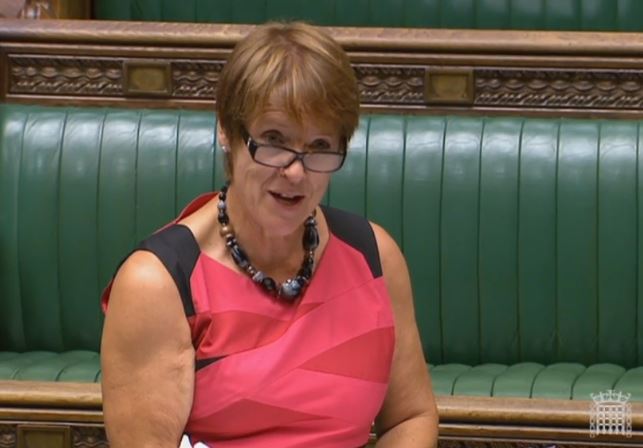
On 8th November 2016 the House of Commons debated a motion from Labour’s Lisa Nandy MP “That this House notes recent proposals by the Government to expand the role of grammar and faith schools; and calls on the Government to conduct a full assessment of the evidence relating to the effect of grammar schools and faith schools on children’s learning.” The Second Church Estates Commissioner, Rt Hon Dame Caroline Spelman MP, spoke in the debate about the important role of Church of England schools:

Caroline SpelmanThe Second Church Estates Commissioner (Dame Caroline Spelman): I rise to speak on behalf of the Church of England in this important Back-Bench debate. The Church has a long and successful history of educating children in our country. It provided education before the state did. In fact, it is still the largest provider of education besides the state. It has 4,700 schools, most of which are primaries, with 200 secondary schools. Some 84% of its primary and 74% of its secondary schools are good or outstanding.

Many of the remaining schools are in remote rural locations, although I should point out that there are some excellent rural schools. The challenge of trying to sustain a class for each year group in a remote rural area and the difficulty in attracting teachers there make it hard to achieve higher standards in those schools. The Church is committed to raising standards, and with the help of digital means and remote learning methods, it is possible to bring the best teaching to such schools. The Church has fought to sustain these schools for the sake of social cohesion, where other institutions might by now have given up. I am sure that hon. Members with rural constituencies will immediately identify with the importance of the village school, which, with the parish church, may be the only institutional hub for such communities. That underlines the importance of keeping them sustainable.

I want to scotch the myth that Church schools are forces for segregation. That could not be further from the truth. Continue reading “Caroline Spelman MP highlights the role of church schools in promoting excellence and social integration”