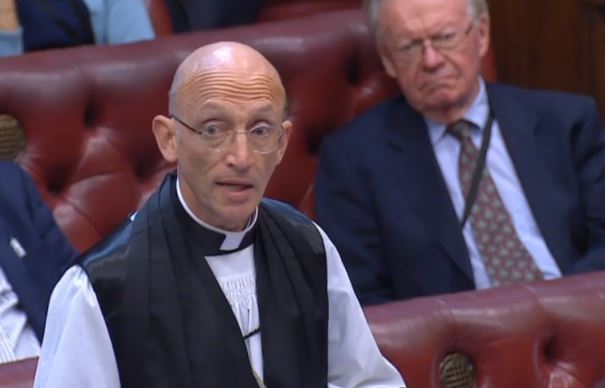
Bishop of Lincoln asks about improving mental health provision in smaller and rural school settings

The Bishop of Lincoln asked a question on improving mental health provision in primary schools, particularly schools in small, rural settings, on 4th February 2025:

The Lord Bishop of Lincoln: My Lords, the Rural Mental Health report produced in the other place highlighted that

“NHS mental health services are often not fairly accessible for rural communities”,

with services largely centred in towns and cities,

“creating barriers to access, compounded by the limitations and weaknesses of rural public transport and digital connectivity”.

Continue reading “Bishop of Lincoln asks about improving mental health provision in smaller and rural school settings”

Bishop of Derby asks about bullying in schools

The Bishop of Derby received the following written answer on 19th December 2024:

The Lord Bishop of Derby asked His Majesty’s Government what assessment they have made of the success of Anti-Bullying Week 2024, and what initiatives they have in place to eradicate bullying.

Continue reading “Bishop of Derby asks about bullying in schools”

Bishop of Derby asks about combatting bullying in schools

The Bishop of Derby received the following written answer on 2nd November 2024:

The Lord Bishop of Derby asked His Majesty’s Government, as part of Anti-Bullying Week, what steps they are taking (1) to collect, record and monitor data on reports of bullying in schools and subsequent responses, and (2) to improve the availability and quality of anti-bullying training and support for teachers.

Continue reading “Bishop of Derby asks about combatting bullying in schools”

Bishop of St Albans asks about impact of VAT on school fees on SEND pupils

The Bishop of St Albans asked a question on the impact that imposing VAT on school fees would have on pupils with special educational needs and disabilities on 10th October 2024:

The Lord Bishop of St Albans: I wonder if I might press the Minister on SEND pupils. The majority of SEND pupils, who were mentioned by the noble Lord, Lord Black, do not have an education, health and care plan, and therefore there is a genuine worry that this policy might mean that their education is interrupted. What mitigating factors are His Majesty’s Government putting in place to ensure that this particularly vulnerable group is supported?

Continue reading “Bishop of St Albans asks about impact of VAT on school fees on SEND pupils”

Bishop of Southwark speaks on risks posed by changes to VAT exemption for independent schools

The Bishop of Southwark spoke in a debate on the impact of changes to the VAT exemption for independent schools on 5th September 2024, raising the issue of unintended effects on SEND provision and potential ramifications for cathedral and choir schools:

The Lord Bishop of Southwark: My Lords, the Government’s intention to levy value added tax in this area was a manifesto commitment at the general election. The Government entertain a well-evidenced belief that parents purchase an economic and social benefit for their children’s future through private schooling. Whatever the experience any of your Lordships have had of such schooling, the undoubted premium placed on forming character or the excellence in pastoral care that some of these schools exhibit, the Government nevertheless have a mandate for change. The noble Baroness, Lady Ramsey, underlined the pressing need for more teachers in our state schools.

However, who will and who will not be affected by this change is a worthy subject of debate. I am happy to say that both the boys’ and girls’ choirs at Southwark Cathedral are almost entirely drawn from state schools, and are consequently unaffected by the VAT change. Furthermore, a number of schools in my diocese offering provision for special educational needs and disabilities have their places funded by the local authorities. But there are cathedral and choir schools, and private schools, with provision for special educational needs that will be severely affected by the change that the Government intend. Many of these are small schools, and therefore the impact will be disproportionately severe.

Continue reading “Bishop of Southwark speaks on risks posed by changes to VAT exemption for independent schools”

Bishop of Chichester speaks in debate on education in the UK

The Bishop of Chichester spoke in a debate on a report from the Education for 11 to 16-year olds Committee, ‘Requires improvement: urgent change for 11–16 education (Session 2023–24, HL Paper 17)’ on 26th July 2024, welcoming the report and highlighting the importance of religious education and the Church of England’s role as an educational provider:

The Lord Bishop of Chichester: My Lords, it is an honour to follow the noble Lord, Lord Aberdare, and the noble Baroness, Lady Blower, who have participated in the excellent report chaired by the group led by the noble Lord, Lord Johnson.

I welcome the priority that has been given to the review of the curriculum for 11 to 19 year-olds at an early stage of the Government coming into office. In particular, I welcome the report of the review group and how it will “refresh” the curriculum,

“build on the hard work of teachers and staff”,

and seek “evolution and not revolution”.

These are important indications that education will not be driven by ideology that leads to it becoming a political football, as sometimes has happened in the past.

In particular, the promise that the review will not

“place undue burdens on education staff”

will need to be delivered ostentatiously, particularly if the Government wish to improve the recruitment and retention of top-quality teachers. To that end, I greatly welcome also the acknowledgement of

“the innovation and professionalism of teachers”.

Continue reading “Bishop of Chichester speaks in debate on education in the UK”

Bishop of Southwell and Nottingham asks about effects of COVID-19 pandemic on educational attainment

The Bishop of Southwell and Nottingham asked a question on the impact of the COVID-19 pandemic on the educational needs of SEN children on 22nd May 2024, during a discussion on the effects of the pandemic on educational attainment for UK schoolchildren:

The Lord Bishop of Southwell and Nottingham: My Lords, head teachers in my diocese in Nottinghamshire are reporting that the adverse impacts of the pandemic include a dramatic increase in attendance concerns, parental anxiety and pupils’ mental health difficulties. At the same time, they are reporting severe pressures on schools funding, leading to staff reductions, which cannot be in the best interests of children, especially where SEN provision is reduced. What assessment have His Majesty’s Government made of the impact of the Covid-19 pandemic on the educational needs of SEN children, and what more can be done to mitigate this?

Continue reading “Bishop of Southwell and Nottingham asks about effects of COVID-19 pandemic on educational attainment”

Bishop of Worcester asks about benefits of inter-school partnerships

The Bishop of Worcester asked a question on the benefits of cooperation and partnerships between schools on 18th March 2024, during a discussion on the contribution of independent schools to the education sector:

The Lord Bishop of Worcester: My Lords, I draw attention to my interest as president of the Woodard Corporation, one of the largest Christian education charities in the country. The noble Lord, Lord Black, drew attention to the partnership between Brentwood School and other schools in the area.

Continue reading “Bishop of Worcester asks about benefits of inter-school partnerships”

Schools (Mental Health Professionals) Bill: Bishop of Winchester applauds measures to address mental health issues in young people

The Bishop of Winchester spoke in a debate on the second reading of the Schools (Mental Health Professionals) Bill on 1st March 2024, pointing out the need for a consistent, universally applied policy to improve student mental health, and the need to address the causes of mental health issues at a root level:

The Lord Bishop of Winchester: My Lords, I am grateful to the noble Baroness for bringing this Bill to us for its Second Reading. We indeed face a crisis in this area and need to be aware of the long-term consequences of not addressing it.

The Bill would pave the way for just the kinds of interventions that are sorely needed. The NSPCC and our own Library briefing state that more than 20% of children and young people are living with poor mental health. CAMHS referrals are provided for only the most severe presenting issues, while early intervention, though widely recognised to be key to good long-term outcomes, is now a thing of distant memory. The sobering fact is that children are taking their own lives while they wait to be seen, and that is deeply shameful.

Last summer, the Church of England published the document Our Hope for a Flourishing Schools System, which makes specific mention of mental health, it being the issue school leaders most often raise with us. It states:

“Children’s mental health and wellbeing is prioritised and resourced generously by a society that invests in the long-term future of its nation by placing children first in funding and political direction. The fulfilling of a child’s potential should never be hindered, blocked or prevented by the system in which they find themselves”.

However, those words are, sadly, far from being the current reality.

Continue reading “Schools (Mental Health Professionals) Bill: Bishop of Winchester applauds measures to address mental health issues in young people”

Bishop of Lincoln asks about methods of improving school attendance

The Bishop of Lincoln asked a questions about application of data analysis to improve pupil attendance and experience in schools on 13th February 2024, during a discussion on the potential of Ofsted reviewing pupil absence rates as part of their inspections:

The Lord Bishop of Lincoln: My Lords, I express gratitude to the Minister for the way in which the data has been produced; I understand that more is to come, and that will be examined in great detail. As an unrepentant pedant, though, I am as interested in the adverbs as the nouns—in how the data is to be applied. How do we get more children across the line in terms of the culture of school? Some years ago, the Children’s Society’s Young Commissioners looked deeply into child poverty in school and how children are identified as those, for instance, receiving free school meals or who are not able to purchase the very expensive school uniforms from the agreed seller. How is school culture being encouraged by government further to change in order to get children across the line? How, indeed, do we expect Ofsted to become the “office of encouragement”?

Continue reading “Bishop of Lincoln asks about methods of improving school attendance”