
Bishop of St Albans presses Government on effect of welfare reform on in-work poverty

On 24th November 2014, Lord McKenzie of Luton asked Her Majesty’s Government how many households are in receipt of the housing element of Universal Credit. The Bishop of St Albans, the Rt Revd Alan Smith, asked a supplementary question:
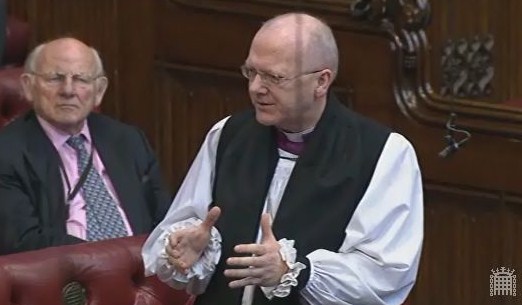
Bishop of St AlbansThe Lord Bishop of St Albans: My Lords, the House will be aware that the Chancellor has announced that the working allowances for universal credit will be frozen until April 2018. There is a real danger, if there is no lift in those allowances—at least in line with inflation—that that will significantly reduce the real net incomes of low earners. Could the Minister tell your Lordships’ House what assessment Her Majesty’s Government have made of the impact of these measures on the level of poverty among those who are already in work, especially for those families who are earning too little to benefit from further rises in the personal tax allowances?

Lord Freud: The working allowances in universal credit are much greater than under the legacy system, so there is a freeze that will have a small effect. Nevertheless, the poverty impacts are to take 300,000 children out of poverty.

(via Parliament.uk)

Bishop of St Albans raises concerns about protection of local welfare budgets

On 18th November 2014, Baroness Farrington of Ribbleton asked Her Majesty’s Government what assessment they have made of cuts in funding to local authorities in the most deprived and least deprived areas of England. The Bishop of St Albans, the Rt Revd Alan Smith, asked a supplementary question: 

Bishop of St AlbansThe Lord Bishop of St Albans: My Lords, the dedicated funding for local welfare provision has been vital in providing a net for some of the most vulnerable in society. It is proposed that this will no longer be ring-fenced but will be part of a general grant to local councils, at a time when their budgets are increasingly pressed—indeed, there may be a move for that money to be used for core statutory services in future. If that money is not to be ring-fenced, will the Minister tell us how Her Majesty’s Government will monitor the effects of these changes and whether they will be willing to report back to your Lordships’ House on them, to ensure that the most vulnerable are not even further disadvantaged?

Baroness Williams of Trafford: The right reverend Prelate makes a good point. The ring-fenced funding pots were not always used for their intended purposes. It is the Government’s belief that in devolving funds straight to local authorities they will make the best use of them. I shall follow up the right reverend Prelate’s question on reporting back—I am sure that we can report back in due course.

(via Parliament.uk)

Bishop of St Albans presses Government to ratify Istanbul Convention

On 18th November 2014, the Bishop of St Albans, the Rt Revd Alan Smith, received an answer from Home Office Minister Lord Bates on the subject of the Istanbul Convention on Preventing and Combating Violence against Women and Domestic Violence.

Bishop of St AlbansThe Lord Bishop of St Albans: To ask Her Majesty’s Government whether they have any plans to ratify the Istanbul Convention now that the Anti-Social Behaviour, Crime and Policing Bill 2014 has received Royal Assent. [HL2559]

The Parliamentary Under-Secretary of State, Home Office (Lord Bates): The Coalition Government signed the Istanbul Convention on 8 June 2012 signalling its strong commitment on tackling violence against women and girls. The UK already has some of the most robust protections in the world against violence towards women and we already comply with the majority of the articles to the convention. Continue reading “Bishop of St Albans presses Government to ratify Istanbul Convention”

Bishop of St Albans presses Government to tackle cold calling by payday lenders

On 17th November 2014, Liberal Democrat Peer Lord Sharkey asked Her Majesty’s Government what steps they are taking to bring organisations which make cold calls connected with the promotion, or sale, of financial services or products under the regulation of the Financial Conduct Authority. The Bishop of St Albans, the Rt Revd Alan Smith, asked a supplementary question:

Bishop of St AlbansThe Lord Bishop of St Albans: My Lords, I wonder if I could press the Minister again, particularly on payday loans. The recent report published by the Children’s Society, Playday not Payday, has highlighted the regulatory gap whereby payday loan companies can make unsolicited marketing calls, whereas, as we have heard, mortgage providers are not allowed to. That report showed that over 40% of people who have taken out payday loans are receiving on average more than one unsolicited phone call a day. Does the Minister not agree that the provisions that prevent the mortgage providers from making that sort of marketing approach really must now be brought in for the payday loan companies in order to protect those who are most vulnerable?

Lord Newby: The very specific arguments that apply in respect of mortgages do not apply to payday loans. The key thing about payday loans at the moment is that the payday loan companies are being regulated for the first time, which is leading to a collapse in the number of payday loan companies, so that it is expected that we may end up with as few as four payday loan companies in operation at the end of this process. However, the FCA is undertaking an in-depth thematic review of the debt management sector to assess the quality of advice and the area mentioned by the right reverend Prelate. If it finds substantial evidence of consumer detriment of the kind he suggests, it will be able to consider the scope of further regulations.

(via Parliament.uk)

Infrastructure Bill – Division

On 15th November 2014, three bishops voted on an amendment to the Infrastructure Bill, during its Report Stage. The amendment, tabled by Labour peer Lord Adonis, sought to create a National Infrastructure Commission, based on recommendations made by Sir John Armitt in his independent review into national infrastructure for the Labour Party.

House of Lords Division Lobby


The Bishop of Norwich, the Rt Revd Graham James, the Bishop of Portsmouth, the Rt Revd Christopher Foster, and the Bishop of St Albans, the Rt Revd Alan Smith, voted ‘content’ with the amendment. No bishop voted ‘not content’.

There were Contents: 195 | Not Contents: 235 | Result: Government Win.

(via Parliament.uk)

Bishop of St Albans co-sponsors amendment to protect Public Forest Estate

On 5th November 2014, the Bishop of St Albans took part in a debate on an amendment to the Infrastructure Bill, which he co-sponsored with Baroness Royall of Blaisdon. The amendment sought to guarantee the protection of the Public Forest Estate, following the recommendations made by the Independent Panel on Forestry, which was chaired by the former Bishop of Liverpool, the Rt Revd James Jones. Following the debate on the amendment, the Government agreed to bring forward amendments to the Bill at Third Reading.

Bishop of St AlbansThe Lord Bishop of St Albans: My Lords, I am glad to speak in support of this amendment proposed by the noble Baroness, Lady Royall. I am also glad to pay tribute to her persistence on this matter which I, too, believe is crucial. When the discussions about the future of the forestry estate have come before the public they have made their views absolutely clear that trees, woods and forests are a vital part of the make-up of the English countryside. Although they now cover only 9% of the land area of England, trees have an iconic place in our relationship with the landscape. Whether living in towns, cities, villages or hamlets, many people express affection and deep regard for the well-being of trees in the locality. Protecting the Public Forest Estate will bring many benefits to the public and the environment. I will mention three of them briefly. Continue reading “Bishop of St Albans co-sponsors amendment to protect Public Forest Estate”

Bishop of St Albans raises concerns about Work Capability Assessment

On 5th November 2014, Lord McAvoy asked Her Majesty’s Government how many people were awaiting a Work Capability Assessment on the latest date for which figures are available. The Bishop of St Albans, the Rt Revd Alan Smith, asked a supplementary question:

Bishop of St AlbansThe Lord Bishop of St Albans: My Lords, great concern has been expressed by some people about how work capability assessments are being carried out and whether those undertaking them have the right skills and expertise. Indeed, in one anecdotal case, the health professional who undertook a complex mental health assessment was a physiotherapist. If that is the case, surely it cannot be right. What are Her Majesty’s Government doing to ensure that those undertaking the assessments have the right skills and experience to be able to do them properly?

Lord Freud: The important thing about doing these assessments is that someone assesses correctly in terms of capability of performing functions and capability of working; that is, what people are able to do. As I said earlier, we have more specialist professional support going into the system to make sure that those assessments are done accurately.

(via Parliament.uk)

Bishop of St Albans receives written answer on financial advisory services

On 3rd November 2014, the Bishop of St Albans received an answer to a written question on the subject of financial advisory services.

Bishop of St AlbansThe Lord Bishop of St Albans: To ask Her Majesty’s Government how the provision of money management, budgeting and debt advice by local authorities and social sector landlords is being monitored.[HL2156]

The Parliamentary Under-Secretary of State, Department for Communities and Local Government (Lord Ahmad of Wimbledon): The Department for Work and Pensions are currently undertaking a review into how local welfare provision has been used in 2013/14 and its anticipated use in 2014/15 which will be published in due course. In addition, as part of its work on Universal Credit, the Department is commissioning budgeting support for claimants who need help and is establishing local delivery partnerships with local government to help provide this.

The Government-funded Money Advice Survey offers advice on managing personal debt, money management and budgeting. Face to face debt advice is provided by Citizens Advice, under contract with the Money Advice Service.

Department for Business Innovation and Skills also provide funding for the Citizens Advice Bureau, which provides people with advice on debt and other issues.

More generally, the Department for Communities and Local Government issued guidance to councils last year on good practice in the collection of council tax arrears. The actions of local authorities (in relation to service failures, maladministration or injustice) can be investigated by the Local Government Ombudsman, whilst the Housing Ombudsman Service looks at complaints about social landlords.

(via Parliament.uk)

Bishop of St Albans calls for pan-European strategy on immigration and asylum seekers

On 30th October 2014, the Parliamentary Under-Secretary of State for the Home Office, Lord Bates, repeated a Government statement concerning search and rescue for migrants and refugees. The Bishop of St Albans, the Rt Revd Alan Smith, asked a supplementary question:

Bishop of St AlbansThe Lord Bishop of St Albans: My Lords, it is clear that we are all deeply worried about this terrible situation. Just last weekend, a family drowned off our own coasts and the horror was felt right across our country. There were serious discussions about whether we needed more people on duty to look after them. There is a deep sense of worry where people put themselves in such danger. I do not think that any of us believe that people are putting their families at risk—sometimes, they are huge, extended families; one was reported earlier this week on television—thinking, “Oh, well, it does not matter if we are likely to drown because we might be saved”. That would seem to me incredible. Surely we need a much more coherent, pan-European strategy underlying the whole question of immigrants and asylum seekers, and we should try to get some agreement on how we can address it. However, I would lament us withdrawing from anything that would help people in such dire circumstances.

Lord Bates: I understand the right reverend Prelate’s point. I should make the point again for the benefit of the House that we are not withdrawing from anything; this was something for which the Italian Government had responsibility, and they have decided to phase it out. The right reverend Prelate is absolutely right that more needs to be done to establish a co-ordinated approach, which was indeed the purpose of the Justice and Home Affairs Council meeting on this specific issue held on 9 and 10 October. One of the outcomes of that meeting was Operation Triton, which we have pledged resources to, in addition to all the other things that we are trying to do to help in the countries from which these people are fleeing for their lives.

(via Parliament.uk)

BISHOP OF ST ALBANS SPEAKS ON SUNDAY TRADING IN DEREGULATION BILL

Bishop of St AlbansThe Bishop of St Albans, the Rt Revd Alan Smith, spoke on amendment 11 to the Deregulation Bill, which concerned the extension of the liberalisation of Sunday trading laws to garden centres. The Lord Bishop of St Albans spoke out against this amendment, arguing about the importance for human health and wellbeing of protecting the seven day week cycle. He said that if Sunday trading laws were to be liberalised to this effect, it would be a thin-edge-of-the-wedge effect, and so such considerations should be made in a separate bill, rather than this amendment.

Read the full speech here: Continue reading “BISHOP OF ST ALBANS SPEAKS ON SUNDAY TRADING IN DEREGULATION BILL”