
On 14th September 2021, the Police, Crime, Sentencing and Courts Bill had its second reading in the House of Lords. The Bishop of Gloucester spoke in response to the bill, expressing concern over the effects of the bill on women and children and calling for a “restorative, responsible, and relational” approach to criminal justice:
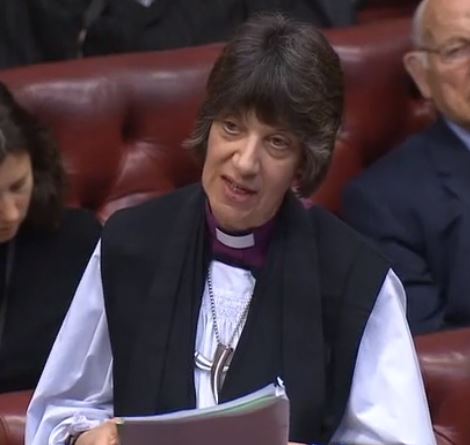
The Lord Bishop of Gloucester: My Lords, I am grateful for the varied contributions heard today from noble and learned Lords, many of whom have vast experience in this area. I declare an interest as Anglican Bishop to Her Majesty’s Prisons in England and Wales and as president of the Nelson Trust.
As a Lord spiritual rooted in Christian hope, I look for a criminal justice system which is restorative, responsible and relational, and which is effective in focusing holistically on prevention and rehabilitation as well as appropriate conviction and punishment.
There are some welcome proposals within this very long Bill. These include community and diversionary cautions, problem-solving courts and additional support for employment for ex-offenders. There are other aspects that raise concern, and I will name just a few of them: increasing sentence lengths, police-led diversion, sentencing of mothers, racial disparities and young offenders.
First, the use of life sentences for younger offenders seems to undermine any chance of reform or redemption. It comes as part of a suite of measures on sentencing which will put ever more pressure on an overcrowded and struggling prison estate, with predictable negative consequences for education and rehabilitative work. Decades of tweaks to lengthen sentences have done nothing to improve the outcome for offenders, prevent cycles of reoffending or improve support for victims. Our sentences are already longer than those of most of our European neighbours, who do not suffer from higher rates of crime; nor are their citizens notably less safe.
My next comment is to encourage improvements in enabling considerable investment so police can consistently divert vulnerable people into support services using community resolution and out of court disposals. People often get caught in the revolving door of repeat low-level crime, simply because they are destitute, traumatised, often homeless, suffering mental ill-health and struggling with addiction.
The Nelson Trust runs Project SHE, a point-of-arrest referral scheme in Avon in Somerset. Over 500 women were diverted away from the criminal justice system in its first two years. Seventy-five percent of these women have four or more complex needs. Over the years, I have seen how repeated short sentences and the revolving door of custody particularly damages women and their families. More must be done, as has been said already, to protect the right to family life of children when their mother is sentenced.
Reportedly, the vast majority of children have to leave their home when their mother goes to prison. Parental imprisonment is recognised as an adverse childhood experience that can have a substantial negative impact on children’s long-term health and well-being, as well as educational attainment. It can also seriously affect their life expectancy and the likelihood of going to prison themselves.
I am not suggesting that no mother should ever go to prison. What I am saying is that, through the passage of the Bill, we can ensure that the right and appropriate response is delivered. For the vast majority of women, that is not prison. May I once again say that we most certainly do not need an additional 500 prison places for women?
I want to comment briefly on how troubling it is, after all that has transpired in recent years, that little attention is still being paid to racial disparities in the criminal justice system. It will be hard to build community resilience or confidence in a system while this is not acknowledged. According to research, young black adults are over eight times more likely to receive a conviction for a low-level, non-violent crime compared with their white counterparts. More must be done. One interesting option among a raft of options to reduce this disparity could be to remove the need for an admission of guilt to receive a community caution.
My next comment is around the issue of an expansion of whole-life orders to younger offenders. On these Benches, we welcome the efforts to reduce the number of children held in remand custody, but not measures that could see greater numbers of children serving longer custodial sentences. Treating children as children is paramount, particularly given what we know about maturity. My friend the right revered Prelate the Bishop of Derby, who is unable to speak today, will be following these issues closely.
Time is up, so, in summary, we must find effective ways of preventing people entering cycles of criminality and reoffending, as well as strengthening and protecting communities. This can be done only by a criminal justice system that inspires confidence and is rooted in a consistent ethos and strategy at every level that is based on evidence and research and joins up the work of the police, courts, probation, parole, prison and civil society organisations within a framework that is restorative, responsible and relational.
Extracts from the speeches that followed:
Baroness Bennett of Manor Castle (GP): The noble Baroness, Lady Stowell, lamented that social norms are breaking down. Great: I have a shortlist—it could be a very long list—of norms that should break down. As the right reverend Prelate the Bishop of Gloucester highlighted, these norms see black young adults being more than eight times more likely to be convicted for a non-violent minor crime than their white counterparts. These norms see some 17,000 dependent children affected by the imprisonment of their mother each year; the widely acclaimed Corston report, completed 15 years ago, which said that most women offenders who get prison sentences should not, has not been implemented. As the noble Lord, Lord Bach, said, these norms see legal aid cut not just to the bone but deep into the marrow, unavailable to many who desperately need it, when we know that justice unfunded is justice denied.
Lord Marks of Henley-upon-Thames (LD): The sentencing provisions in the Bill are overwhelmingly retrograde, pandering to the tabloid view that longer sentences reduce crime. But all the evidence is to the contrary, as my noble friend Lord Beith pointed out—granted that locking up people for longer affords the public the temporary protection of keeping some offenders in custody. But the price of that protection far outweighs any benefit. We pay the cost of imprisoning more people than any other nation in western Europe, but we also institutionalise offenders; we break up families; we make offenders less employable and therefore more dependent on the state; we overcrowd our prisons, which have become violent academies of crime; and so we increase reoffending and the human, social and financial cost of divided and criminalised communities. Yet the Bill establishes more minimum sentences; restricts the discretion to depart from some in cases where there are exceptional circumstances; increases many terms to be served from half to two-thirds of notionally determinate sentences; and ends automatic release at the halfway point for many sentences.
On community sentences, we see increased curfew hours and periods, but nothing about increasing help for offenders to turn their lives around. There is provision for recall to custody for breach of community orders, with short custodial penalties, in the face of all the evidence that these do not work and have a disproportionate effect on women and minorities and an adverse effect on families—points persuasively made by the right reverend Prelate the Bishop of Gloucester.
Baroness Williams of Trafford (Con, Home Office): On the concerns about longer sentences, the noble Lords, Lord Beith, Lord German and Lord Hendy, the right reverend Prelate the Bishop of Gloucester and my noble friend Lord Attlee expressed concern that this legislation will lead to further increases in the prison population. We are committed to a sentencing framework that takes account of the true nature of crimes and targets specific groups of offenders accordingly. The proposals aimed at serious offenders do just that—they are highly targeted interventions for the most serious and most dangerous offenders, and those of most public concern. However, at the other end of the scale, the Bill also looks to divert offenders away from a life of crime and support them into rehabilitation.
The right reverend Prelate the Bishop of Gloucester, the noble Lord, Lord Rooker, and others raised the issue of female offenders. We are actively looking to target female offenders through our problem-solving courts pilot, aiming to reduce the volume and frequency of reoffending, increase health and well-being and improve the maintenance of familial relationships compared to standard court processes and disposals for vulnerable female offenders. We intend to pilot these measures in four to five courts, at least one of which is anticipated to focus on piloting problem-solving measures for female offenders who meet the eligibility criteria. The Government remain fully committed to delivering the female offender strategy, which sets out a very ambitious programme of work to address the specific needs of female offenders.
The noble Lords, Lord Dubs, Lord Rooker and Lord Pannick, and the right reverend Prelate the Bishop of Gloucester raised the issue of the sentencing of primary carers. The case law in this area makes it clear that the court must perform a balancing exercise between the legitimate aims to be served by sentencing and the effect that a sentence has on the family life of others, particularly children. The effect of a sentence on others may be capable of tipping the scales so that a custodial sentence which would otherwise be proportionate becomes disproportionate. However, there will be cases where the seriousness of the offending is such that, despite the existence of dependants, a custodial sentence is warranted. In such cases, it will still be open to the court to find that the effect of a sentence on others is such as to provide grounds for mitigating the length of a custodial sentence.
 The Church of England in Parliament
You must be logged in to post a comment.