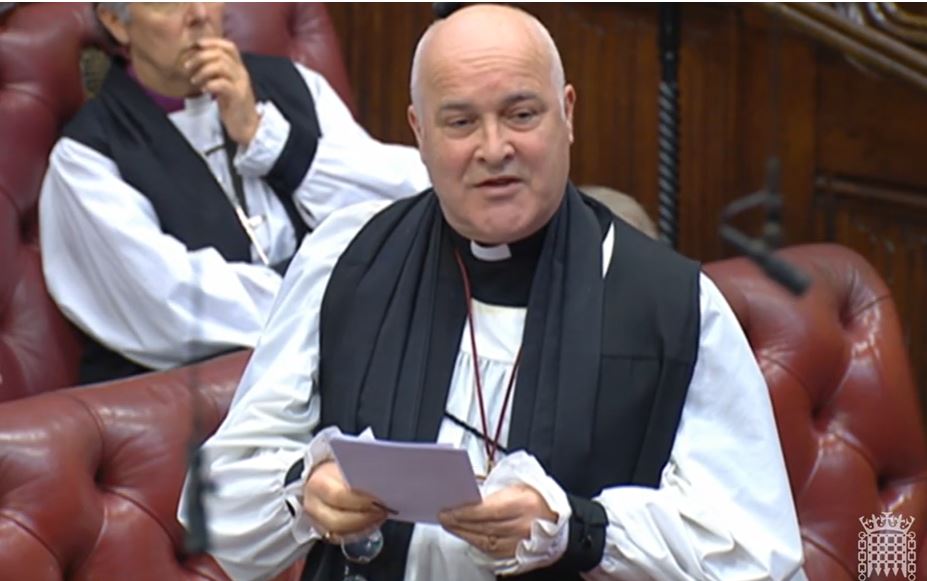
During a debate on the government’s social care strategy on 22nd March 2023, the Archbishop of York asked a question on reforming the social care workforce, emphasising the need to value care workers:
The Lord Archbishop of York: My Lords, the report by the Archbishops’ Commission on Reimagining Care was published in January. I am sure that the Minister is aware of this: in fact, I know that he is having a meeting later today with the right reverend Prelate the Bishop of Carlisle, who co-chaired that commission. We argue for a very bold approach to social care, which puts at its heart the concept of a care covenant, with clear expectations on each of us of what we should give and expect in return, recognising that each of us is a carer and that most of us will need care one day.
The Bishop of Derby received the following written answer on 22nd March 2023:
The Lord Bishop of Derby asked His Majesty’s Government:
what steps they have taken to improve the opportunities for sport and physical activity for women and girls in the criminal justice system.
what progress they have made in improving the availability of sport and physical activity for women and girls in the criminal justice system; and what plans they have to expand provision.
Lord Bellamy (Con): Encouraging engagement in sport and exercise amongst women and girls in contact with the criminal justice system can have a significant impact on reducing reoffending through both early intervention and diversionary activities, as well as rehabilitation for those sentenced.
The Bishop of St Albans received the following written answers on 22nd March 2023:
The Lord Bishop of St Albans asked His Majesty’s Government, further to the Written Answer by Lord Benyon on 8 March (HL5863), how much they paid to farmers in 2022 as part of the Avian Influenza Compensation scheme.
Lord Benyon (Con): In 2022, a total of £41.0 million was paid in compensation to bird keepers whose flocks were culled for avian influenza disease control purposes.
On 21st March 2023, Baroness Pinnock tabled a Motion to Regret on the Building Safety (Leaseholder Protections) (England) (Amendment) Regulations 2023. A vote was held on the motion, in which Bishops took part:
Division 1:
The Bishop of Manchester, the Bishop of St Albans, the Bishop of St Edmundsbury and Ipswich, and the Bishop of Worcester took part in a vote on Baroness Pinnock’s motion to regret regarding the Building Safety (Leaseholder Protections) (England) (Amendment) Regulations 2023:
Baroness Pinnock moved that this House regrets that in laying the Building Safety (Leaseholder Protections) (England) (Amendment) Regulations 2023 (SI 2023/126) His Majesty’s Government have not published data on the number of landlords who have benefited from an error which allowed landlords to transfer costs of remedying historical building defects on to their leaseholders; further regrets that His Majesty’s Government have no intention to identify leaseholders affected by that error to advise them to appeal to the First-tier Tribunal to recover costs; and calls on His Majesty’s Government to publish these figures in a spirit of transparency and write to those affected with clear guidance on how to recover costs.
The motion was agreed. Content: 185 / Not Content: 138.
The Bishop of Manchester, the Bishop of St Albans, the Bishop of St Edmundsbury and Ipswich, and the Bishop of Worcester voted Content.
The Bishop of St Albans spoke in support of a motion to regret relating to leaseholder protection tabled by Baroness Pinnock on 21st March 2023:
‘That this House regrets that in laying the Building Safety (Leaseholder Protections) (England) (Amendment) Regulations 2023 (SI 2023/126) His Majesty’s Government have not published data on the number of landlords who have benefited from an error which allowed landlords to transfer costs of remedying historical building defects on to their leaseholders; further regrets that His Majesty’s Government have no intention to identify leaseholders affected by that error to advise them to appeal to the First-tier Tribunal to recover costs; and calls on His Majesty’s Government to publish these figures in a spirit of transparency and write to those affected with clear guidance on how to recover costs.’
The motion was agreed.
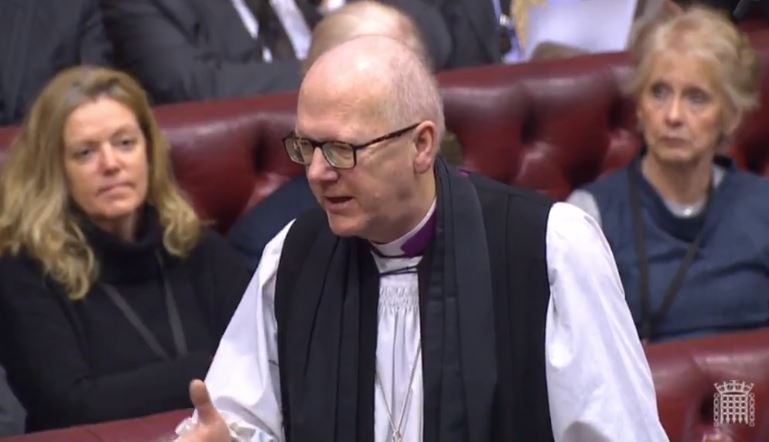
The Lord Bishop of St Albans: My Lords, I shall add a few words of support for the noble Baroness, Lady Pinnock. I stand with a weary sense of déjà vu, looking around at a number of people with whom I have sat as we have worked through building safety and fire safety measures.
What is interesting is that the Government fundamentally tried to grasp this problem. I pay tribute to the right honourable Michael Gove, who has been quite exceptional in taking hold of it and trying to solve it. I say well done to the Government for shifting the main problem in this very troubling area.
On 21st March 2023, the House of Lords debated the Financial Services and Markets Bill in committee. The Archbishop of Canterbury spoke in support of amendments tabled by Baroness Kramer which stressed the importance of the lessons learned from the 2008 financial crash:
The Lord Archbishop of Canterbury: My Lords, I have added my name to Amendments 241C and 241D tabled by the noble Baroness, Lady Kramer, and wish to speak briefly in support of them here. I am particularly grateful to the noble Baroness, Lady Noakes, who made some very helpful and powerful points.
As the noble Baroness, Lady Kramer, said, this marks 10 years since the publication of the Changing Banking for Good report from the parliamentary commission, on which I sat with her. The two amendments to which I have added my name are probing amendments to stress the importance of not forgetting the lessons of 2008-09, because people and sectors entirely can have very short memories.
As the noble Baroness has explained, the amendments seek to prevent alteration to two elements of the banking reform Act 2013 by statutory instrument without proper debate in Parliament, and to prevent changes which go against the recommendations of the parliamentary commission. Our memories have certainly been refreshed this week. If the debate on this group had been held when it was first scheduled two or three weeks ago, I think we would have had a very different reception. If one is grateful for anything in the present crisis, it is that we have been so warmly reminded of why we need a clear memory.
The Bishop of St Albans tabled a question on the health of the British banking sector on 21st March 2023:
The Lord Bishop of St Albans: To ask His Majesty’s Government what assessment they have made of the health of the British banking sector, following the challenges faced by overseas banks.
Baroness Penn (Con): The UK Government welcome the steps taken to support financial stability on Sunday by the Swiss authorities relating to Credit Suisse. This follows the sale on 13 March of Silicon Valley Bank UK to HSBC after the resolution of its US parent. No other UK banks have been materially affected by these actions. The Governor of the Bank of England has confirmed that, in his view:
“The wider UK banking system remains safe, sound, and well capitalised.”
On 21st March 2023 Rt Hon Ben Bradshaw MP spoke to a Motion he had tabled in the House of Commons, for leave to bring in a Bill on same sex marriages in the Church of England. The Second Church Estates Commissioner, Andrew Selous MP, responded.
SAME SEX MARRIAGE (CHURCH OF ENGLAND): TEN MINUTE RULE MOTION
Mr Ben Bradshaw: That leave be given to bring in a Bill to enable clergy of the Church of England to conduct same sex marriages on Church of England premises in certain circumstances; and for connected purposes.
Ben Bradshaw introduces his Ten Minute Rule Bill and Andrew Selous responds
A transcript of the response from Andrew Selous is below:
Mr Andrew Selous MP (Second Church Estates Commissioner): Thank you very much Mr Deputy Mr Speaker. I do not intend to divide the House, but it is necessary to respond to the Bill in my capacity as Second Church Estates Commissioner, because it seeks to usurp the role of the democratically elected General Synod of the Church of England, as well as to remove the freedom of the Church of England to decide its own doctrine, a freedom which Members on all sides of this House champion for religions and beliefs all over the world, and one that we should therefore apply equally to the Church of England.
There are passionately held and differing views about same sex marriage on all sides of this House and I am also acutely aware of the personal pain and hurt that this issue causes for so many people. But it is for the democratically elected assembly of the Church of England, the General Synod, to decide matters of doctrine rather than Parliament. And this has been the settled convention for nearly fifty years, since the 1974 Worship and Doctrine Measure was approved by Parliament.
At the General Synod last month, it was agreed that the Prayers of Love and Faith proposed by the bishops would be finalised, that the pastoral guidance for clergy would be produced, and that a welcoming culture towards LGBTQI+ people would be embedded throughout the Church. It was also agreed not to change the doctrine of marriage. And that Motion was passed by a clear majority in all three Houses of the Synod. Amendments to require the bishops to bring forward proposals for same-sex marriage to the next meeting of Synod and to revisit the issue within the next two years, were rejected by the House of Bishops, the House of Clergy and the House of Laity.
The Right Honourable Gentleman’s Bill proposes that the decision of the Synod, arrived at prayerfully and democratically, should simply be set aside.
In this House, we do not all agree with each other, but we do respect everyone’s right to be here because we have all been given our mandate through the same black boxes on election night. I would ask that the Members of this democratically elected House show the same respect to the democratically elected members of the General Synod.
Directing the Church of England on doctrine is not the job of Parliament. It would infringe on settled principles of religious freedom, which we argue for our sisters and brothers overseas, and it would call into question the rights and protections of conscience for other denominations and faiths as well. Several Catholic members of this House came up to me after the Urgent Question on the 24th of January and told me how grateful they were that Parliament was not telling their church what to do!
The Bill is also unnecessary as should Synod decide to change the doctrine of marriage in the future, it could do so. It would produce a Measure, which would come before Parliament and amend the 2013 Marriage Act. There is no need therefore for Parliament to act independently to change the Act.
Although the Bill is intended to be permissive and not to compel any member of the clergy to solemnise same-sex marriage, it is just not possible to leave it to individual clergy to choose to do things that are clearly contrary to the doctrine of the church. Doctrine is not determined by local decision, varying by parish or diocese, but is decided centrally, not by a small group of bishops, but through the prayerful deliberation and decision of the democratically elected Synod. If the Church lost its ability to require compliance with its doctrine, this would be a breach of the Human Rights Convention as it would be contrary to article 9, read with article 11, for the State to interfere with a religious organisation’s ability to require compliance with its own doctrine.
The Bill’s attempt to give individual freedom and choice would be unworkable and would breach the longstanding convention that Parliament does not legislate for the internal affairs of the Church of England without its consent.
I honoured my commitment to tell the General Synod the views of Parliament as expressed in the Urgent Question on the 24th of January, and I know that the General Synod will continue to listen carefully and respectfully to the views of this House, just as I would ask Parliament to be respectful to the views of the Synod.
Note: The Motion was not opposed in a vote and the Bill was presented, though it will be unlikely to progress any further due to lack of time in the parliamentary session.
The Bishop of Durham received the following written answer on 21st March 2022:
The Lord Bishop of Durham asked His Majesty’s Government, further to the Joseph Rowntree Foundation report An Essentials Guarantee: Reforming Universal Credit to ensure we can all afford the essentials in hard times, published on 27 February, which found that “95 per cent of people on Universal Credit facing debt deductions are going without essentials”, what steps they are taking to prevent debt from being (1) generated, and (2) sustained, in the social security system.
The Bishop of St Albans received the following written answers on 21st March 2022:
The Lord Bishop of St Albans asked His Majesty’s Government what plans they have to limit the spread of Phytophthora ramorum in trees in England.
Lord Benyon (Con): Phytophthora ramorum is primarily distributed across the western regions of GB affecting larch plantations. For over twelve years we have had a robust management programme in place, including aerial and ground-based surveillance and risk-based inspections at nurseries and retail sites. Scotland and Wales have their own management programmes.
Where it is found, given the economic impact of the disease to the forestry industry, Statutory Plant Health Notices are served requiring the destruction of infected trees and those nearby. Specific measures are taken related to the handling, movement and processing of larch infected with P. ramorum, to prevent the spread through the trade in timber and related products.



 The Church of England in Parliament
You must be logged in to post a comment.