
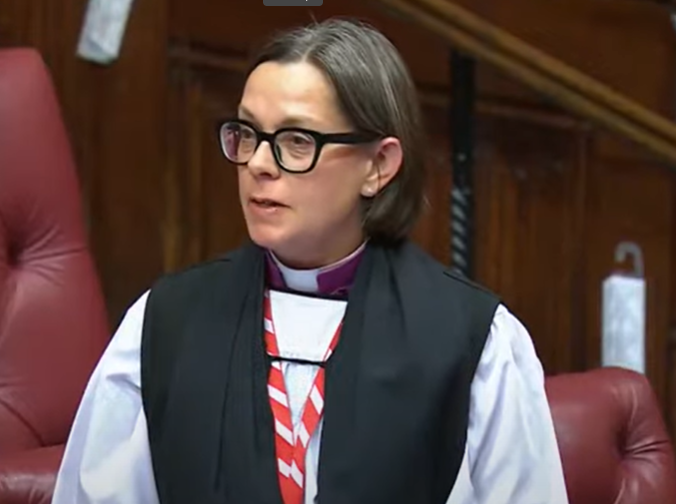
On 24th April 2026, the Bishop of Newcastle spoke in the final committee debate on the Terminally Ill Adults (End of Life) Bill before the prorogation of Parliament, stressing the serious nature of the issues contained in the bill and the concerns raised by the ongoing debate in the House of Lords:
The Lord Bishop of Newcastle: My Lords, I speak as one of the Lords spiritual and as a member of the Select Committee that examined the Bill. I do so with a deep sense of responsibility for the integrity of our legislative process and for the dignity and protection of those whose lives may be most directly affected by what we decide. I have been deeply moved by the personal stories that have been shared by noble Lords in recent months and wish to acknowledge the stories that my noble friend shared with us just now. My own dear cousin died earlier this week from a condition that could at many stages have been described as terminal. She continued resolutely to live life to its fullness, and her sudden death is a matter of great sadness to me.
In our context, where questions of life, death, care and conscience are so closely intertwined, the quality of our scrutiny is not a procedural detail. It is a moral necessity. Some may dismiss my contribution as one grounded in a faith, but this is as legitimate and significant as any other viewpoint, whether grounded in faith, belief or none. While my faith informs my alarm at our designation of dignity or the lack of it, it is from my experience on the Select Committee that I have found that, the more closely we have examined this Bill, the more concerns have come into focus, not fewer. For a Bill of this magnitude in terms of societal change, the highest level of scrutiny is imperative. Within our proceedings, there has been an acknowledgement, even from those closely involved in the Bill, that it is not yet in a settled or satisfactory form. When such admissions are made, it is incumbent on us to listen with care.
The Select Committee heard evidence that raised a number of unresolved and deeply serious questions. These questions were practical as well as deeply principled: whether the state should be obligated to address unmet need before assisting someone to die, even if in doing so the person’s mind might be changed; how we ensure that we continue to uphold our duty to suicide prevention for those who are terminally ill; how such a significant change in the law would be delivered in a way that does not put vulnerable people at further risk; and how this would work for extremely vulnerable populations who do not have the same choice, such as prisoners. These are not marginal concerns. They go to the heart of how we understand protection, vulnerability and moral responsibility.
Across this House, Peers from many different perspectives have expressed concern. That breadth of unease ought not to be dismissed lightly, yet I share the concern that the time afforded for debate has often been limited in ways that do not reflect the gravity of the subject. When the Bill was first introduced, it contained a number of delegated powers of a kind that, as noble Lords have already pointed out, rightly attracted concern. While some adjustments may have been made, the underlying issue remains—whether too much is being left unresolved, to be determined later rather than clarified now. There must be opportunity for a deliberative process as these are examined. Moreover, the committee and the House more broadly have raised a number of detailed questions to which clear answers have not always been forthcoming from the Government or their advisers. That lack of clarity makes it difficult for us to discharge our duty with the confidence that is required.
In my ministry, I am often reminded that how we care for those at the end of life is a measure of our common life together. That care must be marked by compassion, clarity and a steadfast commitment to protect the most vulnerable. For that reason, I believe we must continue to proceed with great caution. Until the questions that have been raised are answered more fully and until this Bill has received the depth of scrutiny it requires, it would be irresponsible to allow it to move forward. This is not about resisting change. It is about ensuring that any change we make is just, humane and worthy of the trust that is placed in us.
Extracts from the speeches that followed:
Lord Baker of Dorking (Con): As I said, one reason I support the Bill is that it reduces the suffering of people when they slowly begin to lose control of their own bodies. It was very interesting to hear what the right reverend Prelate the Bishop of Newcastle said, because in previous debates the main argument was about the sanctity of life. It is only the Bishops who continue to make that argument; no one else will make the argument because what we are concerned with are the safeguards, and this Bill will reduce the suffering of people. As we slowly lose control over our own bodies, people can no longer get up and dress, wash or feed themselves, or prepare their food, or walk or run, or engage in any life whatever; they then lose control of their bowels and bladders, and it is a very unpleasant way to die. If you can get palliative care, you can anaesthetise pain, but you cannot anaesthetise indignity. This Bill allows people to die in a dignified, and sensible, way in their own homes.
Baroness Prentis of Banbury (Con): My Lords, I regret that I was not here this winter during the discussions on the Bill. But watching it on television has been a key part of the rhythm of the weeks that I have spent at home. During my chemo-induced cognitive dysfunction, the plot of “Midsomer Murders” was often beyond me, and the steroid frenzy I felt meant that I often could not settle to a book. But during 13 bouts of chemo and an operation, I kept returning Friday after Friday to this debate. Noble Lords may ask themselves, why? It may be because, as a government lawyer, the constitution is in me like the writing in a stick of rock. But it is also, of course, that as your normal procedures and love of friends, work, food and drink are taken from you because you have to remain isolated, the issues of life and death come sharply into focus.
What I watched, from a unique perspective, with my telly newly installed in my bedroom—shockingly, some might say—was impressive. It was the calm, quiet scrutiny of legislation. Far from few voices were heard, as some have said. I frequently had to consult the booklet to see who was speaking. I saw the former heads of royal colleges explain why no royal college can support the Bill. I saw lawyers worried that coroners are not able to feel that there are sufficient safeguards in the Bill. I saw former NHS managers worried about the effects on the service and staff that they care for so deeply. I saw experts on devolution get into the details. I was impressed by the deep experience of the Bishops, often speaking from their time as parish priests, who, frankly, have held more hands of the dying than the rest of us put together.
As I watched from the coalface of trying not to die, I felt huge sympathy for the very ill people who think that this Bill might be the answer to their problems. Illness leaves you with few options and little control. The systems can seem unyielding and, as a result, uncaring. In my experience, that is worse than pain.


You must be logged in to post a comment.