
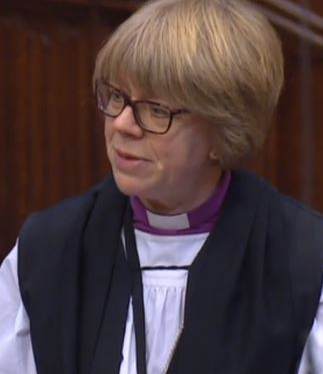
The Archbishop of Canterbury also spoke in the final debate on the Terminally Ill Adults (End of Life) Bill on 24th March 2026, reiterating her opposition to the bill and the need for a different approach to scrutiny and debate should the bill return to the House:
The Lord Archbishop of Canterbury: My Lords, I shall briefly make some reflections. It is a great privilege to follow my friend, the noble Baroness, Lady Rafferty; I thank her for her contribution. I recognise the enormous amount of work that has gone into this Committee stage. I am grateful to the noble and learned Lord, Lord Falconer, for meeting me; I thank him for the time that he has given me.
Noble Lords will know that I oppose the Bill in principle, both as a priest and as a nurse, but it is clear that some things unify us. Whether we support the Bill or oppose it, we are unified by the fact that we want people to die in a dignified, pain-free and compassionate way, with the least possible fear. I also believe that we are unified in the belief that there needs to be investment in palliative care now. I welcome the new modern framework for palliative care that the Government have introduced, but recognise that financial investment still needs to occur.
We are also unified around the fact that if this Bill or topic comes back in some form, we need to do our work differently. There is no doubt in my mind that this is one of the biggest societal shifts that we are seeing or will see. Therefore, we need to take our role seriously, as we have done. There is something about our learning for this process and looking forward to how we do it differently when it comes back. I was very taken by the view of the noble and learned Baroness, Lady Butler-Sloss, of pre-legislative scrutiny, although I do not know the details. We should look seriously at that.
We are also united in knowing that this touches some of our deepest emotions. I am grateful to those who have shared their own experiences and stories; I have felt very humbled listening to them. For me, as a Christian, this is clearly an eschatological question, as my friend, the noble Baroness, Lady Rafferty, said. Of course, for me, as a Christian, death is not the end. There is hope in death and life everlasting. As we talk about these things that touch us deeply, we need to look after each other and ourselves and recognise that this process will have impacted us, as well as those listening.
Extracts from the speeches that followed:
Lord Deben (Con): The second thing that I find very difficult is for it to be said that this is a robust and safe Bill, when, so far, it has not actually met the concerns of all the royal colleges. I entirely agree with the correction made by my noble friend: some of them are opposed to it for particularities, some want particular changes and one, I believe, is opposed to it in principle. However, the point is that we are seeking to make a fundamental change, and that is this other issue that I find so difficult. I think the phrase used by the most reverend Primate the Archbishop of Canterbury was societal change. This is not like the other Bills with which it has been compared; this would make a change to something that we have held as a society for hundreds of years. We have never thought it proper for the state to take life, except when we believed that it was all right for capital punishment, and we certainly believe it to be right in the case of a just war.
We have to face the fact that this would be a fundamental change. Some of the comments that have been made have been really concerning. When it is said, as it was, that this was about nitpicking changes, you realise that there was no understanding of the fundamental change that we are proposing. There are many who take a different view from me about that fundamental change, but we should all accept that this is not a passing issue that can be discussed easily.
Baroness Hunter of Auchenreoch (Lab): My Lords, I spoke at Second Reading to support my noble and learned friend Lord Falconer’s Bill, and I have been here throughout Committee. I am honoured to speak in the same debate as the most reverend Primate the Archbishop of Canterbury and also to follow the noble Lord, Lord Sandhurst, in one of his last speeches here. As a relative newcomer to your Lordships’ House—one of the newbies mentioned by the noble Lord, Lord Carlile—I am in awe, and will always remain so, of the great variety of expertise and experience of noble Lords. These last months have been proof of that writ large: powerful and persuasive arguments from some of the most eminent physicians, lawyers and other professionals in the country, as well as many noble Lords with a long history with the subject and a deep knowledge of this Bill.
I genuinely respect the views of opponents and have followed closely noble Lords’ many amendments and speeches. Indeed, there are among your Lordships long-standing and personal friends of mine, and noble Lords have made their arguments, some at great length. That is why I imposed a self-denying ordinance on speaking myself—until now. I speak up because the other aspect of this House that has so impressed me is the way in which we conduct ourselves: self-regulating, courteous, disciplined; scrutinising and improving legislation in order to fulfil our time-honoured duty of returning Bills to the other place, to our elected representatives. I am proud of our reputation and my role, but something irregular and troubling has gone on, and we all know this. There has been an atmosphere in the House on occasion, despite my noble and learned friend’s extraordinary good temper, which is not what I had hitherto known.
Baroness Cass (CB): When a Bill comes back to the House, I hope it may be possible that it starts from something we talk quite a lot about in the NHS: co-production. That is where we build the blocks upwards, with medical professionals and service users getting together to think about how a viable process might work in the NHS, and lawyers getting together to look at how this could proceed in an effective legal model, and so on for other experts. Rather than starting with pre-legislative scrutiny, as suggested by my noble and learned friend Lady Butler-Sloss and the most reverend Primate the Archbishop of Canterbury, we could start before it with building blocks to create legislation to which people with experience have contributed. That would gain the confidence of all the relevant professional bodies and, most importantly, the people who will benefit from it as patients.
Baroness Hayter of Kentish Town (Lab): We have heard in the debates that the amendments are actually about improving the Bill. But I know, and I think that we all know, that some people would never have supported the Bill, even if we had accepted a thousand amendments. The most reverend Primate the Archbishop of Canterbury—although she was a Prelate at the time—admitted this at Second Reading, saying that she was going to propose a vote against the Bill at Third Reading. We heard her say today that she is against it in principle, so for some these amendments were not about improving the Bill but because they opposed it in principle.
Had we just been interested in trying to make assisted dying safer for the vulnerable groups, we would not have had to have those amendments referred to—that everyone, including a man, should have to have a negative pregnancy test before they could apply for assisted dying. We would not have had to consider the idea that some of the very people who needed this—such as those in care homes—would be denied it; that anyone being treated in an NHS hospital would have to leave for a private place with different doctors and carers if they wanted an assisted death; or, indeed, that the intimate private discussions with the panel should take place in public, so that the public can watch people talking about why they wanted to bring their deaths forward. We would not have been told in the amendments that this all costs too much, even though the estimate is the same as what the NHS spends a year after accidents caused by people wearing flip-flops—I kid you not. The cost—
The Lord Archbishop of Canterbury: Will the noble Baroness confirm that while I have said very clearly that I oppose the Bill and that I would bring it to a vote on principle at Third Reading, I have not in fact tabled any amendments?
Baroness Hayter of Kentish Town: It was the in principle issue that I was discussing rather than amendments, but I take the most reverend Primate’s point completely.
Lord Falconer Thoroton (Lab): There was a moment when we heard from the noble Baroness, Lady Rafferty, who had been the president of the Royal College of Nursing; we then heard from the most reverend Primate the Archbishop of Canterbury, who had been the chief nurse of England and Wales; and sitting on the Woolsack we had the noble Baroness, Lady Watkins, who was a distinguished professor of nursing. That is an indication of the depth of knowledge we have in this House.
I am not going to say the normal thing about what a great debate it has been. Honestly, it has been a horrible debate. Unlike almost every other debate I have ever participated in, there has been quite an edge, particularly from the opponents of the Bill.


You must be logged in to post a comment.