
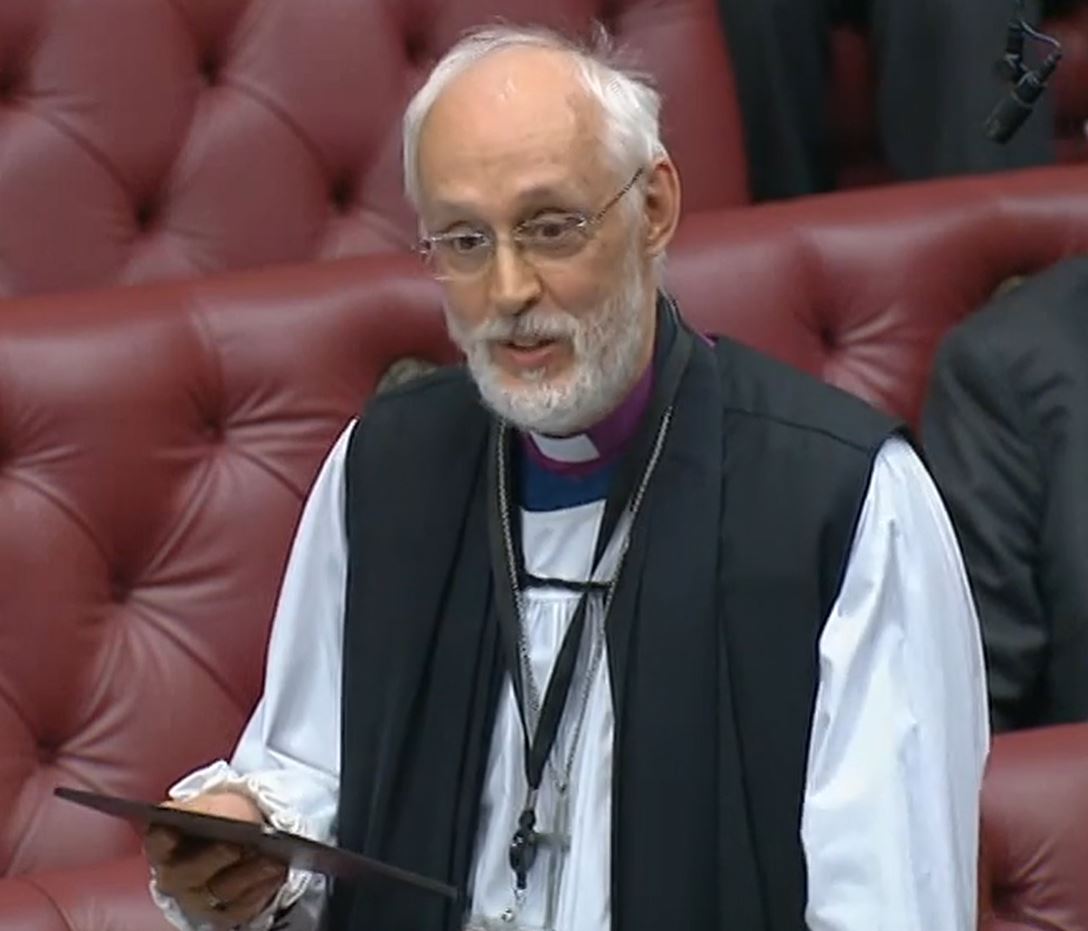
The Bishop of Manchester spoke during the King’s Speech Debate on foreign affairs, defence, and diplomacy on 21st May 2026, emphasising the need to balance security with civil liberties:
The Lord Bishop of Manchester: My Lords, before turning to the main substance of today’s debate, I briefly say that I warmly welcome the inclusion in the gracious Speech of a promise to tackle so-called conversion practices. These have severely damaged and traumatised many LGBT people over decades, not least when performed in the name of religion. I welcome that promise just as warmly today as I welcomed it from this same Bench on the three or four occasions when it has previously been made. I hope that, this time round, we will actually get to the point of legislating. Indeed, the General Synod of the Church of England overwhelmingly voted to press the Government to do just that several years ago.
Turning to today’s main topics, I want to speak briefly about Britain’s soft power, covert foreign influence and defending liberal democracy. As international threats grow more complex and less overt, Britain’s foreign policy and influence abroad depends less on traditional hard power alone and increasingly on proactive British diplomacy. Noble Lords have already alluded to this but, alongside our formal diplomatic missions, key institutions such the British Council and the World Service extend our cultural influence. Many of our universities, along with our public schools, play a key role in shaping future global leaders. They must be sufficiently supported and resourced to do the job we need them to do.
Equally, bodies such as the Commonwealth, and, indeed, my own Church of England, contribute to an extensive international network: we connect local communities, education institutions and development organisations, all of which promote British values such as human dignity and justice on a global scale. The most reverend Primate the Archbishop of Canterbury, speaking in the House earlier this week, highlighted that the Church builds bridges and fosters relationships across lines of race, faith and class. This role in fostering unity is absolutely essential in the face of an increasingly divided world. More broadly, these institutions develop long-term diplomatic relationships, and grass-roots engagement with them embeds liberal democratic principles in cultures abroad and promotes best practice in other nations.
We cannot ignore the growing prevalence of covert operations by foreign powers on British soil. In recent years, there has been a marked increase in incidents of transnational repression in the UK, such as the targeting of Iran International in 2023 and the poisoning of Sergei and Yulia Skripal in Salisbury in 2018, as well as in foreign actors who seek to radicalise British citizens. In the light of these threats, I welcome the Government’s commitment to tackle foreign interference, especially the proposed national security Bill’s focus on criminalising those involved in instigating, or indeed planning, the most violent and egregious attacks.
While previous legislation has already placed some caps on foreign political donations, I am also concerned about how technology-enabled routes of access to the British public may enable undue ideological influence over our political system, including seeking to weaponise differences of religion or heritage within the UK. Strengthening the transparency of donations to political campaigns, to individuals either directly involved in or prominently seen as being engaged in politics and to parties more broadly is essential if we are to defend the democratic integrity of our electoral processes.
I welcome the Government’s renewed interest in defending against these threats, but at the same time I remain concerned about the impact of some proposals on our civil liberties. Recent years have seen a steady tightening of regulations around protests. This has major implications for the freedom of expression that underpins our liberal society. It is crucial that any new government powers are firmly rooted in a commitment to maintain personal liberty and freedom of expression. I believe we can do this at the same time as ensuring that our freedoms are not abused as a means of promoting hostility. Others have already alluded to the dramatic rise in antisemitism that killed two of my Jewish neighbours on Yom Kippur last year and frightened so many others of us who live in the city of Salford.
Liberal democracy stands under threat, not only from non-democratic standards, but from what Viktor Orbán, lately of Hungary, proudly referred to as “illiberal democracy”. From Hungary to the USA, we see jurisdictions where votes may still be largely free and fair, but the use of executive patronage and commercial pressure to force the judiciary, the civil service, the press, religious institutions and businesses to collude with the leaders’ whims and wishes make democracy a very thin defence. That must never happen here. This United Kingdom, which I am so proud to serve in your Lordships’ House, is far more than a blot of pink on an increasingly multicoloured map. Britain is a way of life, a way of life inevitably far from perfect, but which can yet be a beacon of hope across the globe. That is what is worth defending. That is what our foreign and defence policies must provide.


You must be logged in to post a comment.