
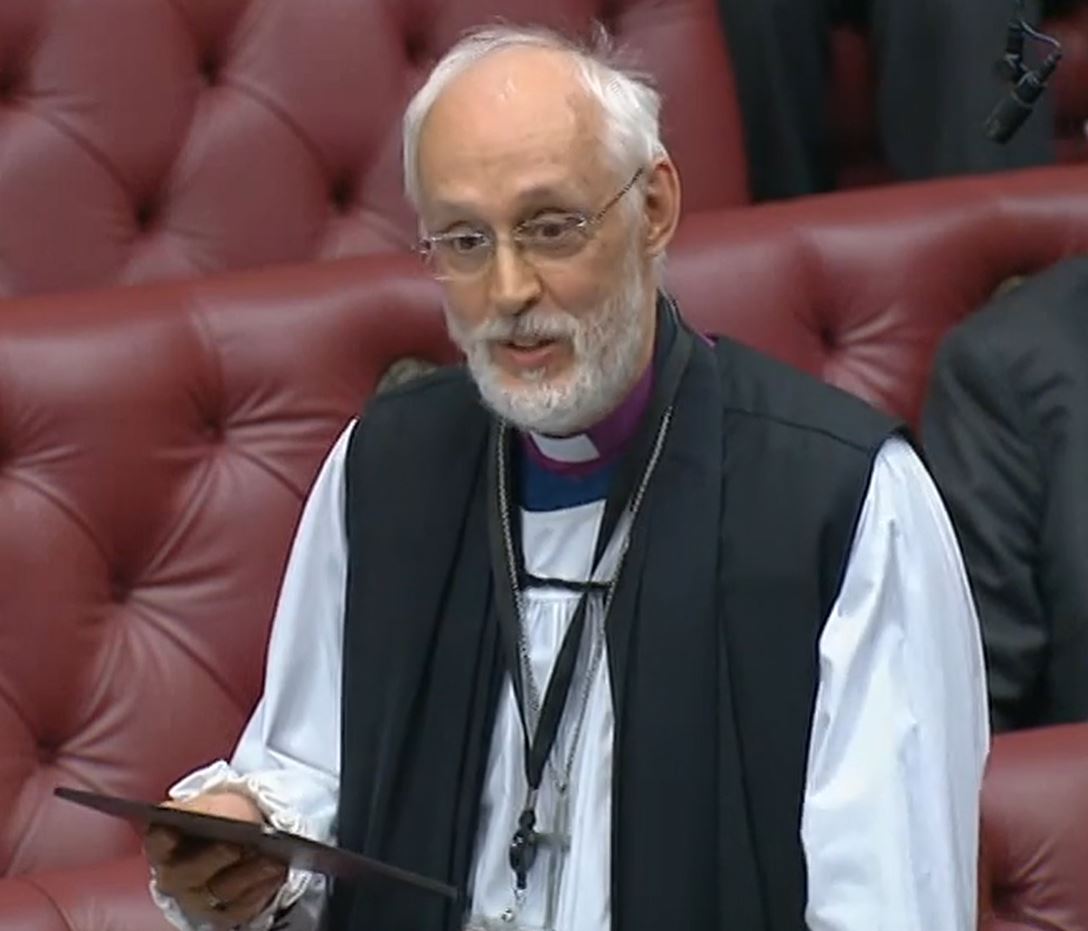
The Bishop of Manchester spoke at the second reading of the Social Housing Bill on 1st June 206, noting the need for secure and high-quality social housing to combat child poverty and help build communities:
The Lord Bishop of Manchester: My Lords, it is always daunting to follow the noble Lord, Lord Best, on a matter to do with housing. I begin by declaring my interest: I am the chair of the Church Housing Association, a recently formed, not-for-profit social housing provider that we are seeking to build, literally and metaphorically, on the five core values that were set out in the most reverend Primate the Archbishop of Canterbury’s commission on housing, Coming Home, which was debated in your Lordships’ House a few years ago. Those values—that social housing should be safe, secure, sustainable, sociable and satisfying—provide a set of tests against which any proposed legislation could be measured, hence I warmly welcome the Bill. It will make social housing better.
Housing is a fundamental human right. It is a foundation for other core rights, including things such as health, dignity, sanitation and sometimes the right to life itself. The Bill rightly addresses the concern that there is not enough stock in this country to house those in need.
We have heard some facts—I will offer one or two more. In June 2025, more than 172,000 children in England alone were living in temporary accommodation. For the last six years, temporary accommodation has been a contributing factor to the deaths of at least 74 children. Those are all government figures.
Lack of secure housing, moreover, is damaging our children’s ability to learn. I speak to secondary school heads in Manchester who are having to make special provision for study for children who have no permanent home, who sometimes arrive at school in the morning not knowing where a taxi will take them home to in the evening. We cannot allow this to continue.
Protecting and increasing our housing stock is an essential step to reduce the waiting list. That is why I welcome the Bill’s commitment to exempt newly built homes from the right-to-buy scheme and to streamline processes that will incentivise local councils to build more homes. Indeed, I applaud what is already happening, such as the increased investment in building housing for social rent that Manchester City Council has made in the last couple of years, supported by the Manchester Social Housing Commission, which it has been my privilege to chair. Yet, while building new homes and reducing leakage from the social housing sector are important, it is clear that the condition of our existing housing—as has already been mentioned—poses a very real threat to the health, well-being and lives of many social housing tenants. Here I turn, as others have, to concerns not adequately addressed by the Bill.
The measures introduced in Awaab’s law, as the noble Lord, Lord Best, referred to, were a direct response to the death of a young child in my diocese. These measures hold social housing providers to account for addressing the root causes of damp and mould, not just blaming them on the lifestyle of the tenants. Among those living in these conditions, the proportion with an occupant suffering from a health condition has now increased to 47%. Almost half of those living in those conditions have a health condition.
Alongside mould and damp, we are approaching a decade on from the Grenfell tragedy, yet too many people are still living in homes that do not provide adequate protection against fire. Some 44% of buildings with unsafe cladding have not yet even begun remediation works. These are official figures. I echo the noble Lord, Lord Best, by inviting the Minister to set out for us how the Government intend to prioritise the safety and condition of existing homes alongside the delivery of new housing.
I turn from stock condition to poverty. We are all created equal. We should all be afforded equal opportunities. For children growing up in poverty, their aspirations for the future are overshadowed by the constant burden their families face in making ends meet, confronting food insecurity or being unable to afford to heat the home properly. I have had to address this House too many times on the growth of food banks. If the Government do not prioritise making social homes more affordable—genuinely affordable does not mean 80% of market rent, and when we define it like that we are not only insulting Britain’s households; we are abusing the Oxford English Dictionary—and if we do not address this problem, the cycle of poor life outcomes for today’s children, tomorrow’s adults, will only continue.
Poverty is a problem not only for social renters but for those in the private sector. Currently, more than 45% of private renters are living in unaffordable housing, according to IPPR research. Might the Government consider introducing double-lock rent caps in private sector housing, not only to slow the growing number of private renters who are falling into poverty but to free up social housing stock by making this sector more accessible to low-income families?
Sometimes, over time, the unintended side-effects of what was a well-intended piece of legislation—it might have done some good in its time—can come to outweigh the merits of the policy behind it. Some 40% of properties acquired through right to buy appear in the private rented sector within 10 years. As the noble Baroness, Lady Pinnock, reminded us, they do so at much higher rents and often much poorer standards, both of physical maintenance and support for the tenants in them. That was not the intention of right to buy but that has been the outcome.
At the same time, it is now beyond any remaining doubt that subsidies to enable first-time buyers to get on to the housing market have done little more than further inflate property values. That is all they have done; there was a report on it in just the last week or so. The real beneficiaries have been the volume builders and those with significant capital already in property. Money that could and should have been spent building more social housing or keeping rents lower has been wasted on pointless political posturing. Can we be assured that that era is now over?
This housing crisis is not just a question of supply but of dignity, health and justice. The Church of which I am proud to be a part is committed to its long-standing role in building communities and supporting social cohesion. But families cannot participate in community life when their most basic needs are not being met. This Bill will be judged not only by the number of homes it delivers but by whether those homes enable renters to feel safe and secure, plan for their futures and nurture their communities.
Back in 1990, as a young parish priest, inspired by the noble Lord, Lord Best—he was not a Lord then but he was a great campaigner for housing—I wrote to my then bishop. I warned him that the crisis of unemployment that had plagued the 1980s was about to be superseded by a crisis in social housing. Some 25 years on, that crisis is still with us. This Bill can be a big step towards addressing it. I look forward to its progress.
Extracts from the speeches that followed:
Baroness Warwick of Undercliffe (Lab): My Lords, it is an honour to follow the right reverend Prelate the Bishop of Manchester, who has consistently championed the social housing sector.
Social housing is a vital national asset built to provide families on low incomes with a safe, secure, affordable place to live. After decades of marginalisation and underfunding, the tragic reality is that thousands of families still lack a safe and affordable home. Over 170,000 children currently live in temporary accommodation. I am proud that after a regrettable period of decline and marginalisation under successive Conservative Governments, this Government are once again asserting the value and importance of social housing. The Social Housing Bill is an important pillar of this work.
Baroness Watkins of Tavistock (CB): Finally, can the Bill make provision for councils to consider purchasing additional social housing stock that is currently vacant? The latest data, to which I was so kindly referred by the noble Baroness, Lady Taylor of Stevenage—I received her note only this afternoon—states:
“The overall number of unsold units increased”,
by December of last year, “by 11%” from the previous quarter,
“to 7,313, with the number of units unsold for over six months … increasing … to 3,016 units, the highest number since December 2023”,
indicating the points that other noble Lords have made about the difficulty of selling stock at the moment. Is it not time that we bought this stock and put it into social ownership for rent? Further investigations could be done across England to understand the detail more fully. How can we allow such properties to remain vacant for prolonged periods after completion while families with children live in temporary accommodation? The right reverend Prelate the Bishop of Manchester identified this challenge.
The Bill is welcomed, but let us swiftly try to improve its intentions, so that we genuinely increase the social housing stock at pace and make life happier and healthier for many of our population.
Baroness Thornhill (LD): I am grateful to follow all the contributions. I started off making notes of what people were saying, because the seven minutes has given us time to get some detail and some quality. I will not make a list of everybody, but I will quickly go through some thoughts outside the scope of the Bill that are quite interesting. I will kick off by saying that I was quite troubled—I echo what the noble Baroness on the other side said—by some of the comments made in the Chamber, particularly around who the “true” people who need social housing are and about the most vulnerable people in society being “state dependent”. I want to register that that has made me feel really uncomfortable.
However, I was greatly enlivened by the noble Lord, Lord Rook, and the right reverend Prelate the Bishop of Manchester, who brought together housing injustice and poverty, and of course most poignantly by the noble Lord, Lord Bird. The connections between health, housing and poverty were ably brought out by my noble friend Lady Teather, the noble Baroness, Lady Murphy, and the noble Lord, Lord Babudu. They are inextricably linked, and as people in this world we absolutely know that.
Baroness Taylor of Stevenage (Lab, DHCLG): We are all concerned about the safety and decency of social housing. There have been a number of mentions of Awaab’s law in our debate today. The noble Lords, Lord Best, Lord Babudu and Lord Stoneham, the right reverend Prelate the Bishop of Manchester and the noble Baronesses, Lady Murphy and Lady Jones, all highlighted these issues. Reforms are already under way which will deliver transformational and lasting change in the safety and quality of social homes. The newly updated decent homes standard will ensure that all rented homes in England are decent, safe and warm, designed with tenant safety at their core, while remaining proportionate and affordable for providers to deliver.
In addition, the Government have legislated on Awaab’s law, requiring social landlords to investigate and fix damp, mould and emergency hazards within strict timeframes. We have committed to bring forward regulations for further hazards using a test and learn approach. We will announce timings for the implementation of phase 2 in due course.
 The Church of England in Parliament
You must be logged in to post a comment.