
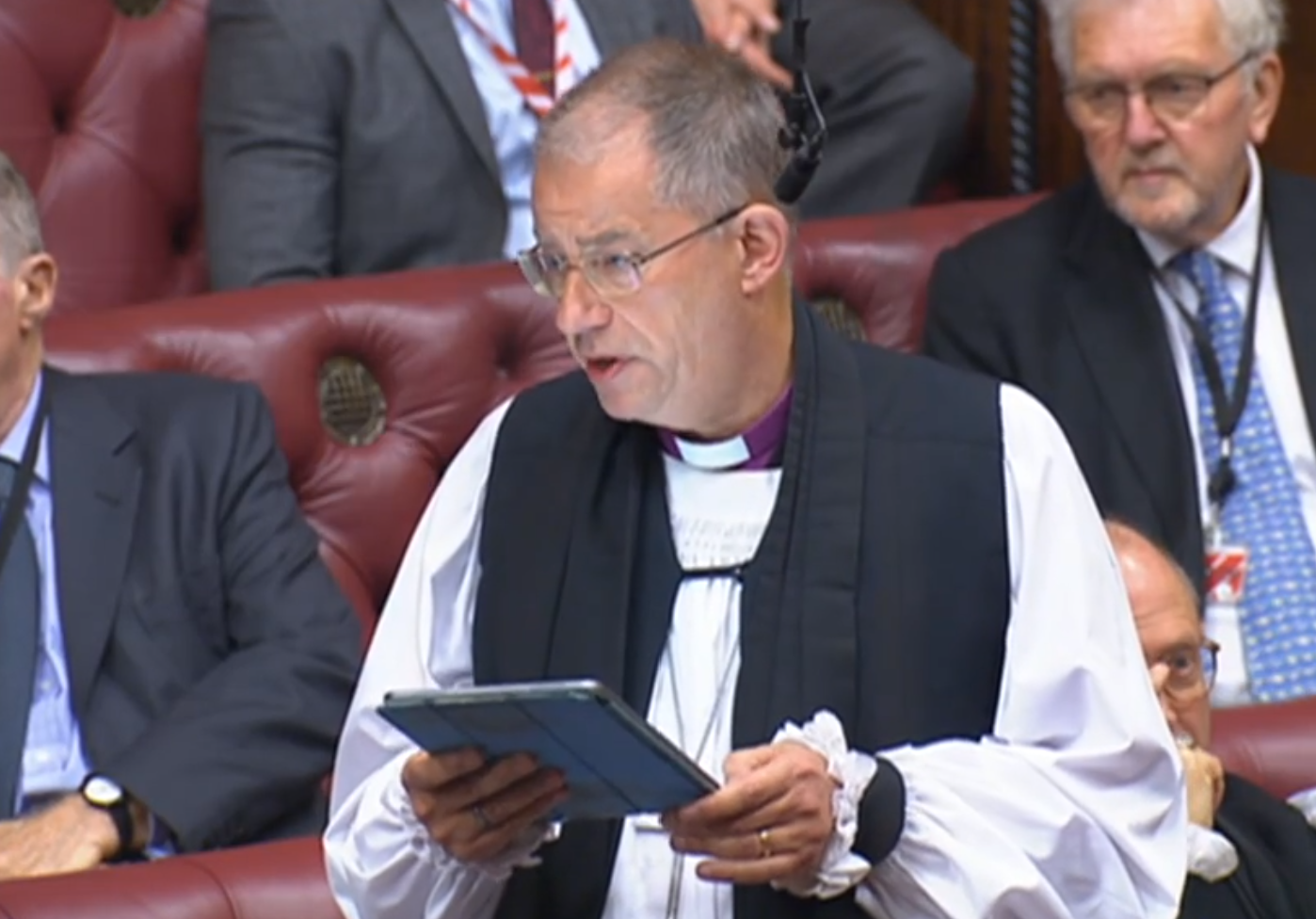
The Bishop of Oxford spoke in the Archbishop of Canterbury’s debate on AI and society, raising the impact of AI adoption in the workplace and the need for meaningful employment pathways for UK workers:
The Lord Bishop of Oxford: My Lords, it is a real pleasure to take part in the debate and particularly to follow the noble Lord, Lord Tarassenko, with his wisdom and great knowledge of the field.
Humanity stands at a real crossroads in the present moment. Artificial intelligence brings many potential benefits, as the most reverend Primate the Archbishop of Canterbury said, but also great jeopardy for the world. The Prophet Jeremiah invites the people of his generation facing crisis to:
“Stand at the crossroads, and look, and ask for the ancient paths, where the good way lies; and walk in it, and find rest for your souls”.
The primary risk of AI in the present moment is that the technology is being developed primarily for profit, financial gain and shareholder benefit—as the noble Baroness, Lady Kidron, said—rather than for the benefit of humanity and our common home. Those commercial gains are mind-boggling for the few. But as profits rise, the very concept of what it means to be human is being reduced. Human beings shrink in dignity and glory to become simply consumers of goods or services—here to give our attention, money, brand loyalty and image—or else women and men, made in the image of God for life in all its fullness, are reduced to units of production, serving the algorithm and filling in the ever-diminishing gaps left by robots and AI.
Warehouses, call centres, transport, entry-level jobs in the professions and coding are all seeing vast reductions in the workforce in the aim of efficiency. We need a different kind of prophet now. What kind of future are we creating? Is it an empty utopia for some, based on entertainment that will not satisfy and what feels like slavery for others?
Nowhere is this dilemma seen more clearly than in the area of work. Elon Musk famously predicted in 2023, in dialogue with our then Prime Minister, that AI will put an end to jobs, as if that is a good thing. But work is not merely an instrument. As Pope Leo has argued, work
“expresses and enhances the dignity of our lives. It is a requirement of the human condition, a normal path toward maturity, development and personal fulfilment”.
Last year, in the diocese of Oxford, we invited 100 young people, mainly sixth-formers, into our clergy conference to listen to their concerns about the world in small groups. AI and tech were at the very top of their list for a variety of reasons, but the most common was what AI would do to the jobs and careers of these outstanding young people. Those fears have been underscored, as noble Lords have said, by Alan Milburn’s report on the rising number of young people not in education or employment, and by the cries of those submitting hundreds of applications and being turned down by AI in now dehumanised appointment processes. Our young people are more than data points, more than slaves to the algorithm and more than consumers. This kind of societal change is not inevitable. Technological change is not always progress. AI development needs the brake as well as the accelerator, as one of the founders of Anthropic said last night.
The UK can be, and needs to be, structured in such a way that there are meaningful pathways into good, creative employment and lifelong work as the foundation for human dignity, well-being and stable family life. We therefore need a much bigger, wider conversation on the societal impact of AI, drawing in the whole of our society. Governments need a richer, deeper understanding of what it means to be human, beyond creating a nation of consumers to a nation of citizens, drawing on the ancient paths of wisdom. That conversation will then be able to shape our economy for the benefit of families and society, not simply the profits of technology companies.
We need more investment, not less, in entry-level jobs, a rehumanising of the application and support process, more dialogues on the risks and dangers of working with algorithms, and some bigger thinking. A century ago, our nation responded to another new technology with the founding of the BBC—a radical step for the common good. We will need similar new institutions for the public benefit.
I sincerely hope for a response from the Minister to this debate which will demonstrate humility and acknowledge the crossroads, the jeopardy, and which will seek to broaden and deepen the conversations on the choices we must make.
Extracts from the speeches that followed:
Lord Clement Jones (LD): This really has been a stimulating and thoughtful debate. I never expected it to range from the Pope to Star Trek, but nevertheless, it has been extremely wide ranging. I very much welcome the Church’s continuing involvement in AI policy. The right reverend Prelate the Bishop of Oxford was a member of the original House of Lords AI Select Committee, which I had the honour of chairing. It was he who proposed the ethical framework of five principles that the committee adopted in its 2018 report. Those principles—that AI should serve the common good, operate with intelligibility and fairness, respect data rights and privacy, be accompanied by universal AI education and never be given the autonomous power to hurt, destroy or deceive human beings—have since found their way, in substance, into the G20 AI principles, the OECD AI principles and a succession of international declarations. The right reverend Prelate planted those seeds in 2018.
As a liberal humanist, I come to these questions from a different angle from the most reverend Primate and the right reverend Prelate. But this debate has demonstrated, as many noble Lords have mentioned, a convergence of values that goes beyond well beyond any single set of beliefs. Pope Leo’s Magnifica Humanitas encyclical, mentioned by so many noble Lords today, deserves attention well beyond the 1.3 billion Catholics it formally addresses. It is an alliance, as the right reverend Prelate the Bishop of Portsmouth said. What is most compelling is the encyclical’s insistence that no person can be reduced to productivity, cognitive performance or mere data, and that every human being bears a freedom and value no machine can replace or block. I would express that in the language of liberal rights rather than theology, but the substance is identical.
A number of noble Lords—including, I think, most recently the noble Lord, Lord Parkinson—described the benefits of AI. We have also talked about some of the risks, in particular hidden risks such as the threat to resilience and the deskilling of curiosity: “offloading”, as the noble Baroness, Lady Spielman, described it. Those risks have been extremely cogently articulated today.
Lord Markham (Con): The same story repeated itself in the 20th century. Manufacturing employment declined dramatically, yet society adapted again. One hundred years ago, there were no software engineers, cyber security specialists, sports psychologists, social media managers, professional gamers or personal trainers. Indeed, the very idea that millions of people would earn their living helping others improve their fitness, well-being, appearance or online presence would have seemed absurd. Those jobs became possible because technology created wealth. When most people spent all their income on food and survival, there was little demand for gyms, beauty salons, sports coaching, holidays or countless other services we now take for granted. Technological progress did not simply replace jobs; it created entirely new forms of prosperity and human endeavour. Therefore, when the right reverend Prelate the Bishop of Oxford asks what jobs AI will destroy, and rightly expresses concern over that, we should also ask, what opportunities will it create?
The honest answer is that many of those opportunities are currently beyond our imagination, as the noble Lord, Lord Johnson, said. The jobs of 2050 may be as difficult for us to envisage as software engineering or digital marketing would have been for our great-grandfathers. But AI is not simply another technological advance; it may prove to be a general-purpose technology on a par with electricity, the steam engine or the internet. The printing press democratised knowledge; artificial intelligence may democratise expertise.
Baroness Lloyd of Effra (Lab, DBT/DESIT): Noble Lords, including the noble Lords, Lord Markham, Lord Johnson and Lord McNally, the noble Baronesses, Lady Spielman, Lady Stuart and Lady Fall, and the right reverend Prelate the Bishop of Oxford, importantly drew our attention to the impacts on labour markets. We are looking very seriously at how AI may reshape the labour market and the lived experience of work across the country. We have established the AI and Future of Work Unit, bringing together expertise from across departments and industry to monitor how AI is affecting jobs, wages and opportunity in real time. Early analysis shows that AI is progressing rapidly and may be changing patterns of hiring in some occupations, but it also makes it clear that these trends are complex and not driven by any single factor. That is why our approach is not to assume outcomes but to track closely, assess rigorously and act early where needed. We are strengthening this capability further through the creation of the new AI economics institute, expanding our ability to understand the broad economic impacts of AI.
 The Church of England in Parliament
You must be logged in to post a comment.