
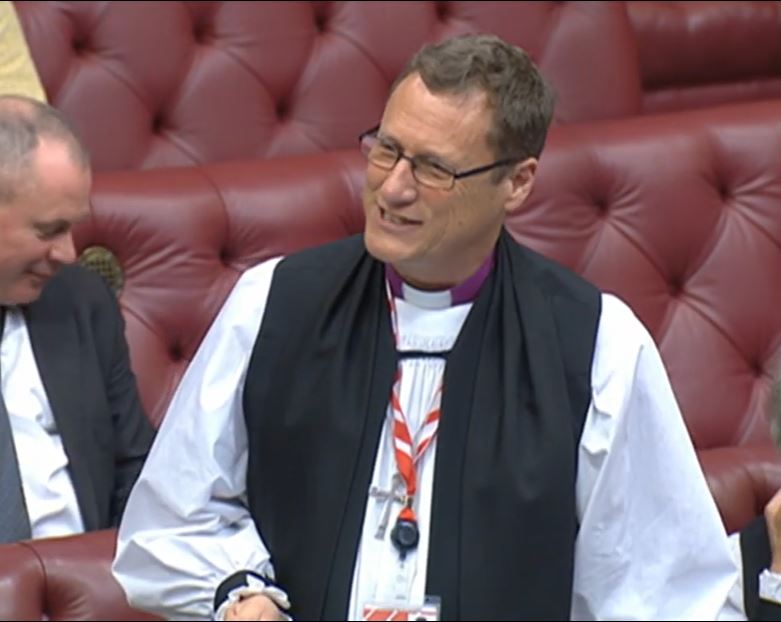
The Bishop of Leicester took part in the Archbishop of Canterbury’s debate on AI and society on 5th June 2026, highlighting the importance of trust in communities and the pitfalls of algorithmic content
The Lord Bishop of Leicester: My Lords, in the past, if you wanted to persuade people to think badly of others, you were limited by two things: the number of people you personally knew and the number of conversations you could physically have. Social media removed the second of those limits, letting one person reach millions at once. Artificial intelligence is now loosening the first. It allows one person to produce vast quantities of content of increasingly high quality. The frictions that once limited the spread of contempt have disappeared. We should not, then, be surprised that the fabric of our society is being torn.
For society to function, we need a broadly common understanding of the world and what is happening in it. Democracy is about disagreements over what to do about the opportunities and challenges we face, but for that disagreement to be constructive, we must all be able to access the bare facts: what is happening, who is involved and who is affected? Generative AI throws all this into question. Anyone, anywhere can now produce an image of an event that has never occurred or a video of a public figure saying something they never said. I really do mean anyone, anywhere. The BBC recently reported that accounts producing AI-generated anti-immigration content that appeared to be British were in fact run from east Asia, the Gulf and the United States.
Even as the number and reach of deepfakes continue to grow, there is also the fact that AI allows people for the first time to visualise abstractions on demand. A fear or suspicion that once lived only in the imagination can now be rendered as an apparent photograph in seconds and shared to incite or confirm the same fear in others. This matters because human beings have always been moved more powerfully by images than by arguments. Importantly, what people see shapes how they act in the encounters of ordinary life and at the ballot box.
We know from Allport’s contact theory that what most helps people to let go of prejudicial abstractions is interpersonal encounter, particularly with a common purpose in mind. Here AI poses a further threat as a growing number of people are turning to AI companions for friendship, romantic intimacy, therapy or spiritual guidance. Systems are always there, always ready to listen. They never have a bad day. They have no ego or agenda of their own, apparently. They are in a sense the perfect partner, but that is the problem. As others have already said, real human relationships are difficult. They require us to tolerate frustration, to forgive, to be forgiven, to encounter a mind that is genuinely not our own. These are the muscles of social life.
I have two specific proposals to help ensure that we are intentional in the way AI develops and works for the good of relationships and our shared life in this nation. First, I suggest that we must require social media platforms to change their structural incentives so that they algorithmically deprioritise content damaging to public debate. As Frances Haugen, the former Facebook product manager, put it:
“Anger and hate is the easiest way to grow on Facebook”.
That should not be so. Secondly, following the EU, we should mandate a crisis protocol, a set of obligations that come into force when a platform’s content begins to threaten public order or social cohesion in a measurable way, as it did in Leicester in 2022, when false claims about attacks on Muslims and Hindus fuelled unrest.
In this parliamentary Session we have Bills before us concerning AI and others on extremism and state threats, but I dare to say that they barely scratch the surface of what I have described. They do not touch the structural incentives behind inflammatory content, and nor do they support positive connection across difference. This is what the Church of England, like so many in civil society organisations, wants to work towards, but we need the legislative and regulatory framework to be able to have the maximum impact.
Extracts from the speeches that followed:
Baroness Teather (LD): The scale of AI’s potential impact, on all areas of life for good and ill, requires this breadth of thinking. My first question to the Minister is: where is this cross-cutting, ethical thinking taking place in government? Who is holding the bigger questions about the potential impact of AI on the shape of society? How might the public engage in this wider conversation? I am particularly thinking about those who will be most affected, such as young people, about whom many noble Lords have already spoken.
Also, where are the negotiations at an international level taking place? What are the shared values that we are seeking to influence? I recognise the challenges of that, but if we could at least articulate what we want to do, it would be transparent for all to see.
I will briefly touch on a couple of themes about how AI, without that shaping, could threaten our ability to think and make judgments about the world. The first is about its potential to revolutionise access to research and information. While AI is already a game-changer for scientific and medical research, as so many have already said, this tool that promised to aid the pursuit of truth is also threatening our ability to discern fact from fiction. Already, it is being used to generate and promulgate fake information, which gets presented with great certainty. A report by Demos last week warned that one in three adults reported seeing political deepfakes generated by AI immediately before the recent local and devolved elections. The research also suggested that some are being exposed to much higher levels of deepfakes than others. The coupling of AI generated misinformation with personalised targeting of content through social media feeds is a toxic mix undermining democracy and driving division. It is also a force that is often hidden from view, because we have no idea what anyone else is seeing. This is what threatens our common understanding of fact, which the right reverend Prelate the Bishop of Leicester discussed.
Lord Clement-Jones (LD): The encyclical speaks of algorithms blocking access to healthcare, employment and security on the basis of data tainted by prejudice, and of the silence of those who have no voice when such decisions are made. This is exactly the power issue that was raised by the noble Baronesses, Lady Kidron and Lady Helic. It argues explicitly that algorithmic processes must
“not be imposed from above in an opaque and unilateral manner”,
and that communities need transparency, accountability and meaningful avenues for recourse. That is precisely what the Horizon scandal, referred to by my noble friend Lady Teather and the Dutch case raised by the noble Lord, Lord Raval, taught us. It is precisely why mandatory algorithmic impact assessments and clear accountability and transparency principles are moral necessities, not just some sort of regulatory red tape.
As my noble friend Lord McNally and the noble Lord, Lord Parkinson, mentioned, AI models scraping creative content without consent, which produces deepfakes and synthetic information, are creating a huge threat to our creative industries, which has 2 million workers and is worth £145 billion per annum to the UK economy. They are also corroding public trust and causing creative and democratic harm, as described by my noble friend and the noble Baronesses, Lady Prashar and Lady Helic.
The Office for Budget Responsibility estimates that AI could materially impact 40% of the UK labour force over the next 10 years, with administrative, secretarial sales and customer service roles most exposed. This potentially creates societies susceptible to political as well as economic dislocation and, in the words of the right reverend Prelate the Bishop of Leicester, affects the very fabric of society. These issues must urgently be addressed.
Lord Markham (Con): As the noble Lord, Lord Alderdice, said, future AI companions and robotic carers may provide comfort, companionship and practical support to millions. They may know our stories, understand our habits, remember every conversation, never become impatient, never tire and never forget. For some people, particularly those who are isolated, vulnerable or neurodivergent, such technologies may prove genuinely transformational. Yet, they raise profound questions. If AI can become our tutor, adviser, healthcare companion and perhaps even our friend, what becomes of human relationships? As the noble Baroness, Lady Gill, the noble Lords, Lord Taylor and Lord Frost, the right reverend Prelate the Bishop of Leicester and many others asked, what happens if people increasingly choose the company of machines over the complexities of other human beings? What happens if young people can learn, work, shop and socialise without ever leaving their homes? What happens if a society connected by technology becomes disconnected from one another? What if AI replaces love and, as the noble Lord, Lord Griffiths, warned, we need the other AI—artificial insemination—alongside artificial intelligence?
As the noble Lord, Lord Rook, said, the danger is not that machines become more human. The danger is that humans become less human, that convenience replaces community, that interaction replaces relationships and that simulation replaces companionship. I return to where I began. The most reverend Primate the Archbishop has done this House a great service by reminding us that the central question is not what artificial intelligence can do; the central question is what kind of society we wish to become as we embrace AI to enhance that society rather than diminish it.
Baroness Lloyd of Effra (Lab, DBT/DESIT): Many noble Lords, including the right reverend Prelate the Bishop of Leicester, my noble friend Lady Gill, and the noble Baronesses, Lady Prashar, Lady Teather and Lady Helic, mentioned concerns that the misuse of AI has the potential to alter the nature of truth and public discourse. AI can lower the barrier to entry for creating disinformation, allowing for greater scale and speed of production and more persuasive and realistic content. This can increase the volume and sophistication of misleading information circulating online, making it harder for individuals to distinguish between authentic and false content. We remain well prepared to ensure the integrity and security of the democratic processes, with robust systems in place to protect against a range of threats, including foreign interference.


You must be logged in to post a comment.