Bishop of Salisbury raises concerns about impact on civilians of Sudanese Government military actions

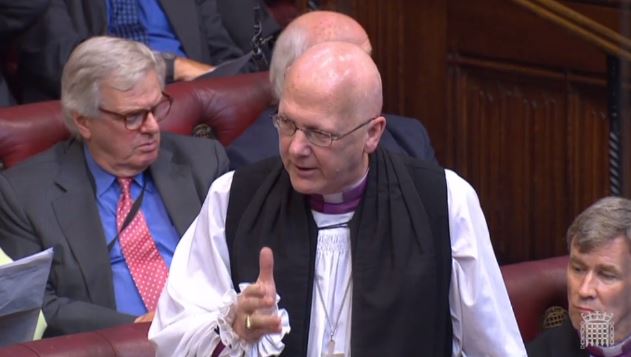
SalisburyOn 6th July 2016, Baroness Cox asked Her Majesty’s Government “what is their assessment of the current situation in Sudan in the light of continuing military offensives and aerial bombardments by the Government of Sudan in South Kordofan, Blue Nile and Darfur”. The Bishop of Salisbury, Rt Revd Nicholas Holtam, asked a follow up question:

The Lord Bishop of Salisbury: My Lords, I should like to underline the points made by the noble Baroness in her opening question about the significance of deliberate and targeted terrorism by the Sudanese Government on their own people, particularly in the bombing in the Nuba mountains, where Anglican schools have been repeatedly destroyed. My own diocese, the diocese of Salisbury, has a link with what is now Sudan and South Sudan that goes back more than 40 years, and there is a delegation from the Anglican communion in Sudan this week. Will the Minister inform the House how the Government intend to continue to provide leadership in relation to humanitarian aid in this continuing crisis?

Continue reading “Bishop of Salisbury raises concerns about impact on civilians of Sudanese Government military actions”

Bishop of Ely on the challenges for the UK following the EU referendum

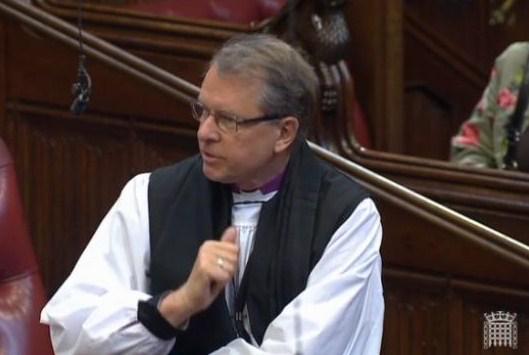
On 5th July 2016 the House of Lords debated a motion to take note of the result of the referendum on the UK’s membership of the European Union. The Bishop of Ely, Rt Revd Stephen Conway, spoke in the debate, focusing on leadership, common values, education and the rural workforce.  

Ely 2The Lord Bishop of Ely: My Lords, I cannot match that passion, but I join other noble Lords in saying how much I appreciated the speech earlier of our boss—I mean of my friend, the most reverend Primate the Archbishop of Canterbury. He and I have both worked in the north-east and been welcomed by the people of that area, many of whom voted to leave, just as people in fenland in my current diocese and people in east Kent, beloved of the most reverend Primate, did. These people were not, it seems to me, voting against the European Union but were making a great cry—a lament—about not having been heard for several generations by us, the political class. This was their opportunity to make us listen, after feeling excluded for so long. Continue reading “Bishop of Ely on the challenges for the UK following the EU referendum”

Bishop of St Albans asks Government to consider removing incentives to bulk buying of alcohol

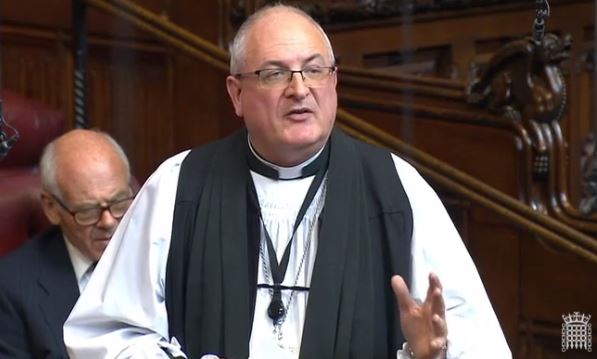
St Albans 2On 5th July 2016 Lord Brooke of Alverthorpe asked Her Majesty’s Government “when they expect Public Health England to publish its independent evidence-based report on alcohol”. The Bishop of St Albans, Rt Revd Alan Smith, asked a follow up question:

The Lord Bishop of St Albans: My Lords, back in 2011 the Scottish Government passed legislation which meant that there was no financial advantage in multibuy alcohol purchases so that each can or whatever it was would be the same price. That has discouraged the bulk buying of alcohol and as a consequence has reduced levels of harmful drinking. Have Her Majesty’s Government considered a similar law, and if not, why not? Continue reading “Bishop of St Albans asks Government to consider removing incentives to bulk buying of alcohol”

Archbishop of Canterbury on the future for the United Kingdom after the EU Referendum

On 5th July 2016 the House of Lords debated a motion “That this House takes note of the outcome of the European Union referendum.” The Archbishop of Canterbury, Most Revd & Rt Hon Justin Welby, spoke in the debate. His speech is below in full, followed by extracts from the speeches of other Peers. 
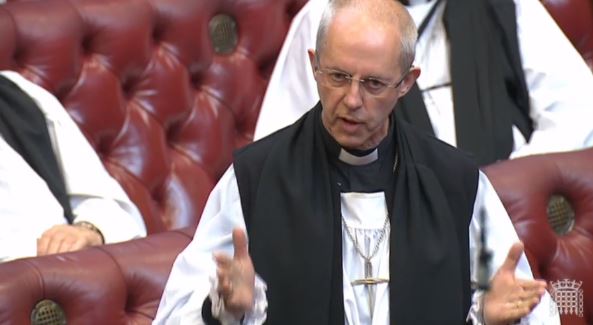
2ABCEUdebateThe Archbishop of Canterbury:  My Lords, the events of the past two weeks have led to some of the most traumatic and dynamic changes that we have known. The course of the campaign was robust—as it properly should be on such great issues—but at times veered over the line on both sides: it was not merely robust but unacceptable. Through such comments were created cracks in the thin crust of the politeness and tolerance of our society, through which, since the referendum, we have seen an outwelling of poison and hatred that I cannot remember in this country for very many years. It is essential, not only for this House but for the leaders of both sides and throughout our society, to challenge the attacks, xenophobia and racism that seem to have been felt acceptable, at least for a while.

Just over a week ago, at Lambeth Palace, at the breaking of the fast of Ramadan, I shared an iftar with the new Mayor of London, Sadiq Khan, and the Chief Rabbi. There were more than 100 young people of every faith and of no faith there. That sense of hope and energy for the future carried us through the rest of the week. It is there and we can reach for it. If, however, we are to thicken the crust through which the cracks have come, if we are to move to a place where we are not yet speaking of reconciliation but beginning to get on a path where in future healing and reconciliation will begin to happen, we need to beware. St Paul, in his letter to the Galatians, says to them at one point:

“Love one another, cease to tear at one another, lest at the end you consume one another”.

We are in danger of doing that in the way that our politics is developing at the moment. If we are to tackle that, we have to put in place some fundamental issues to be capable of creating the agile, flexible, creative, entrepreneurial and exciting society—full of the common good and of solidarity and love for one another—which is the only way that this country will flourish and prosper for all its citizens in the world outside the European Union of the future. Continue reading “Archbishop of Canterbury on the future for the United Kingdom after the EU Referendum”

Division: Tobacco and Related Products Regulations 2016

On 4th July 2016 the House of Lords voted on an amendment to the Government’s Tobacco and Related Products Regulations 2016. The Bishop of Chester, Rt Revd Peter Forster, took part. Continue reading “Division: Tobacco and Related Products Regulations 2016”

Children and Social Work Bill: Bishop of Durham supports amendment on young parents leaving care

On 4th July 2016 the House of Lords considered the Government’s Children and Social Work Bill in Committee. The Bishop of Durham, Rt Revd Paul Butler, spoke in support of an amendment from Labour Peer Baroness Armstrong of Hill Top on young parents who are care leavers. The amendment was withdrawn following debate. The Bishop said:

Bp Durham June 2015 bThe Lord Bishop of Durham: My Lords, I feel that I could already write the Minister’s response by saying that of course these needs are already met in Clause 3(5)(a) or (b), as the subsection refers to meeting “his or her needs”. However, when, year after year, report after report notes that these needs are not dealt with, surely we reach the point where they need to be specified—hence I support the noble Baroness’s amendments. The needs of these young parents have so consistently not been adequately met that we now need to specify them so that they are. Continue reading “Children and Social Work Bill: Bishop of Durham supports amendment on young parents leaving care”

Children and Social Work Bill 2016: Bishop of Durham supports amendment on corporate parenting

On 4th July 2016 the House of Lords considered the Government’s Children and Social Work Bill in Committee. The Bishop of Durham, Rt Revd Paul Butler, spoke in support of an amendment from Labour Peer Lord Warner on corporate parenting. The amendment was withdrawn following debate. The Bishop said:

Bp Durham June 2015 bThe Lord Bishop of Durham: My Lords, I also support this amendment. I apologise for not being here for day one* but at Second Reading I explained that I would not be able to be present last week. At Second Reading, there were a number of clauses—this is one of them—where I was concerned that the work of independent fostering agencies, adoption agencies and the voluntary sector as a whole, which provides increasing support to children in care and leaving care, was hardly noticed. Continue reading “Children and Social Work Bill 2016: Bishop of Durham supports amendment on corporate parenting”

Bishop of Ely urges Government to speak out against attacks on EU citizens living in UK

On 4th July 2016 Lord Soley asked Her Majesty’s Government “what role they see for the United Kingdom in relation to the European Union”. The Bishop of Ely, Rt Revd Stephen Conway, asked a follow up question.

ElyThe Lord Bishop of Ely: Whatever happens in the long term, in the meantime will the Government speak up trenchantly against the ugly and unseemly behaviour of some of our fellow citizens in the way they speak to and are violent towards citizens from the EU who are resident here, and who are productive citizens in our midst?

Baroness Anelay of St Johns: The right reverend Prelate is of course not only right but clearly has the complete agreement of this House. This country has proved throughout its history that it not only tolerates but welcomes those who come here to contribute to our society. I deplore attacks upon them.

(via Parliament.uk)

Church of England Week in Westminster, 27th June – 1st July 2016

WestminsterWelcome to the Church of England’s weekly round-up of activity in Parliament.

This week Bishops in the House of Lords called for action to counter fear and race hatred following the outcome of the EU referendum. Bishops also asked questions about freedom of speech at universities, radicalisation in prisons, and strengthening religious education. Bishops also spoke in debates on zero hours contracts, trust in public institutions and historic sex abuse allegations. During the recall of the House the previous week, the Bishop of Leeds paid tribute to Jo Cox MP. Continue reading “Church of England Week in Westminster, 27th June – 1st July 2016”

Bishop of Chelmsford on trust in public life and institutions

On 30th June 2016  Lord Fairfax of Cameron led a debate “That this House takes note of the role of openness and transparency in reinforcing confidence in public institutions.” The Bishop of Chelmsford, Rt Revd Stephen Cottrell, spoke in the debate:

Chelmsford 251115The Lord Bishop of Chelmsford: My Lords, I thank the noble Lord, Lord Fairfax of Cameron, for introducing this debate. I am still relatively new to this House, so you may not know that if there is a stick lying on the ground with a label on it saying, “wrong end”, I am prone to pick it up. I was drawn by the title of this debate and therefore went to the Library to read the briefing pack, which was fascinating. Its conclusion opens by saying that overall, the survey suggests that the public continue to have a very poor valuation of current standards in public life; respondents generally gave negative answers. That is something we should be concerned about.

My contribution will be over in 10 minutes and then you can get on with the debate that obviously some of you want to have, but I want to speak about what I see as the moral and spiritual dimensions to this issue. Continue reading “Bishop of Chelmsford on trust in public life and institutions”