Domestic Violence – Bishop of Birmingham asks Government about culture change in the police and CPS

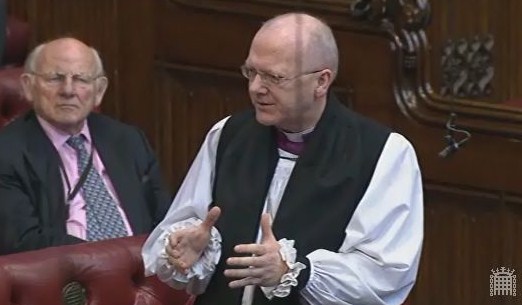
In the House of Lords on 25th November 2014 Baroness Gale asked Her Majesty’s Government ‘what progress has been made since March, when the Domestic Violence Disclosure Scheme, known as “Clare’s Law”, was implemented in all police forces in England and Wales.’ The Bishop of Birmingham, Rt Rev David Urquhart, asked a supplementary question:
01.04.14 Bishop of Birmingham
The Lord Bishop of Birmingham: My Lords, I am grateful to the noble Baroness for her response to some of the questions. I would like to press her a little further on the deep need for culture change, specifically in the area of training for the police and the Crown Prosecution Service. Is she minded to enable the Government to make that mandatory?

Continue reading “Domestic Violence – Bishop of Birmingham asks Government about culture change in the police and CPS”

Bishop of St Albans – Work Capability Assessment (Written Answer)

On 25th November 2014, the Bishop fo St Albans, the Rt Revd Alan Smith, received a written answer from the Depatment of Work and Pensions on the Work Capability Assessment.

Bishop of St AlbansThe Lord Bishop of St Albans: To ask Her Majesty’s Government whether people who are undergoing a work capability assessment because of mental health problems are guaranteed assessment by health professionals who have psychiatric expertise.[HL2851]

The Parliamentary Under-Secretary of State, Department for Work and Pensions (Lord Freud): All healthcare professionals who carry out work capability assessments on behalf of the DWP are fully trained in disability assessment and are registered with their respective Regulatory Body. Healthcare professionals receive comprehensive training in the functional effects of mental health conditions. In addition all health professionals are supported by mental function champions who have specialist knowledge of mental health conditions and provide support and best practice advice.

(via Parliament.uk)

Consumer Rights Bill – Vote

On 24th November 2014, three bishops took part in a division of the House of Lords, during Report Stage of the Government’s Consumer Rights Bill.

Amendment 31

House of Lords Division Lobby

Labour Peer Baroness Hayter of Kentish Town moved amendment 31, which sought to remove the requirement for trading standards officers to give 48 hours notice before inspecting businesses, as the Bill currently requires.

The Bishop of Chester, the Rt Revd Peter Forster, the Bishop of Derby, the Rt Revd Alastair Redfern and the Bishop of St Albans, the Rt Revd Alan Smtih, voted ‘content’. No bishop voted ‘not content’.

There were Contents: 194 | Not Contents: 220 | Result: Government Win

(via Parliament.uk)

Bishop of St Albans presses Government on effect of welfare reform on in-work poverty

On 24th November 2014, Lord McKenzie of Luton asked Her Majesty’s Government how many households are in receipt of the housing element of Universal Credit. The Bishop of St Albans, the Rt Revd Alan Smith, asked a supplementary question:

Bishop of St AlbansThe Lord Bishop of St Albans: My Lords, the House will be aware that the Chancellor has announced that the working allowances for universal credit will be frozen until April 2018. There is a real danger, if there is no lift in those allowances—at least in line with inflation—that that will significantly reduce the real net incomes of low earners. Could the Minister tell your Lordships’ House what assessment Her Majesty’s Government have made of the impact of these measures on the level of poverty among those who are already in work, especially for those families who are earning too little to benefit from further rises in the personal tax allowances?

Lord Freud: The working allowances in universal credit are much greater than under the legacy system, so there is a freeze that will have a small effect. Nevertheless, the poverty impacts are to take 300,000 children out of poverty.

(via Parliament.uk)

Farewell to the Bishop of Newcastle

After twelve years on the Bishops’ Benches in the House of Lords, Rt Rev Martin Wharton retires as Bishop of Newcastle at the end of this month. We look back at some of his work in parliament.14.03 Bishop of NewcastleRt Rev Martin Wharton joined the House of Lords in 2002, five years after becoming Bishop of Newcastle. At the time of his retirement in November 2014 only two other serving Lords Spiritual had spent longer in the House. His contributions over those years were notable for being measured, meaningful – usually aimed at highlighting a matter of social or economic injustice – and very often involved reference to the people and communities of the north-east. Continue reading “Farewell to the Bishop of Newcastle”

Church of England Week in Westminster, 17th – 21st November 2014

Welcome to the Church of England’s weekly round-up of activity in Parliament.

Westminster-abbeyThis week bishops spoke in debates about the Modern Slavery Bill, the Azure Card and the UN Convention on the Rights of the Child. They also took part in divisions on the Government’s Consumer Rights Bill.

They also asked questions about the regulation of cold calling, the Gangmasters Licensing Authority, local authority welfare spending, the Istanbul Convention, adoption services and visa applications from the Commonwealth.


Continue reading “Church of England Week in Westminster, 17th – 21st November 2014”

Bishop of Worcester takes part in debate on relationship between children’s rights and internet use

“The Church of England schools’ commitment to this aim is seen in the breadth of our holistic educational vision. We seek to conceive of education as developing children’s creativity and awareness of the world around them—of course, we are not alone in that. To fit students for a life of active civic engagement, and not just to learn facts, is what education should be about.”

On 20th November 2014, Baroness Kidron led a debate in the House of Lords to take note of the impact of the United Nations Convention on the Rights of the Child on children’s and young people’s online and digital interactions. The Bishop of Worcester, the Rt Revd John Inge, took part in the debate, which was timed to mark the 25th anniversary of the Convention. The Bishop spoke about the ability of online education resources to release the talents of all children, noting the Church of England’s commitment to a holistic educational vision in its schools. He also highlighted some of the risks associtated with young people using the internet and supported calls for the government to review how the UNCRC can be applied to the context of these online and digital interactions.

WorcesterThe Lord Bishop of Worcester: My Lords, I begin by echoing the congratulations offered to the noble Baroness, Lady Shields, on an excellent maiden speech. I join her in applauding the wonderful work in this area of the noble Baroness, Lady Kidron, to whom I am also grateful for providing the House with an opportunity to take stock of the changes wrought over the past couple of decades by the growth of the internet and evolution of digital technologies—on this auspicious day, 25 years since the establishment of the UN Convention on the Rights of the Child, which coincides, as she pointed out, with the beginning of the development of the internet. What a different world we live in now that the convention has come of age. It behoves us to consider the new cultural landscape in which we find ourselves, in which 81% of 12 to 15 year-olds use the internet every day. Continue reading “Bishop of Worcester takes part in debate on relationship between children’s rights and internet use”

Bishop of Worcester supports calls for review of Azure card system for asylum seekers

“If we wish to dissuade people from coming to this country without the legal right to be here, it is wrong to try to send a message by treating asylum applicants, even when appeal rights are exhausted, in a way unworthy of our values.”

On 20th November 2014, Lord Roberts of Llandudno led a take-note debate in the House of Lords on the subject of the Azure card, the means of support through which the Government supports people making applications for asylum who are not allowed to work in the UK. The Bishop of Worcester, the Rt Revd John Inge, spoke in the debate, highlighting a number of concerns about the current system, including the level of support provided and the limited number of places in which the card can be used. He called on the Government to review the current system.

WorcesterThe Lord Bishop of Worcester: My Lords, I am very grateful to the noble Lord, Lord Roberts, for securing this debate on a very important matter. The churches have long held, and maintained in this House, that those who have applied for asylum and who are not allowed to do paid work should be given enough financial help to maintain a decent basic standard of living for themselves and their families. Indeed, the most reverend Primate the Archbishop of York has more than once led delegations on this theme. Surely every person who is in this country should be treated in accordance with our values. If we wish to dissuade people from coming to this country without the legal right to be here, it is wrong to try to send a message by treating asylum applicants, even when appeal rights are exhausted, in a way unworthy of our values. Continue reading “Bishop of Worcester supports calls for review of Azure card system for asylum seekers”

Consumer Rights Bill – Divisions

On 19th November 2014, four bishops took part in two divisions of the House of Lords, during the Report Stage of the Government’s Consumer Rights Bill. 

House of Lords Division Lobby

Amendment 1

Shadow Business Spokesperson, Labour peer Lord Stevenson of Balmacara, moved amendment 1, to insert the new clause Consumer credit: bill of sale. The amendment sought to develop a new regulatory framework related to bills of sale as a form of consumer credit.

The Bishop of Chester, the Rt Revd Peter Forster, the Bishop of Norwich, the Rt Revd Graham James, the Bishop of Peterborough, the Rt Revd Donald Allister, and the Bishop of Worcester, the Rt Revd John Inge, all voted ‘not content’ with the amendment. No bishop voted ‘content’.

There were Contents: 176 | Not Contents: 244 | Result: Government Win

(via Parliament.uk)

Continue reading “Consumer Rights Bill – Divisions”

Bishop of Worcester calls for simplification of visa rules for Commonwealth countries

On 19th November 2014, Lord Lea of Crondall asked Her Majesty’s Government whether they have made any proposal to other European Union member states, either severally or collectively, which would limit (1) the right of United Kingdom citizens to live and work in other European Union member states, or (2) the parallel right of citizens of other European Union member states to live and work in the United Kingdom. The Bishop of Worcester, the Rt Revd John Inge, asked a supplementary question:

WorcesterThe Lord Bishop of Worcester: My Lords, the Minister mentioned the reputation that this country has for hospitality. Is he aware of an associated issue: the difficulty that members of the Commonwealth face in obtaining a visa even to visit, let alone to work and live in this country, which seriously hampers a lot of very important overseas links with dioceses, including my own—so much so that my friends in Tanzania were unable to be present at my wife’s funeral earlier this year? Is that sort of impediment government policy and, if not, can he assure us that it will be addressed?

Lord Bates: We very much encourage people to come to this country, whether to study or to work. We want to encourage the best and the brightest to come to this country, as well as tourists; there are many people we want to encourage—but there is a difference between that and people who significantly abuse the system in coming here because of benefits.

(via Parliament.uk)