Vote – Motion to Regret on role of Leader of the House of Lords

On 28th July 2014, two bishops took part in a division of the House of Lords on Crossbench Peer Baroness Boothroyd’s Motion to Regret on the role of the Leader of the House of Lords.

House of Lords Division Lobby

Baroness Boothroyd moved that this House welcomes the appointment of Baroness Stowell of Beeston as Leader of the House of Lords, but regrets the decision of the Prime Minister to diminish the standing of the House by failing to make her a full member of the Cabinet; and requests that the Prime Minister reconsiders this decision.

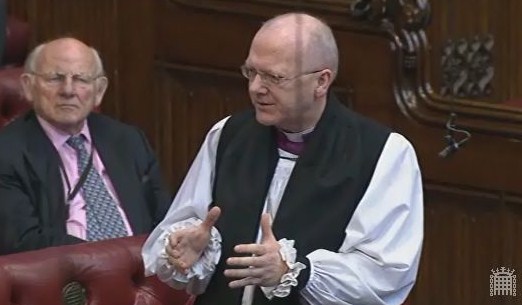
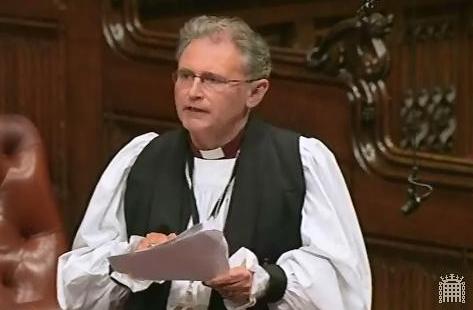
The Bishop of Chester, the Rt Revd Peter Forster (who also spoke during the debate) and the Bishop of Sheffield, the Rt Revd Steven Croft, voted ‘content’ with the motion. No bishop voted ‘not content’.

There were: Contents: 177 | Not Contents: 29 | Result: Government Defeat

(via Parliament.uk)

Bishop of Chester speaks during debate on constitutional role of Leader of the House of Lords

On 28th July 2014, former speaker of the House of Commons, and Crossbench Peer the Rt Hon. the Baroness Boothroyd, moved a Motion to Regret in the House of Lords. The Motion stated:

That this House welcomes the appointment of Baroness Stowell of Beeston as Leader of the House of Lords, but regrets the decision of the Prime Minister to diminish the standing of the House by failing to make her a full member of the Cabinet; and requests that the Prime Minister reconsiders this decision.

The Bishop of Chester, the Rt Revd Peter Forster, took part in the debate on the motion. He spoke of the way in which power is distributed throughout the contemporary political system and how this distribution of power may need to be reconsidered if the public are to be re-engaged with the political process.

14.03 Bishop of ChesterThe Lord Bishop of Chester: My Lords, I want to associate these Benches fully with both sides of the Motion; first, the welcome to the noble Baroness in her role as Leader of the House and, secondly, the regrets that have been expressed already in our debate. Rather than focus on the details, I shall make a few comments about the wider symbolic significance of these events. A healthy society distributes power. The banking crisis arose partly because power got too concentrated in certain institutions and in a certain section of the financial community. Government, if it is about nothing else, is about the exercise of power. We have to accept and acknowledge that, and not try to deny it. The exercise of power calls for clear leadership, which is right, too. Continue reading “Bishop of Chester speaks during debate on constitutional role of Leader of the House of Lords”

Bishop of Chester highlights impact of built environment on well-being of society

On 28th July 2014, the Bishop of Chester, the Rt Revd Peter Forster, took part in a short debate in the House of Lords on the Government’s response to the Farrell Review of architecture and the built environment. He supported the relaxing of planning laws, to enable people to have a greater say in the built environment in which they live. He also argued that architects should play a more significant role in issues of planning, cautioning that houses built in the past 20 years risked becoming the slums of the future.

14.03 Bishop of ChesterThe Lord Bishop of Chester: My Lords, reference to the Tower of Babel earlier stimulated me to speak in the gap, and I believe that there is time to do so. Skyscrapers are quite ambiguous—they work in some places but not in others. Why does the Shard work but the Cheesegrater look completely out of place? Maybe that is just my own subjective judgment. Why do some cities that have no need of skyscrapers feel they want them? Some cities in Australia that have all the space they could possibly want still have an instinct to build skyscrapers. It indicates how important the environment is for us. We see no skyscrapers in Paris or Rome. The urban planners there do not allow them. Continue reading “Bishop of Chester highlights impact of built environment on well-being of society”

Bishop of St Albans asks Government about UK involvement in South Sudan peace settlement

On 28th July 2014, Conservative Peer Baroness Hodgson of Abinger asked Her Majesty’s Government what steps they are taking to ensure that any future peace settlement in South Sudan is inclusive. The Bishop of St Albans, the Rt Revd Alan Smith, asked a supplementary question:

Bishop of St AlbansThe Lord Bishop of St Albans: My Lords, it is evident that the long-term process of finding an inclusive Sudanese-led reconciliation can begin only once hostilities cease and a political settlement and resolution is reached. This is why international diplomacy is so vital. Will the noble Lord tell the House what plans the Government have to address the current understaffing of the UK Sudan unit, which has a role in this?

Lord Wallace of Saltaire: My Lords, the number of staff in the UK Sudan unit has fluctuated over the past few months; my understanding is that it is now rather larger than it was two or three months ago. I do not think that we can wait until the fighting stops to begin negotiations; local fighting is likely to continue for some considerable time and we have to start to move to construct at least the basis of some form of government now.

(via Parliament.uk)

Church of England Week in Westminster, 21st-25th July 2014

Red BenchesWelcome to the Church of England’s weekly round-up of activity in Parliament by the Lords Spiritual.

In the past week, bishops in the House of Lords have spoken in debates on the Criminal Justice and Courts Bill, human rights abuses in North Korea and international religious freedom.

They have also put questions to the Government on events in Ukraine, oversight of schools in Birmingham and LGBT rights in Uganda.


Monday 21st July

MH17 and Gaza – Government Statement13.10 Bishop of Coventry

A Government statement on the Ukraine (Shooting Down of MH17) and Gaza was repeated in the House of Lords by the Leader of the House, Baroness Stowell of Beeston. The Bishop of Coventry, the Rt Revd Christopher Cocksworth, asked a supplementary question. The question, and the response from the minister, can be read here.


Criminal Justice & Courts Bill – Committee Stage

14.03 Bishop of ChesterThe Bishop of Chester, the Rt Revd Peter Forster, spoke during the Committee Stage of the Criminal Justice and Courts Bill. He spoke in support of an amendment to make assault on workers selling alcohol a specific criminal offence. Following the debate on the amendment, it was withdrawn without being put to a division of the House. The Bishop’s remarks can be read here

Continue reading “Church of England Week in Westminster, 21st-25th July 2014”

Bishop of Coventry – religious freedom “canary in the mine of human rights”

“Freedom of belief, including the freedom to change one’s belief, is like a canary in the mine of human rights. Abuses of religious freedom are often an early indication that all is not well….Where religious freedom is abused, peace and security often become more elusive.”

On 24th July 2014, Crossbench Peer Lord Alton of Liverpool led a short debate in the House of Lords to take note of international compliance with Article 18 of the Universal Declaration of Human Rights concerning freedom of belief. The Bishop of Coventry, the Rt Revd Christopher Cocksworth, spoke in the debate. He spoke of the role of religious freedom as a marker for other freedoms, and the positive role religious freedom can play in strengthening democracy and countering radicalisation and terrorism. He also spoke of the responsibility held by religious institutions to speak together on the importance of religious freedom for all, and to model these freedoms themselves.

13.10 Bishop of CoventryThe Lord Bishop of Coventry: My Lords, like other Members of your Lordships’ House, I am grateful to the noble Lord, Lord Alton, for securing this debate and pay tribute to his great efforts on this vital issue. I thank him for his reference to the 800th anniversary of the Magna Carta. I have a personal connection with the charter, as one of my predecessors, William, was among the reverend fathers who advised the King to enshrine its principles of justice and freedom, including freedoms of religion. Magna Carta, despite our own failings—to which reference has been made—to live up to its logic, remains the seed of a tree of which Article 18 of the Universal Declaration of Human Rights is part, and under the cover of which all the peoples of the world should be allowed to stand. Continue reading “Bishop of Coventry – religious freedom “canary in the mine of human rights””

Bishop of Coventry asks Government about asylum for Ugandan LGBT people

On 23rd July 2014, Lord Lexden asked Her Majesty’s Government what action they propose to take over the abuse of the human rights of LGBT people in Uganda as a result of the passing of the Anti-Homosexuality Act there. The Bishop of Coventry, the Rt Revd Christopher Cocksworth, asked a supplementary question:

13.10 Bishop of CoventryThe Lord Bishop of Coventry: My Lords, I apologise to the Minister for my enthusiasm. I have not asked a question in this House before so I wanted to get on with it. The Minister will be aware that the most reverend Primates the Archbishop of Canterbury and the Archbishop of York wrote to the President of Uganda in January to reiterate a statement made by all the Primates of the Anglican Communion, in which they said:

“The victimisation or diminishment of human beings whose affections happen to be ordered towards people of the same sex is anathema to us”.

In that spirit, do the Government intend to provide asylum to those who are fleeing the worrying consequences of this law which enshrines such diminishment?

Continue reading “Bishop of Coventry asks Government about asylum for Ugandan LGBT people”

Bishop of Rochester supports amendment to Criminal Justice and Courts Bill

On 23rd July 2014 the Bishop of Rochester, the Rt Rev James Langstaff, spoke during the Committee Stage of the Criminal Justice and Courts Bill.

Bishop of RochesterBishop James spoke in support of Lord Ramsbotham’s amendment to remove clause 29 relating to the creation of ‘secure colleges and other places for detention of young offenders’  from the Bill. Continue reading “Bishop of Rochester supports amendment to Criminal Justice and Courts Bill”

Bishop of Peterborough highlights human rights abuses in North Korea

“There is great evil in the North Korean regime, which the civilised world cannot simply ignore…not to do anything about evil on this scale is to collude with it” – Bishop of Peterborough, 23/7/14

14.02 PeterboroughOn 23 July 2014 Lord Alton of Liverpool tabled a debate to ask Her Majesty’s Government ‘what was their response to the work of the United Nations Commission of Inquiry on Human Rights in the Democratic People’s Republic of Korea’.

The Bishop of Peterborough, the Rt Rev Donald Allister, spoke about the importance of keeping diplomatic channels open, the situation of  the Christian population in North Korea and the need to keep up pressure over human rights abuses. Drawing on his experiences of visiting South Korea, he spoke about the growth of Christianity there and the Anglican Church’s initiative, TOPIK—Towards Peace in Korea. Continue reading “Bishop of Peterborough highlights human rights abuses in North Korea”

Bishop of Birmingham responds to Government statement on ‘Trojan Horse’

On 22nd July 2014, a Government statement on Birmingham Schools was repeated in the House of Lords by the Parliamentary Under-Secretary of State for Schools, Lord Nash. The Bishop of Birmingham, the Rt Revd David Urquhart, responded to the statement. He called for Government support of the Kershaw Report, asked for clarity on responsibility and accountability in the education system, and argued that the incident highlighted the need for greater understanding of faith and religion throughout civil society.

T01.04.14 Bishop of Birminghamhe Lord Bishop of Birmingham: My Lords, I am grateful to the Minister for bringing the Secretary of State’s Statement to the House and for the publication of Peter Clarke’s report. As he mentioned, this goes alongside Ian Kershaw’s report, which was published on Friday, about Birmingham City Council and it has the support of the Birmingham Trojan horse review group, of which I am a member. That group has published its own, wider recommendations in this complex and troubling period. Does the Minister agree that both reports are thorough and hard-hitting, and that there is much in common in their findings? Continue reading “Bishop of Birmingham responds to Government statement on ‘Trojan Horse’”