Bishop of Peterborough highlights human rights abuses in North Korea

“There is great evil in the North Korean regime, which the civilised world cannot simply ignore…not to do anything about evil on this scale is to collude with it” – Bishop of Peterborough, 23/7/14
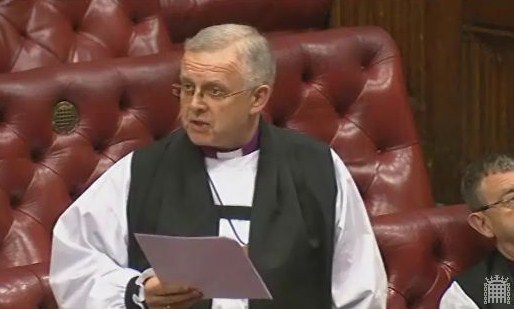
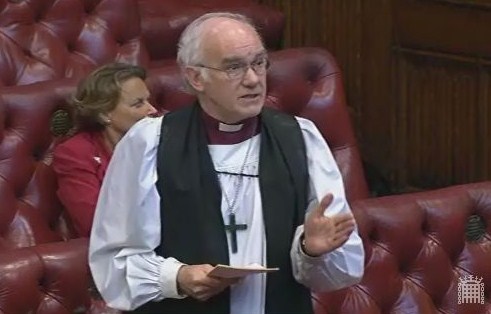
14.02 PeterboroughOn 23 July 2014 Lord Alton of Liverpool tabled a debate to ask Her Majesty’s Government ‘what was their response to the work of the United Nations Commission of Inquiry on Human Rights in the Democratic People’s Republic of Korea’.

The Bishop of Peterborough, the Rt Rev Donald Allister, spoke about the importance of keeping diplomatic channels open, the situation of  the Christian population in North Korea and the need to keep up pressure over human rights abuses. Drawing on his experiences of visiting South Korea, he spoke about the growth of Christianity there and the Anglican Church’s initiative, TOPIK—Towards Peace in Korea. Continue reading “Bishop of Peterborough highlights human rights abuses in North Korea”

Bishop of Birmingham responds to Government statement on ‘Trojan Horse’

On 22nd July 2014, a Government statement on Birmingham Schools was repeated in the House of Lords by the Parliamentary Under-Secretary of State for Schools, Lord Nash. The Bishop of Birmingham, the Rt Revd David Urquhart, responded to the statement. He called for Government support of the Kershaw Report, asked for clarity on responsibility and accountability in the education system, and argued that the incident highlighted the need for greater understanding of faith and religion throughout civil society.

T01.04.14 Bishop of Birminghamhe Lord Bishop of Birmingham: My Lords, I am grateful to the Minister for bringing the Secretary of State’s Statement to the House and for the publication of Peter Clarke’s report. As he mentioned, this goes alongside Ian Kershaw’s report, which was published on Friday, about Birmingham City Council and it has the support of the Birmingham Trojan horse review group, of which I am a member. That group has published its own, wider recommendations in this complex and troubling period. Does the Minister agree that both reports are thorough and hard-hitting, and that there is much in common in their findings? Continue reading “Bishop of Birmingham responds to Government statement on ‘Trojan Horse’”

Bishop of Chester supports amendment to Criminal Justice and Courts Bill

On 21st July 2014, the Bishop of Chester, the Rt Revd Peter Forster, spoke during the Committee Stage of the Criminal Justice and Courts Bill. He spoke in support of an amendment to make assault on workers selling alcohol a specific criminal offence. Following the debate on the amendment, it was withdrawn without being put to a division of the House. 

14.03 Bishop of ChesterThe Lord Bishop of Chester: My Lords, I have considerable sympathy for the amendment, although I wonder how it will interact with the remainder of the law on assault if this is criminalised in a specific way. I declare an interest in that I used to be a publican. When I was employed in a university, one of the members of staff had to go down to the magistrates’ court and swear that they were a fit person to keep order. That is the only time when I have been into a court of law in my life, and the magistrates were not quite sure that this young clergyman would be able to do so. My main task was to prevent the students drinking the profits rather than sorting out any brawls. Continue reading “Bishop of Chester supports amendment to Criminal Justice and Courts Bill”

Bishop of Coventry responds to statement on MH17 and Gaza

On 21st July 2014, a Government statement on the Ukraine (Shooting Down of MH17) and Gaza was repeated in the House of Lords by the Leader of the House, Baroness Stowell of Beeston. The Bishop of Coventry, the Rt Revd Christopher Cocksworth, asked a supplementary question.

13.10 Bishop of CoventryThe Lord Bishop of Coventry: My Lords, perhaps I may return us to the tragic event of the downing of flight MH17 to join others in expressing deep and profound condolences to the families, friends and colleagues of those who died. In particular, I express the deep sympathies of those of us who spend quite a lot of our time caring for those who are bereaved and, in so doing, I pay tribute to the Protestant, Anglican, Old Catholic and Roman Catholic ministers who have been trying to care for the stricken families at Schiphol Airport. They have a very demanding task. Continue reading “Bishop of Coventry responds to statement on MH17 and Gaza”

Church of England gives evidence to Modern Slavery Bill Committee

On 21st July 2014, the Church of England’s Foreign Policy Adviser, Dr Charles Reed, gave evidence to the Public Bill Committee for the Government’s Modern Slavery Bill. The transcript of the evidence session, at which Dr Reed and Cecilia Taylor-Camara (Head of the Bishops Conference Office for Migration Policy, Catholic Bishops for England and Wales) gave evidence, is reproduced in full below.

Dr Charles Reed, Foreign Policy Adviser, Church of England

Q 24 The Chair:  For this session we have until 4.45 pm. Will the witnesses please introduce themselves for the record?

Cecilia Taylor-Camara: I am Cecilia Taylor-Camara, senior policy adviser to the Catholic Bishops Conference of England and Wales.

The Chair:  I ask the witnesses to speak up a little. This is rather a large room and the sound is not brilliant, so please shout if necessary.

Dr Reed: I am Charles Reed, international policy adviser for the Church of England.  Continue reading “Church of England gives evidence to Modern Slavery Bill Committee”

Bishop of Carlisle speaks against Assisted Dying Bill – new legislation would destroy balance of current law

“By going down this track we would be sending a clear message to society, and especially its most vulnerable members, about individual lives having a different value according to their circumstances.”

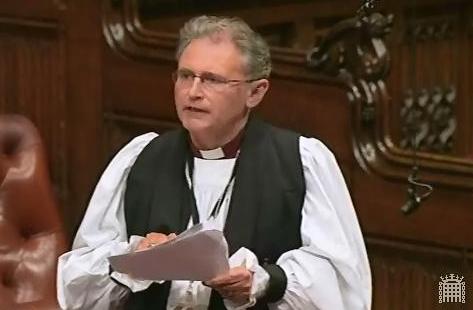
On 18th July 2014, the Bishop of Carlisle, the Rt Revd James Newcome, spoke during the Second Reading of the Assisted Dying Bill. The Bishop spoke against the Bill, raising concerns that the proposed Bill would destroy the balance currently provided by legislation, and highlighting the risks associated with the Bill in relation to the welfare of vulnerable individuals. 

14.06.09 Bishop of CarlisleThe Lord Bishop of Carlisle: My Lords, a word that is frequently used in your Lordships’ House is “balance”. It has already been used several times in this debate—in particular, by my noble and learned friend Lady Butler-Sloss, the noble Lord, Lord Condon, the noble Baroness, Lady Kennedy, and the noble Lords, Lord Kerr of Kinlochard and Lord Wills, and probably many others whom I may have missed. We constantly look for balance in our legislation and in the way that the legislation is applied. Continue reading “Bishop of Carlisle speaks against Assisted Dying Bill – new legislation would destroy balance of current law”

Bishop of Bristol speaks against Assisted Dying Bill: raises concerns about ‘unintended consequences’

“Many of us who are opposed to the Bill are greatly concerned by the unintended consequences that it will inevitably bring into play. It is simply not good enough for those who support the Bill to dismiss out of hand this genuine concern. It is for them to give us consistent evidence that our fears are unfounded. Sadly, the available evidence appears to raise, rather than allay, anxiety.”

On 18th July 2014, the Bishop of Bristol, the Rt Revd Mike Hill, took part in the Second Reading debate of the Assisted Dying Bill. The Bishop spoke against the Bill, focusing on the unintended consequences that the Bill would present, if passed.

14.03 Bishop of Bristol

The Lord Bishop of Bristol: My Lords, many of us will speak today in the name of compassion, but, as is clear, we shall take very different views in terms of what compassion looks like in relation to those who are suffering unbearably and, in particular, as to whether my noble and learned friend Lord Falconer’s Bill is fit for the purposes he and his supporters pursue with such vigour. Continue reading “Bishop of Bristol speaks against Assisted Dying Bill: raises concerns about ‘unintended consequences’”

Church of England Week in Westminster, 14th – 18th July 2014

Welcome to the Church of England’s weekly round-up of activity in Parliament by the Lords Spiritual.

In the past week, Bishops in the House of Lords have spoken in debates on human rights in the Republic of Sudan, the Infrastructure Bill, the Serious Crime Bill, the Assisted Dying Bill and spoke during tributes to the outgoing Leader of the House.

They have also put questions to the Government on Disabled Students’ Allowance, preventing child abuse, fuel poverty and the new government of India.

In the House of Commons, the Second Church Estates Commissioner answered questions on food banks, church and cathedral repairs, human trafficking, women bishops and pay, procurement and ICT in the Church Commissioners.

Continue reading “Church of England Week in Westminster, 14th – 18th July 2014”

Assisted Dying Bill – Archbishop of York speaks against

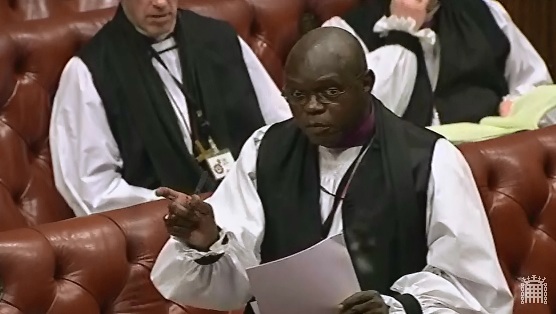
The Archbishop of York, Most Rev John Sentamu, spoke on 18th July 2014 in the Second Reading of the Assisted Dying Bill in the House of Lords.  His speech follows in full:

Archbishop of York

My Lords, let me state at the outset that the ‘official’ Church of England position was made very clear on 9th July 2005, when the General Synod voted on a motion referring to the joint submission of the C of E House of Bishops and the Roman Catholic Bishops’ Conference to your Lordships’ House Select Committee [1].  The motion argued strongly against making assisted suicide or euthanasia lawful. The vote was carried by 297 votes to 1.

This position was reaffirmed in a General Synod motion in 2012 [2].

My Lords, this present Bill is not about relieving pain or suffering. It makes that quite clear in its definition of a terminally ill patient to include those whose progressive illness can be relieved but not reversed.   This bill is about asserting a philosophy, which not only Christians, but also other thoughtful people of goodwill who have had experience in care for the dying must find incredible: that is, the ancient Stoic philosophy that ending one’s life in circumstances of distress is an assertion of human freedom.   That it cannot be.   Human freedom is won only by becoming reconciled with the need to die, and by affirming the human relations we have with other people.    Accepting the approach of death is not the attitude of passivity that we may think it to be.   Dying well is the positive achievement of a task that belongs with our humanity.   It is unlike all other tasks given to us in life, but it expresses the value we set on life as no other approach to death can do.    Continue reading “Assisted Dying Bill – Archbishop of York speaks against”

Bishop of Carlisle urges engagement with Indian Government on violence against women

On 17th July 2014, Lord Harries of Pentregarth asked Her Majesty’s Government what is their assessment of the new Government of India and the challenge presented by poverty in that country. The Bishop of Carlisle, the Rt Revd James Newcome, asked a supplementary question.

14.06.09 Bishop of CarlisleThe Lord Bishop of Carlisle: My Lords, does the Minister agree that while the gender gap in employment and political participation is narrowing in India, there is still much that needs to be done by the Government for the health and safety of girls and women? If that is the case, can the Minister assure us that this matter will be given the attention it deserves at the Girl Summit being hosted by the UK Government next week?

Baroness Northover: The Girl Summit is extremely important. The right reverend Prelate is right about the gender gap in India, but I also notice that in the budget of last week money was put into trying to ensure that girls attend and are safe in school. I have myself seen a major programme which puts money into the hands of families of girls to try to ensure that they stay in school and have the incentives to be there.

(via Parliament.uk)