Bishop of Birmingham leads tributes on birth of Prince George

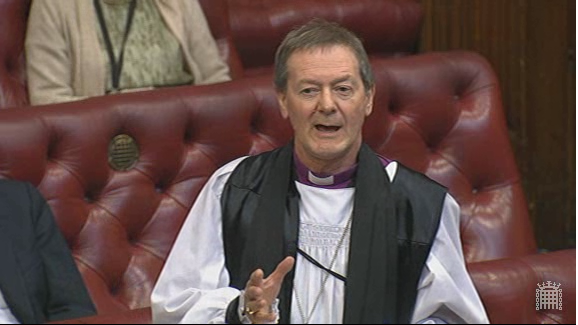
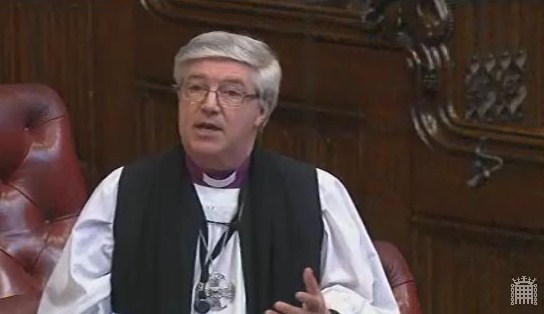
On 23rd July 2013, tributes were offered by the House of Lords to Her Royal Highness the Duchess of Cambridge, on the birth of her son. The Bishop of Birmingham, the Rt Revd David Urquhart, led tributes on behalf of the Lords Spiritual.

01.04.14 Bishop of BirminghamThe Lord Bishop of Birmingham: My Lords, the day’s proceedings in your Lordships’ House begin far too often with the announcement of a death. My friend the most reverend Primate the Archbishop of Canterbury and my other colleagues on this Bench regret not being present today because they are attending the funeral of the late Bishop of Coventry, Colin Bennetts. None the less, it is a wonderful joy and delight for us to join in the words of colleagues in this House as we pause to celebrate the birth of a new baby. Their Royal Highnesses the Duke and Duchess of Cambridge can be assured not simply of the congratulations, prayers and good wishes of those who occupy this Bench but, I am sure, the whole of the Church and faiths in England and the rest of the country.

My friend the most reverend Primate the Archbishop of Canterbury, your Lordships may like to know, did not, as was the custom in times past, actually attend the birth. Instead, he has offered his own prayers and congratulations to their Royal Highnesses, sharing, “in their joy at this special time”, and praying that God would, “bless this family with love, health and happiness”. Continue reading “Bishop of Birmingham leads tributes on birth of Prince George”
Bishop of Birmingham raises concerns about community instability in Lebanon

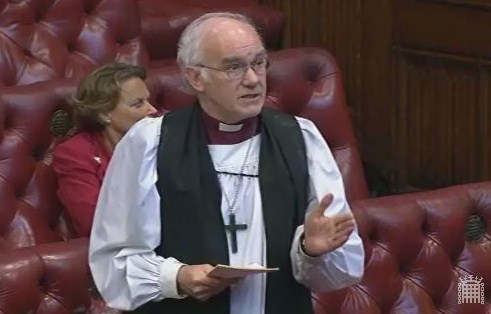
On 23rd July 2013, Lord Risby asked Her Majesty’s Government what assessment they have made of the current social and economic situation in Lebanon. The Bishop of Birmingham, the Rt Revd David Urquhart, asked a supplementary question on what is being done to ease tensions between communities affected by the movement of refugees:

01.04.14 Bishop of BirminghamThe Lord Bishop of Birmingham: My Lords, Lebanese communities have shown incredible generosity in coping with refugees but the flow is reaching breaking point. Will the Minister accept that, in addition to providing support for refugees, more work should be done to alleviate tension between communities and to strengthen the resilience of host families?

Baroness Warsi: I completely agree with the right reverend Prelate that there has been a huge show of generosity and a real welcome from the Lebanese people. Noble Lords may be aware that the population of Lebanon is about 4 million. The number of registered refugees is 600,000 but it is estimated that the real number could be a lot higher—somewhere around 1 million. That is the equivalent of the whole of the Romanian population arriving on British shores over a very short period. A huge amount of pressure has been put on local resources, which has of course caused tensions. It is for that reason that we are supporting not just the refugee communities but the host communities as well.

(via Parliament.uk)

Bishop of Chester speaks about energy security during Energy Bill debate

On 23rd July 2013, the Bishop of Chester, the Rt Revd Peter Forster, spoke during the Committee Stage of the Government’s Energy Bill. He spoke during a debate on an amendment to develop the interconnectedness of European energy and electricity markets, focussing his remarks on the question of energy security.

14.03 Bishop of ChesterThe Lord Bishop of Chester: My Lords, when I am in a really tedious meeting I sometimes flick to my iPhone if I succumb to the temptation. The Energywatch organisation has a splendid app which tells you exactly what electricity generation is going on at any particular moment. I can tell your Lordships that at this moment we are depending upon supplies from overseas of 7%, or 3 gigawatts. Wind is producing at the moment less than one sixth of that. Over time, I am struck by just what a significant proportion of our electricity already comes in that way. Three gigawatts is not nothing; it is a very significant amount.

When the Minister responds, it would be helpful to give some indication as to what security there is. I belong to those who have some anxieties that in three or four years’ time, if economic activity picks up and some outages occur at a couple of big stations that we are not expecting, and if the weather is very cold and the wind is not blowing, we are going to depend upon electricity coming from these interconnectors. We can depend on it only if we know that they will be available. If the weather is also inadvertent in other countries, what security do we have that the electricity will be available from other places? I am entirely with the view that we should have a European electricity market. That is absolutely right but it has to be with certain guarantees for supply in this country, especially when supply gets tight in a few years’ time. Continue reading “Bishop of Chester speaks about energy security during Energy Bill debate”

Vote – Intellectual Property Bill

On 23rd July 2013, the Bishop of Chester, the Rt Revd Peter Forster, took part in a division on the Government’s Intellectual Property Bill, during its Report Stage. 

House of Lords Division Lobby

Lord Stevenson of Balmacara moved amendment 4, which opposed the introduction of penalties for unauthorised copying of registered designs.

The Bishop of Chester voted ‘not content’. No bishop voted ‘content’.

There were: Contents: 153 | Not Contents: 233 | Result: Government Win

(via Parliament.uk)

Bishop of Birmingham highlights quality of education provided by Church of England schools

On 22nd July 2013, Baroness Bakewell asked Her Majesty’s Government whether they have plans to encourage religiously selective schools to adopt more open admission policies. The Bishop of Birmingham, the Rt Revd David Urquhart, asked a supplementary question:

01.04.14 Bishop of BirminghamThe Lord Bishop of Birmingham: Does the Minister agree with the Secretary of State that Church of England schools are most often found in very challenging areas in our communities and provide excellent education? Would he encourage the expansion of religious schools of that kind in oversubscribed areas?

Lord Nash: Where we have areas of basic need, we are keen to encourage all comers to help us. I entirely agree with the right reverend Prelate about the performance of Church of England schools. Again, in respect of achieving five A* to C grades, including in English and maths, they score 62% versus 58%, and at level 4 of key stage 2 they score 82% as opposed to 78%. We would welcome expansion of these schools as they provide an excellent education.

(via Parliament.uk)

Bishop of Derby – Religious Freedom (Written Answer)

On 22nd July 2013 the Bishop of Derby, the Rt Revd Alastair Redfern, received an answer to a written question on the subject of freedom of religion.

DerbyThe Lord Bishop of Derby: To ask Her Majesty’s Government what is their assessment of the European Union guidelines on promotion and protection of freedom of religion or belief, agreed by the Council of Ministers on 24 June.

The Senior Minister of State, Department for Communities and Local Government & Foreign and Commonwealth Office (Baroness Warsi): We worked closely with EU partners to develop guidelines for EU country offices to strengthen their work on the right to freedom of religion or belief across the world. We were gratified that these guidelines took as their original inspiration the UK’s own freedom of religion or belief toolkit. We believe the guidelines are a valuable tool for EU country offices and the embassies of individual EU member states to use, and look forward to strengthened joint working with our EU partners to ensure that the right to freedom of religion or belief is more widely guaranteed and that any violations are tackled in the most effective manner.

(via Parliament.uk)

Bishop of Derby takes part in debate on future of civil society

On 18th July 2013, Baroness Prosser led a debate in the House of Lords on the future of civil society. The Bishop of Derby, the Rt Revd Alastiar Redfern, spoke during the debate. The Bishop concern that as the traditional elements of civil society – family, nation and church – had become weak, civil society had become an elective exercise and that people now had to be persuaded to come together to create the energy and momentum for human flourishing.

Bishop of DerbyThe Lord Bishop of Derby: My Lords, I, too, thank the noble Baroness for securing this debate. I shall pursue the definition that the noble Lord, Lord Hastings, began to open up in his speech with the notion of the three legs of the stool and what civil society means. I start from the presupposition that we live in an age of liberalism in the technical sense; that is, we are very concerned for the individual to be free, and to be liberal about all those freedoms. Those freedoms are very good things, but any good often creates a problem.

I want to preface what I am saying with some words from TS Eliot. He said that the danger in liberalism is that it releases energy rather than accumulates it. It releases energy and then it is difficult to gather it together, because everybody is free, to make the building blocks of a civil society. He said that it relaxes rather than fortifies. The more we create rights, the bigger the problem with what we call cohesion. The more we are concerned about individual good, the bigger the problem with the common good. The more people have individual freedom, the more chance there is of becoming isolated, lonely and marginalised. It is very important to debate the civil society at this time when we desperately need energy to be accumulated around people for their well-being and flourishing and not dissipated into people being atomised on their own. The Government want to work with civil society—for the state to co-operate in accumulating energy for good things to happen. The National Council for Voluntary Organisations defines civil society as when,

“people come together to make a positive difference to their lives, and the lives of others”—

accumulating energy, making a positive difference to their lives and the lives of others. Continue reading “Bishop of Derby takes part in debate on future of civil society”

Bishop of Norwich updates House on Church of England role in WW1 commemorations

On 18th July 2013, Lord James of Blackheath asked Her Majesty’s Government whether they will discuss with the Church of England how to commemorate the 304 British soldiers who were executed by the British Government in World War I and who are currently not commemorated in any existing war memorials. The Bishop of Norwich, the Rt Revd Graham James, asked a supplementary question:

14.06.12 Bishop of NorwichThe Lord Bishop of Norwich: My Lords, while I am sure the Minister is aware that the Church of England does not have sole responsibility to add names to war memorials but would be glad to work with others on this important issue, is he aware of the work being undertaken by the Church of England, the Imperial War Museum and the War Memorials Trust together to develop educational materials linked to the centenary of World War I to help school children and the wider public to learn more about all the people commemorated and to cherish these memorials and all that they represent?

Lord Gardiner of Kimble: I entirely agree with the right reverend Prelate and I am aware of the very important work being done by the Imperial War Museum, the Commonwealth War Graves Commission and the Heritage Lottery Fund. The important thing is that English Heritage is restoring, as we all see, the national memorial in Whitehall. I commend it for doing that and I hope very much that others will take that lead so that war memorials across the land, in whosever ownership or custodianship, are in very good order for the commemorations.

(via Parliament.uk)

Bishop of Norwich speaks in debate on Mesothelioma Bill

On 17th July 2013, the Bishop of Norwich, the Rt Revd Graham James took part in the debate on the Report Stage of the Mesothelioma Bill. The Bishop, recalling that the former Bishop of Peterborough Ian Cundy had suffered from Mesothelioma before his death in 2009, spoke in support of a group of amendments which sought to impose a levy to stimulate research. The Bishop argued that the proposed levy would stimulate more high-quality researchers to think that mesothelioma was a worthwhile and reliable area in which to have a sustained work programme. A division was called on Lord Alton’s amendment on research funding. More information can be found here.

14.06.12 Bishop of NorwichThe Lord Bishop of Norwich: My Lords, I support this group of amendments and I thank the Minister for his work, which was well illustrated at the beginning of this debate. I knew very little about mesothelioma until I saw its debilitating effects on friends, including the former Bishop of Peterborough, Ian Cundy, who some Members may recall died in 2009. The knowledge that the cause of this cancer has been lurking in one’s body for 20 years or more of active life may suggest in itself that more research into detection and treatment may prove valuable. There is nothing that can be done to rewrite someone’s life history, which may include often unwitting exposure to asbestos while young, but much can be done to promote research into a disease that will kill 2,400 people in the UK this year—the equivalent of wiping out one of Norfolk’s smaller market towns within 12 months. If that sort of tragedy happened it would be front page news but this passes us by too easily. Continue reading “Bishop of Norwich speaks in debate on Mesothelioma Bill”

Bishop of Norwich asks Government about oversight of public forest estate

On 17th July 2013, Baroness Royall of Blaisdon asked Her Majesty’s Government what further developments there have been since the publication of their response to the report of the Independent Panel on Forestry. The Bishop of Norwich, the Rt Revd Graham James, asked a supplementary question:

14.06.12 Bishop of NorwichThe Lord Bishop of Norwich: My Lords, can the Minister assure us that the Government will keep faith with the recommendation to establish guardians of the public forest estate and, if so, tell us what their role will be in relation to the new management organisation that is being established?

Lord De Mauley: My Lords, before I answer that perhaps I should reiterate my thanks to the right reverend Prelate the Bishop of Liverpool and his independent panel for the work that they did for us on this.

We envisage that there will be a group of guardians who will draw on the interests and expertise of public forest users and will be able to advise and support the delivery of the new body’s remit. The guardians will be focused on the outcomes that the management body delivers, such as environmental biodiversity and social benefits, and any questions of significant land acquisitions and disposals.

(via Parliament.uk)