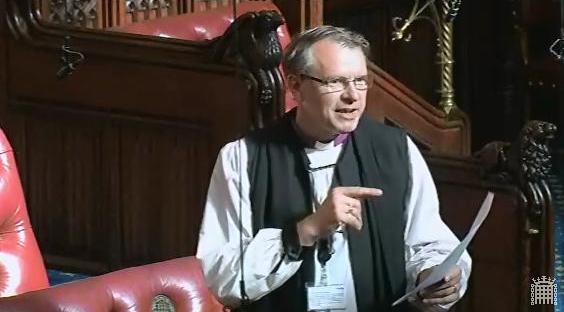
House of Commons approves the Bishops and Priests (Consecration and Ordination of Women) Measure

Bishops and Priests (Consecration and Ordination of Women) Measure

20th October, 2014

[Relevant document: The 233rd Report from the Ecclesiastical Committee, Bishops and Priests (Consecration and Ordination of Women) Measure, HC 622.]

5.07 pm

Green BenchesThe Second Church Estates Commissioner (Sir Tony Baldry):

I beg to move,

That the Bishops and Priests (Consecration and Ordination of Women) Measure (HC 621), passed by the General Synod of the Church of England, be presented to Her Majesty for her Royal Assent in the form in which it was laid before Parliament.

It is now nearly a century since Parliament recognised that it should no longer be the body that initiated legislation concerning the running of the Church of England. However, Church legislation becomes part of the law of England, so it requires parliamentary approval and Royal Assent. A Measure such as the one before us has to have been passed by the General Synod of the Church of England. Most Measures require simple majorities in the Synod, but this one falls in that special category of particularly important instruments that need to have achieved at least two-thirds majorities in each of the Houses of Bishops, Clergy and Laity. Continue reading “House of Commons approves the Bishops and Priests (Consecration and Ordination of Women) Measure”

Criminal Justice and Courts Bill – vote on indeterminate sentences

On 20th October 2014 the House of Lords debated the Government’s Criminal Justice and Courts Bill during its Report Stage. Peers debated an amendment from Crossbench Peer Lord Lloyd of Berwick to Clause 10, relating to treatment of prisoners serving indeterminate sentences. The Bishop of Rochester, Rt Rev James Langstaff, joined several Peers in expressing support for the amendment and he voted for its inclusion during the subsequent Division of the House. Continue reading “Criminal Justice and Courts Bill – vote on indeterminate sentences”

Lords Approves the Bishops and Priests (Consecration and Ordination of Women) Measure

Bishops and Priests (Consecration and Ordination of Women) Measure

14th October 2014

Motion to Direct

5.35 pm

Moved by

That this House do direct that, in accordance with the Church of England Assembly (Powers) Act 1919, the Bishops and Priests (Consecration and Ordination of Women) Measure be presented to Her Majesty for the Royal Assent.Archbishop of Canterbury

The Archbishop of Canterbury:

My Lords, it is now 95 years since Parliament conferred on the Church of England the power to initiate legislation, which, following parliamentary approval and Royal Assent, becomes part of the law of England.

Most of the Measures passed by the Church Assembly and, since 1970, by the General Synod have been necessary but modest revisions of the church’s rule book and the law of England. Texts such as the Church of England (Miscellaneous Provisions) Measure 2014 or the Ecclesiastical Fees (Amendment) Measure 2011 were not framed with excitement in mind, but even they sound positively racy compared with that early piece of Church Assembly legislation considered by this House in the days of Archbishop Davidson—the Ecclesiastical Dilapidations Measure 1923. Just occasionally, though, the church brings to Parliament legislation which is of more significance and effect. The Church of England (Worship and Doctrine) Measure 1974 was one such, and so was the legislation passed by Synod in 1992 to enable women to be ordained priests in the Church of England. Continue reading “Lords Approves the Bishops and Priests (Consecration and Ordination of Women) Measure”

Human Trafficking – Question from Bishop of Derby

On 22nd September 2014 the Bishop of Derby, Rt Rev Alastair Redfern, received a written answer to a question on child victims of human trafficking.
Bishop of Derby
Home Office – Human Trafficking (HL1545)
Asked by the Lord Bishop of Derby on 28 July 2014:
To ask Her Majesty’s Government how many child victims of human trafficking were interviewed in 2013 by competent authority staff, as opposed to specialist interviewers.

Continue reading “Human Trafficking – Question from Bishop of Derby”

Bishop of Sheffield calls for development of Armed Forces credit union

On 29th July 2014, the Bishop of Sheffield, the Rt Revd Steven Croft, co-sponsored and spoke in support of an amendment to the Armed Forces (Service Complaints and Financial Assistance) Bill. The amendment, tabled by Lord Kennedy of Southwark, sought to establish a credit union specifically for members of the armed forces and their families. He noted the Church’s own work in setting up the Churches’ Mutual Credit Union, and highlighted the well-developed system of credit unions for service personnel in the United States. He called on the Minister to give an update on the progress made towards the creation of such an institution. Following the debate, Lord Kennedy withdrew his amendment, but indicated that he may bring it back at the Third Reading of the Bill.

14.03.27 Bishop of SheffieldThe Lord Bishop of Sheffield: My Lords, from these Benches I welcome the amendment in the name of the noble Lord, Lord Kennedy, and give it our full support. The amendment gives strong support to the setting up of a credit union for the Armed Forces and their families in a similar way in which the church is setting up its own credit union—the Churches’ Mutual Credit Union. The Armed Forces, like the clergy and other groups, need a source of affordable credit for short and long-term needs. As a society we have duty of support and care to our Armed Forces. Recent research in a number of strands shows clearly that the ability to obtain credit at reasonable rates of interest is a vital element in building resilience to poverty and debt across our whole society. The inability to obtain such credit in times of need raises the possibility of falling further into debt, of food and fuel poverty and of a downward spiral. Continue reading “Bishop of Sheffield calls for development of Armed Forces credit union”

Bishop of Rochester supports amendment to Criminal Justice and Courts Bill

On 23rd July 2014 the Bishop of Rochester, the Rt Rev James Langstaff, spoke during the Committee Stage of the Criminal Justice and Courts Bill.

Bishop of RochesterBishop James spoke in support of Lord Ramsbotham’s amendment to remove clause 29 relating to the creation of ‘secure colleges and other places for detention of young offenders’  from the Bill. Continue reading “Bishop of Rochester supports amendment to Criminal Justice and Courts Bill”

Bishop of Chester supports amendment to Criminal Justice and Courts Bill

On 21st July 2014, the Bishop of Chester, the Rt Revd Peter Forster, spoke during the Committee Stage of the Criminal Justice and Courts Bill. He spoke in support of an amendment to make assault on workers selling alcohol a specific criminal offence. Following the debate on the amendment, it was withdrawn without being put to a division of the House. 

14.03 Bishop of ChesterThe Lord Bishop of Chester: My Lords, I have considerable sympathy for the amendment, although I wonder how it will interact with the remainder of the law on assault if this is criminalised in a specific way. I declare an interest in that I used to be a publican. When I was employed in a university, one of the members of staff had to go down to the magistrates’ court and swear that they were a fit person to keep order. That is the only time when I have been into a court of law in my life, and the magistrates were not quite sure that this young clergyman would be able to do so. My main task was to prevent the students drinking the profits rather than sorting out any brawls. Continue reading “Bishop of Chester supports amendment to Criminal Justice and Courts Bill”

Church of England gives evidence to Modern Slavery Bill Committee

On 21st July 2014, the Church of England’s Foreign Policy Adviser, Dr Charles Reed, gave evidence to the Public Bill Committee for the Government’s Modern Slavery Bill. The transcript of the evidence session, at which Dr Reed and Cecilia Taylor-Camara (Head of the Bishops Conference Office for Migration Policy, Catholic Bishops for England and Wales) gave evidence, is reproduced in full below.

Dr Charles Reed, Foreign Policy Adviser, Church of England

Q 24 The Chair:  For this session we have until 4.45 pm. Will the witnesses please introduce themselves for the record?

Cecilia Taylor-Camara: I am Cecilia Taylor-Camara, senior policy adviser to the Catholic Bishops Conference of England and Wales.

The Chair:  I ask the witnesses to speak up a little. This is rather a large room and the sound is not brilliant, so please shout if necessary.

Dr Reed: I am Charles Reed, international policy adviser for the Church of England.  Continue reading “Church of England gives evidence to Modern Slavery Bill Committee”

Bishop of Carlisle speaks against Assisted Dying Bill – new legislation would destroy balance of current law

“By going down this track we would be sending a clear message to society, and especially its most vulnerable members, about individual lives having a different value according to their circumstances.”

On 18th July 2014, the Bishop of Carlisle, the Rt Revd James Newcome, spoke during the Second Reading of the Assisted Dying Bill. The Bishop spoke against the Bill, raising concerns that the proposed Bill would destroy the balance currently provided by legislation, and highlighting the risks associated with the Bill in relation to the welfare of vulnerable individuals. 

14.06.09 Bishop of CarlisleThe Lord Bishop of Carlisle: My Lords, a word that is frequently used in your Lordships’ House is “balance”. It has already been used several times in this debate—in particular, by my noble and learned friend Lady Butler-Sloss, the noble Lord, Lord Condon, the noble Baroness, Lady Kennedy, and the noble Lords, Lord Kerr of Kinlochard and Lord Wills, and probably many others whom I may have missed. We constantly look for balance in our legislation and in the way that the legislation is applied. Continue reading “Bishop of Carlisle speaks against Assisted Dying Bill – new legislation would destroy balance of current law”

Bishop of Bristol speaks against Assisted Dying Bill: raises concerns about ‘unintended consequences’

“Many of us who are opposed to the Bill are greatly concerned by the unintended consequences that it will inevitably bring into play. It is simply not good enough for those who support the Bill to dismiss out of hand this genuine concern. It is for them to give us consistent evidence that our fears are unfounded. Sadly, the available evidence appears to raise, rather than allay, anxiety.”

On 18th July 2014, the Bishop of Bristol, the Rt Revd Mike Hill, took part in the Second Reading debate of the Assisted Dying Bill. The Bishop spoke against the Bill, focusing on the unintended consequences that the Bill would present, if passed.

14.03 Bishop of Bristol

The Lord Bishop of Bristol: My Lords, many of us will speak today in the name of compassion, but, as is clear, we shall take very different views in terms of what compassion looks like in relation to those who are suffering unbearably and, in particular, as to whether my noble and learned friend Lord Falconer’s Bill is fit for the purposes he and his supporters pursue with such vigour. Continue reading “Bishop of Bristol speaks against Assisted Dying Bill: raises concerns about ‘unintended consequences’”